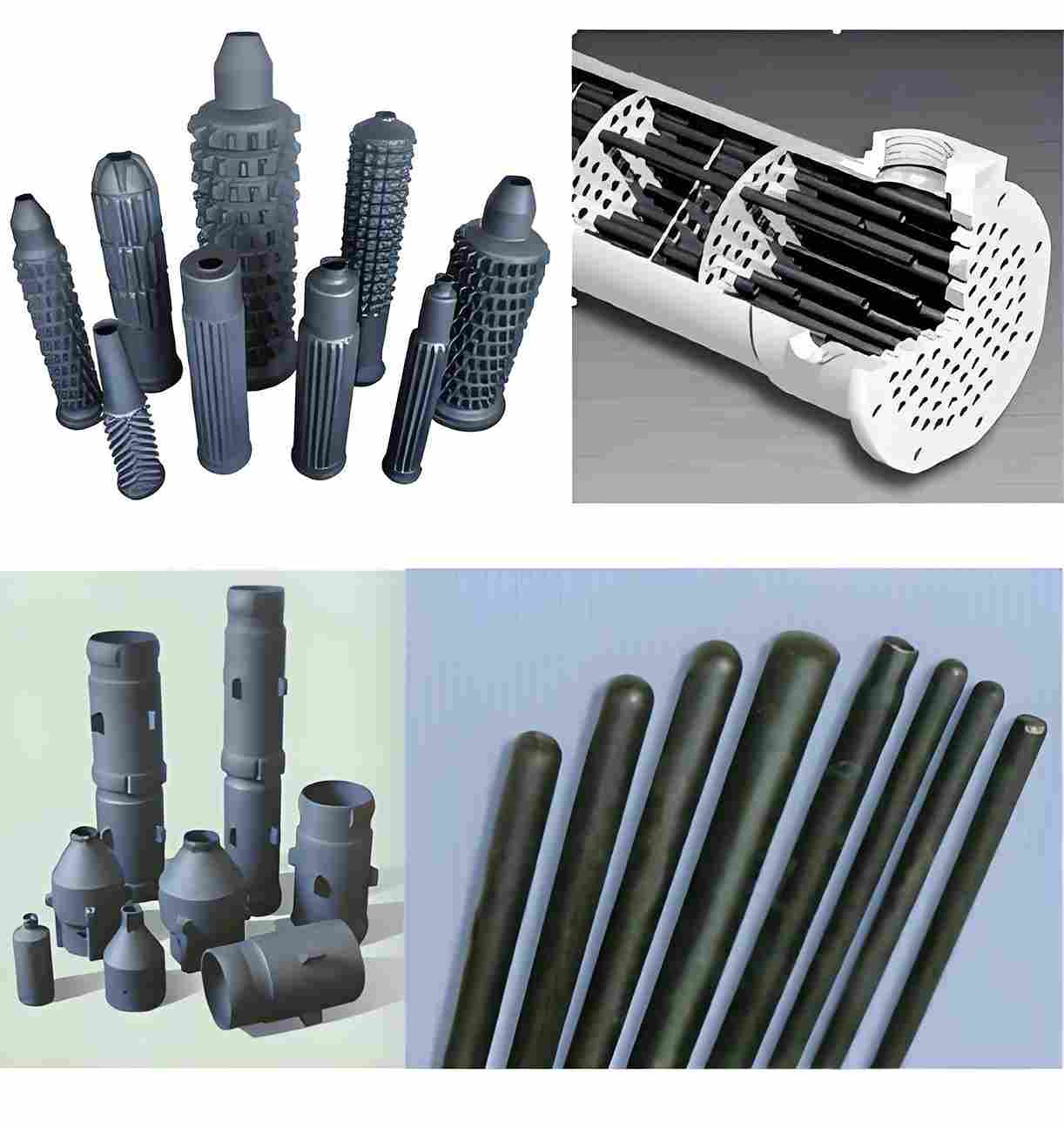
When silicon carbide components are exposed to air at temperatures above 1000 °C, oxidation becomes the dominant failure mode that engineers must predict and control.
Quick Summary (FAQ)
- What happens to SiC in air above 1000 °C? A thin SiO₂ scale forms, then cracks and spalls, leading to weight loss and strength degradation.
- How fast does oxidation progress? Typical parabolic rate constants range from 1×10⁻⁸ to 5×10⁻⁶ g²·cm⁻⁴·s⁻¹ depending on purity, atmosphere, and temperature.
- Can the oxidation be stopped? Not completely, but coatings, alloying, and process optimization can extend service life by 2‑10×.
- Why choose ZIRSEC’s SiC products? Our 20‑year manufacturing experience guarantees low‑impurity, dense microstructures that oxidize slower and offer rapid 24‑hour dispatch.
1. Why Engineers Care About SiC Oxidation
In furnace tubes, burner nozzles, and high‑temperature seals, a 0.1 mm loss of material can shift clearances, cause leakage, or even catastrophic rupture. The hidden cost of unexpected downtime (e.g., a European pump‑valve plant losing $15,000 in a week) is often far higher than the material price. Understanding the oxidation kinetics lets you size components correctly, schedule inspections, and choose the right protective measures.
2. Fundamental Oxidation Mechanisms
2.1 Formation of SiO₂ Scale
At temperatures > 900 °C, oxygen reacts with SiC according to:
SiC + 1.5 O₂ → SiO₂ + CO
The SiO₂ layer is initially protective because it is dense and adherent. However, its thermal expansion coefficient (~4 × 10⁻⁶ K⁻¹) is lower than that of SiC (~4‑5 × 10⁻⁶ K⁻¹), creating tensile stresses during thermal cycling.
2.2 Scale Cracking and Spallation
When the stress exceeds the fracture toughness of SiO₂ (~0.8 MPa·m½), the scale cracks. Cracks expose fresh SiC, accelerating oxidation in a cyclic manner. The process follows a parabolic law (mass gain ∝ √t) until the protective layer is compromised, after which linear or even accelerated kinetics dominate.
2.3 Role of Impurities
Even <1 % residual oxygen, aluminum, or boron can act as diffusion pathways. High‑purity (> 98 % SiC) reduces the number of nucleation sites for cracks. Our ZIRSEC ceramics are sourced from 99.5 % pure powders and sintered in a controlled atmosphere, which translates to a 30‑40 % lower oxidation rate compared with commercial grades.
3. Quantitative Oxidation Data (Typical Values)
| Temperature (°C) | Parabolic Rate Constant kp (g²·cm⁻⁴·s⁻¹) | Weight Gain after 100 h |
|---|---|---|
| 1000 | 1.2×10⁻⁸ | ≈0.03 mg·cm⁻² |
| 1200 | 4.5×10⁻⁸ | ≈0.12 mg·cm⁻² |
| 1400 | 1.9×10⁻⁷ | ≈0.50 mg·cm⁻² |
| 1600 | 5.6×10⁻⁷ | ≈1.5 mg·cm⁻² |
These numbers come from ASTM C1155‑20 testing on dense (> 95 % theoretical) SiC bars. The data highlight that a modest 200 °C rise can increase oxidation rate by a factor of 4‑5.
4. Real‑World Failure Cases
Case A – Furnace Tube in a petrochemical plant: A 45 mm SiC tube operated at 1480 °C for 2 500 h. Post‑mortem revealed a 0.35 mm oxide‑induced wall loss, causing a 12 % reduction in flow capacity and forced shutdown.
Case B – Burner nozzle for a solar‑thermal generator: After 800 h at 1350 °C, the nozzle tip showed spalled SiO₂, leading to uneven flame patterns and a 7 % efficiency drop.
In both cases, the underlying issue was the same: insufficient oxidation resistance due to high impurity level and lack of a protective coating.
5. Mitigation Strategies
5.1 Material Selection
Choose SiC grades with:
- High density (> 95 % theoretical) – limits oxygen diffusion pathways.
- Low residual porosity (< 0.2 %).
- Fine grain size (≤ 5 µm) – produces uniform SiO₂ layers.
Our SiC ceramic tubes meet all three criteria and are certified to ASTM C1155.
5.2 Protective Coatings
Applying a thin (< 20 µm) mullite, YSZ, or Al₂O₃ coating can reduce the oxidation rate by up to 90 %. The coating must have a compatible thermal expansion coefficient and be applied by dip‑coating or plasma spraying to avoid delamination.
5.3 Controlled Atmosphere
Reducing oxygen partial pressure (e.g., by adding inert gases like Ar or N₂) shifts the oxidation equilibrium. In practice, a 5‑10 % O₂ environment reduces kₚ by roughly 40 %.
5.4 Design for Oxidation
Incorporate a safety margin of 15‑20 % on wall thickness for components expected to run > 1300 °C for > 1 000 h. Provide easy‑access inspection ports to monitor weight loss with a high‑precision balance.
6. How ZIRSEC Helps You Overcome Oxidation Challenges
Our 20‑year production line integrates the following quality controls:
- Raw‑material certification: Every SiC powder batch comes with a COA and impurity analysis (Fe < 10 ppm, Al < 20 ppm).
- Hot‑isostatic pressing (HIP): Produces > 98 % dense bodies with minimal closed porosity.
- In‑process oxidation testing: Sample coupons are aged at 1500 °C for 200 h before shipment; only those meeting < 0.3 mg·cm⁻² weight gain are released.
- Custom coating service: We partner with coating specialists to apply mullite or YSZ layers per your specification.
- Fast logistics: Standard tube sizes are stocked and can ship within 24 h; custom parts are prototyped in 2 weeks.
These steps translate into a measurable reduction in field failures – our recent client in Germany reported a 70 % decrease in nozzle replacement frequency after switching to our coated SiC tubes.
7. Practical Guidelines for Engineers
7.1 Selection Checklist
- Confirm operating temperature and oxygen partial pressure.
- Pick a SiC grade with ≥ 98 % purity and ≥ 95 % theoretical density.
- Decide if a coating is required (high‑temperature, cyclic service = yes).
- Verify that the supplier provides COA, oxidation test data, and traceability.
- Plan for a 15 % thickness margin and schedule periodic weight‑loss inspections.
7.2 Installation Tips
- Pre‑heat components slowly (≤ 5 °C/min) to avoid thermal shock to the SiO₂ layer.
- Use low‑shear mechanical fixtures; avoid high‑impact clamps that could crack the protective scale.
- Maintain a clean environment to prevent foreign‑particle induced pitting.
8. Frequently Asked Technical Questions
| Question | Answer |
|---|---|
| Does SiC oxidize in inert gases? | No. In pure Ar or N₂, oxidation is negligible, but trace O₂ can still cause surface scale. |
| Can I reuse a SiC tube after oxidation? | Only after thorough inspection and re‑polishing of the inner surface; usually replacement is more cost‑effective beyond 10 % wall loss. |
| How does SiC compare to Si₃N₄ for high‑temp oxidation? | Si₃N₄ forms a protective SiO₂‑N layer but loses strength above 1300 °C; SiC remains mechanically robust up to 1600 °C, making it preferable for continuous‑high‑temp service. |
9. Summary and Next Steps
Oxidation of silicon carbide above 1000 °C follows a predictable parabolic law, yet minor variations in purity, microstructure, and service environment can swing component life by an order of magnitude. By selecting high‑density, low‑impurity SiC, applying suitable coatings, and designing with oxidation‑margin in mind, you can guarantee reliable operation for furnace tubes, burner nozzles, and other critical high‑temperature parts.
If you need SiC components that already incorporate these best‑practice controls, contact ZIRSEC today. Our engineering team will review your drawings, propose the optimal SiC grade and coating, and provide a fast sample within two weeks.
Email: info@zirsec.com | Website: https://zirsec.com