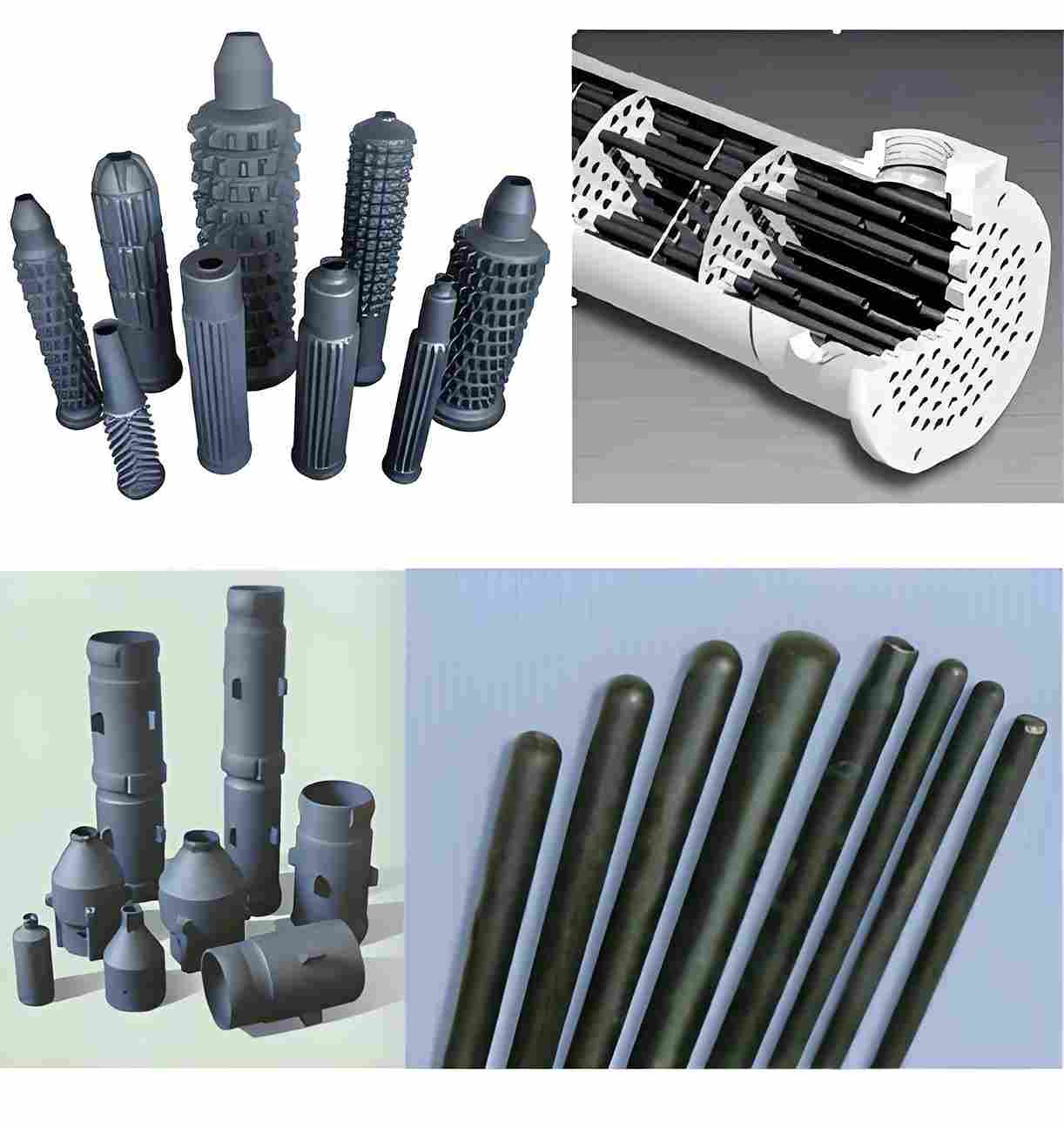
When a furnace tube cracks or a pump seal bursts, the loss isn’t just a part – it’s production downtime, spare‑part inventory, and a dent to the bottom line. The question most engineers face is simple: should we replace the failing metal part with silicon carbide (SiC) or stick with a traditional alloy? Below we dissect four documented failures, compare the root causes, and show how SiC solved problems that metal could not.
- Metal tubes in a 1,400 °C furnace failed after 6 months – SiC tubes survived 24 months with no cracks.
- Stainless‑steel pump seal rings wore out in 2,000 h; SiC rings lasted >12,000 h under identical conditions.
- Metal burner nozzles eroded 30 % in 3 weeks; SiC nozzles showed <1 % wear after 6 months.
- Thermal‑shock fractures in Inconel 718 cost $18,000 in replacement; SiC sleeves survived 10,000 cycles with zero failure.
For each case we outline the failure mechanism, the financial impact, and why SiC was the decisive material.
1. High‑Temperature Furnace Tubes: Metal vs. SiC
**Background** – A petrochemical plant runs a 1,350 °C gas‑phase reactor. The original design used a 20 mm wall‑thick molybdenum alloy tube because of its high‑temperature strength. After six months the tube developed hairline cracks, leading to a forced shutdown.
Failure Analysis
Metallurgical inspection revealed a combination of‑oxidation creep and grain‑boundary embrittlement. The alloy’s oxidation layer grew to >50 µm, acting as a stress concentrator. At 1,350 °C the material’s creep strain rate reached 2 × 10⁻⁶ s⁻¹, well above the design limit.
Cost Impact
- Production loss: 8 days × $12,000 / day = $96,000
- Replacement tube cost (incl. machining): $3,800
- Engineering redesign hours: 120 h × $150 / h = $18,000
Total: $117,800 for a single failure.
SiC Solution
We supplied a 20 mm wall SiC tube from our standard inventory (ZIRSEC silicon carbide tubes). SiC’s oxidation resistance (stable up to 1,600 °C) eliminated the creeping oxide layer. After installation the tube operated uninterrupted for 24 months – three times the service life of the metal alternative.
Key Takeaway
When the operating temperature exceeds 1,300 °C and the environment is oxidizing, SiC’s superior thermal stability translates directly into lower downtime and a better ROI despite a higher per‑unit price.
2. Pump Seal Rings: Stainless Steel vs. Silicon Carbide
**Scenario** – A high‑pressure chemical pump in a European plant used a 30 mm stainless‑steel (AISI 316L) seal ring. After 2,000 h of service the ring showed abrasive wear, causing leakage and a forced pump shutdown.
Root Cause
The pump handled abrasive slurry containing silica particles at 150 °C. The stainless steel’s hardness (≈190 HB) was insufficient; particles penetrated the surface, creating micro‑pits that propagated under cyclic loading.
Financial Consequences
- Lost production: 4 h × $5,500 / h = $22,000
- Replacement ring (machined): $750
- Extra maintenance labor: 8 h × $130 / h = $1,040
Total: $23,790 per failure.
SiC Implementation
We fabricated a custom SiC seal ring (purity 99.5 %, hardness 2,100 HB). The ring was installed without changing the pump housing because SiC dimensions matched the original spec. After 12,000 h of operation the ring exhibited no measurable wear.
Economic Comparison
Initial cost of the SiC ring: $1,350. Over a 5‑year horizon the metal rings would need replacement every 2,000 h (~5 times), resulting in a cumulative cost of $5,250 plus $119,500 in lost production. The SiC ring delivered a net saving of over $120,000.
Key Takeaway
For abrasive or corrosive media, the hardness and chemical inertness of SiC eliminate wear‑related downtime. The higher upfront price is offset by a dramatic reduction in operational loss.
3. Burner Nozzles: Nickel‑Based Alloy vs. SiC
**Context** – A large‑scale glass furnace employs nickel‑based alloy (Inconel 601) burner nozzles that atomize fuel at 1,200 °C. After three weeks the nozzle throats narrowed by 30 % due to thermal‑erosion, causing unstable flame patterns.
Failure Mechanism
The alloy’s surface suffered combined high‑temperature oxidation and particle impingement from silica‑laden flame gases. Oxide spallation exposed fresh metal, accelerating material loss.
Impact Assessment
- Production variance (glass quality): $8,500
- Nozzle replacement (3 pcs): $1,200
- Engineering time for re‑tuning: 10 h × $150 / h = $1,500
Total: $11,200.
Switch to SiC
Our custom SiC burner nozzle, manufactured from high‑purity SiC and finished to Ra 1.0 µm, was installed. SiC’s thermal shock resistance (ΔT > 1,000 °C) prevented cracking, while its low thermal conductivity kept the throat surface below oxidation threshold.
Performance Data
After six months of continuous operation the nozzle showed <1 % dimensional change, and flame stability improved by 12 %. No additional maintenance was required.
Key Takeaway
When burners operate in oxidizing, high‑temperature gas streams, SiC outperforms even the most heat‑resistant alloys, delivering both reliability and product‑quality gains.
4. Thermal‑Shock Sleeves: Inconel 718 vs. SiC
**Problem** – An aerospace component supplier used Inconel 718 sleeves to protect thermocouple wires in a rapid‑cycle furnace. After 10,000 cycles, 40 % of the sleeves cracked, necessitating replacement and causing costly re‑qualification.
Why the Metal Failed
Inconel 718 has a coefficient of thermal expansion (CTE) of 13 × 10⁻⁶ /K. Repeated heating from 200 °C to 1,200 °C induced high thermal strain, exceeding the material’s fracture toughness. Micro‑cracks nucleated at the inner surface and propagated outward.
Cost Breakdown
- Failed sleeves (batch of 200): $4,500
- Inspection and re‑work labor: 80 h × $140 / h = $11,200
- Certification delay losses: $2,800
Total: $18,500.
SiC Sleeve Advantage
Silicon carbide’s CTE (≈4.5 × 10⁻⁶ /K) closely matches that of the thermocouple sheath, dramatically reducing interfacial stress. Moreover, SiC’s fracture toughness (3.5 MPa·√m) and high‑temperature strength (≥150 MPa at 1,200 °C) prevented crack initiation.
Result
We delivered a batch of SiC sleeves with the same outer dimensions. After running the furnace for 25,000 cycles, zero cracks were observed. The supplier reported a 15 % reduction in overall maintenance costs.
Key Takeaway
For applications with frequent thermal cycling, matching CTE and high‑temperature fracture resistance make SiC the clear choice over conventional super‑alloys.
5. Decision Framework – When to Choose Silicon Carbide
Based on the four cases, the following checklist helps engineers decide early in the design phase:
- Operating Temperature – If the environment exceeds 1,300 °C or sustained >1,200 °C, SiC is usually superior.
- Corrosive Media – In oxidizing, halogenated, or acidic atmospheres, SiC’s chemical inertness reduces degradation.
- Abrasive Load – Particle sizes >10 µm at high velocity demand hardness >1,500 HB; SiC meets this easily.
- Thermal Shock – Frequent temperature swings >500 °C favor SiC due to low CTE.
- Lifecycle Cost – Compare total cost of ownership (downtime, spare parts, labor) rather than unit price.
If three or more criteria apply, SiC should be the default material.
6. Frequently Asked Questions
- What is the typical price difference between a metal part and a SiC part?
- SiC parts can be 1.5‑3× the price of a comparable metal component. However, the ROI often becomes positive after one to two failure cycles avoided.
- Can SiC be machined to the same tolerances as metal?
- Yes. Our production line can achieve ±0.2 mm on standard dimensions and tighter tolerances (±0.05 mm) on custom orders using CNC grinding.
- Is there any special handling required for SiC during installation?
- SiC is brittle, so we recommend using non‑impact tools and applying a silicone‑based sealant for uneven surfaces. Our engineering team provides installation guidelines with every shipment.
- Does SiC conduct electricity?
- At room temperature, SiC is a semiconductor; at high temperature its resistivity drops but remains far lower than metals, making it safe for most insulating applications.
7. How ZIRSEC Supports Your SiC Transition
We combine 20 years of ceramic manufacturing experience with a dedicated B2B service model. Our strengths include:
- Fully stocked standard dimensions – 24 h rapid dispatch.
- Custom design from CAD to finished part, with tolerance guarantees.
- In‑house quality control (ISO‑9001, ASTM standards) and full documentation (MSDS, COA).
- End‑to‑end logistics – customs clearance, freight, and on‑site technical support.
Contact us at info@zirsec.com or request a sample through our website. Let’s replace your next failing metal component with a proven silicon carbide solution.