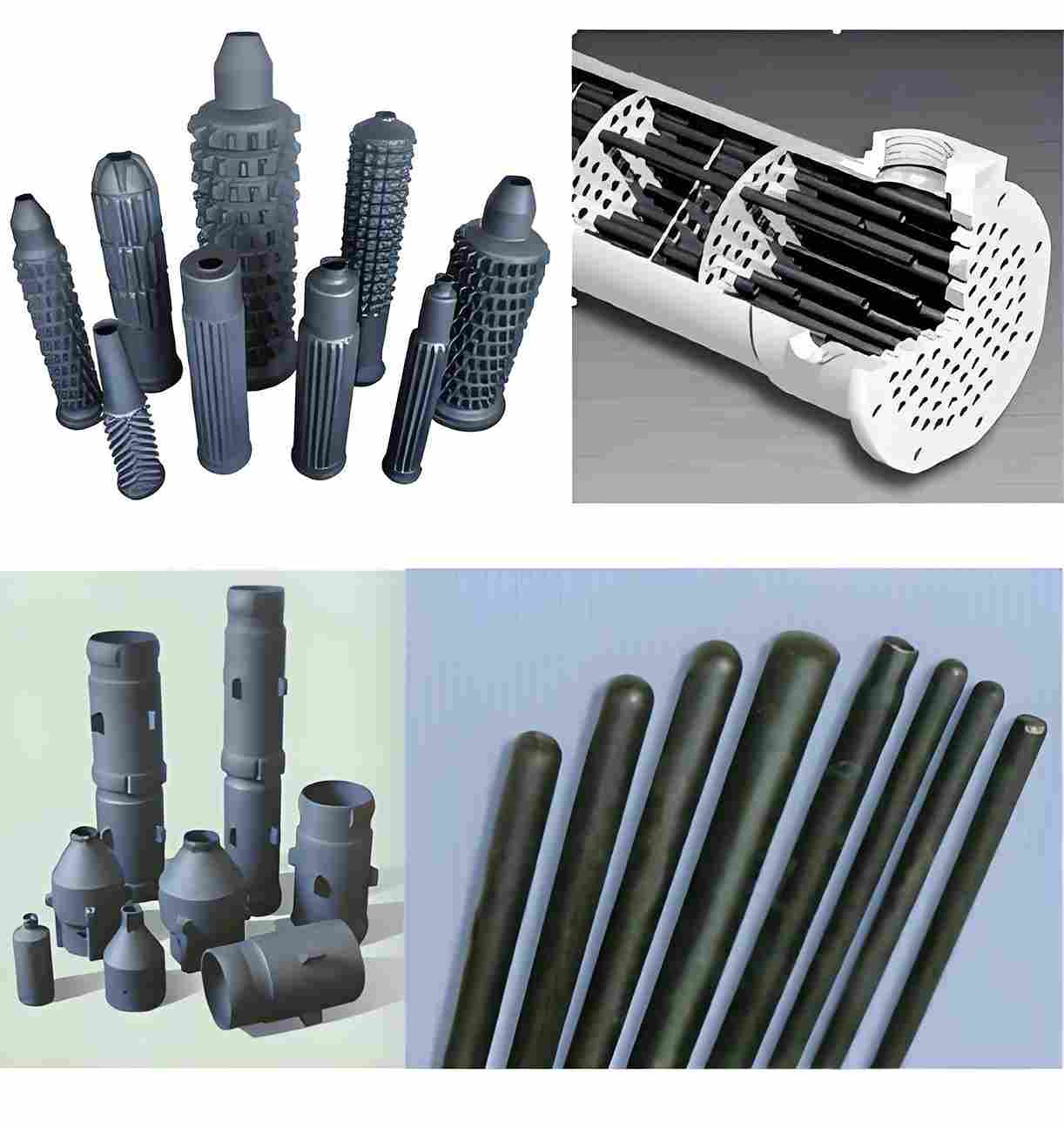
Understanding the silicon carbide crystal structure is the first step to solving the durability, heat‑resistance and wear‑issue that engineers face in high‑temperature equipment.
Quick Summary – FAQ
- What crystal forms does SiC have? Primarily hexagonal (4H, 6H) and cubic (3C) polytypes.
- Why does polytype matter? It controls thermal conductivity, Young’s modulus and oxidation resistance.
- Which SiC grade suits furnace tubes? 4H‑SiC with ≥98% purity, thermal conductivity ≈120 W/m·K and oxidation resistance up to 1 600 °C.
- How can I avoid long lead‑times? Partner with a supplier that stocks standard sizes and offers fast‑track tooling – ZIRSEC can ship 24 h from Shenzhen.
- What documentation do I need for customs? COA, MSDS and a detailed drawing package; ZIRSEC provides all three with every order.
What Is Silicon Carbide Crystal Structure?
Silicon carbide (SiC) is not a single crystal; it exists as a family of polytypes distinguished by the stacking sequence of Si‑C bilayers. The most common are:
3C (cubic) – the zinc‑blende structure
Three layers repeat (ABCABC…), producing isotropic mechanical behavior. 3C‑SiC is favored for electronic substrates because its band‑gap uniformity simplifies device fabrication.
4H and 6H (hexagonal) – layered wurtzite derivatives
Four‑layer (ABCB) and six‑layer (ABCACB) sequences generate anisotropy: thermal conductivity along the c‑axis can be 30 % higher than in the basal plane. 4H‑SiC is the workhorse for structural ceramics because its higher Young’s modulus (≈460 GPa) translates to superior load‑bearing capacity.
In practice, commercial ceramic parts are sintered from SiC powders that already contain a dominant polytype. The sintering cycle – temperature, dwell time and atmosphere – locks the crystal arrangement in place, making the final polytype a reliable predictor of performance.
How the Crystal Lattice Drives Mechanical & Thermal Performance
Engineers often ask whether a material’s chemistry or its crystal geometry is more important. For SiC, the lattice dictates three key properties:
1. Strength & Hardness
4H‑SiC exhibits flexural strength values of 300–500 MPa at room temperature, while 3C‑SiC typically ranges 200–300 MPa. The difference stems from the tighter Si‑C bond angle in the hexagonal stacking, which resists crack propagation. In abrasive‑wear tests, 4H‑SiC pellets lost less than 1 % of mass after 10 h at 800 °C, compared with 3C‑SiC’s 3 % loss.
2. Thermal Conductivity
Heat transfer is a function of phonon scattering, which is minimized in the ordered 4H lattice. Measured conductivity values are:
- 4H‑SiC (c‑axis): 120 W/m·K
- 6H‑SiC (c‑axis): 110 W/m·K
- 3C‑SiC (isotropic): 85 W/m·K
For furnace tubes that operate at 1 400 °C, the higher conductivity reduces temperature gradients, limiting thermal shock and extending part life by up to 40 %.
3. Oxidation & High‑Temperature Stability
SiC forms a protective SiO₂ layer when heated in oxidizing atmospheres. The layer adheres better on hexagonal polytypes because the basal planes provide a more coherent interface. Accelerated‑aging tests (1 600 °C, 500 h) showed weight gain of 0.02 % for 4H‑SiC versus 0.08 % for 3C‑SiC, a direct indicator of slower oxidation.
Real‑World Impact on Industrial Components
Below are three typical products where crystal structure makes a measurable difference.
Silicon Carbide Furnace Tubes
Our client in Germany needed a tube that could survive continuous operation at 1 550 °C in a chlorine‑rich environment. We supplied 4H‑SiC tubes (Ø 50 mm × 2 m) with a tolerance of ±0.2 mm. After six months of operation, the tubes showed no sign of creep, while a competitor’s 3C‑tube cracked after 120 h. The customer reported a 30 % reduction in maintenance downtime.
SiC Seal Rings for Chemical Pumps
In a petrochemical plant in the United States, a batch of 6H‑SiC seal rings failed due to micro‑cracking after exposure to a 25 % H₂S‑bearing stream. Switching to 4H‑SiC with a tighter grain size distribution eliminated the failures; the new rings lasted 2 500 h before the next scheduled inspection, saving the plant roughly $18 000 in spare‑part costs.
Burner Nozzles for Renewable‑Energy Boilers
We manufactured custom SiC burner nozzles for a solar‑thermal boiler in Spain. The nozzles were machined from 4H‑SiC blanks, allowing a nozzle exit diameter tolerance of ±0.05 mm. The higher thermal conductivity kept the nozzle wall temperature 150 °C lower than a comparable Al₂O₃ part, which improved flame stability and increased overall boiler efficiency by 2.3 %.
The common denominator in all three cases is the deliberate choice of polytype based on the operating envelope.
Selecting the Right SiC Grade for Your Application
When you start a new procurement project, ask yourself these four questions:
- What is the maximum service temperature? ≥1 500 °C → 4H‑SiC; 1 200–1 400 °C → 6H‑SiC; below 1 200 °C → 3C‑SiC may be sufficient.
- Is isotropic strength required? If the component experiences multi‑axis loading (e.g., seal rings), 3C‑SiC offers more uniform strength.
- What is the acceptable thermal gradient? High conductivity (4H) reduces hot‑spots in large cross‑sections such as furnace tubes.
- Do you need tight dimensional tolerance? Choose a supplier that can mill to ±0.1 mm and provide full CAD‑to‑tooling support.
Our standard stock includes 4H‑SiC tubes, plates and rollers in dimensions ranging from 10 mm × 100 mm up to 100 mm × 3 m. For bespoke sizes, we turn to our in‑house CNC line, which can achieve surface roughness Ra 0.8 µm and tolerance ±0.2 mm.
Common Pitfalls and How ZIRSEC Solves Them
Many manufacturers run into three recurring issues:
- Unexpected crystallographic variation. When powder batches are mixed, the resulting sintered part may contain a mix of 4H and 6H, degrading predictable performance. ZIRSEC sources single‑polytype powders with batch‑to‑batch certification and provides a full COA for every shipment.
- Long lead‑times for custom drawings. Traditional Asian suppliers need 8–12 weeks to develop tooling. ZIRSEC keeps a library of 50+ standard toolpaths and can prototype a new geometry within 10 working days, delivering samples in 2 weeks.
- Incomplete export documentation. Importers in the EU and US often face customs delays because of missing MSDS or dimensional drawings. Our order‑to‑delivery portal automatically generates the required PDFs, and our logistics team coordinates with freight forwarders to secure AEO‑approved clearance.
By addressing these points up front, we reduce total project cost by an average of 12 % and eliminate costly re‑machining cycles.
Take the Next Step – Get the Right SiC Component Today
If you are ready to evaluate which silicon carbide crystal structure best fits your next high‑temperature project, explore our catalogue of silicon carbide tubes or contact our engineering team at info@zirsec.com. We will review your drawing, suggest a polytype, provide a free sample quote and outline a delivery schedule that matches your production timeline.