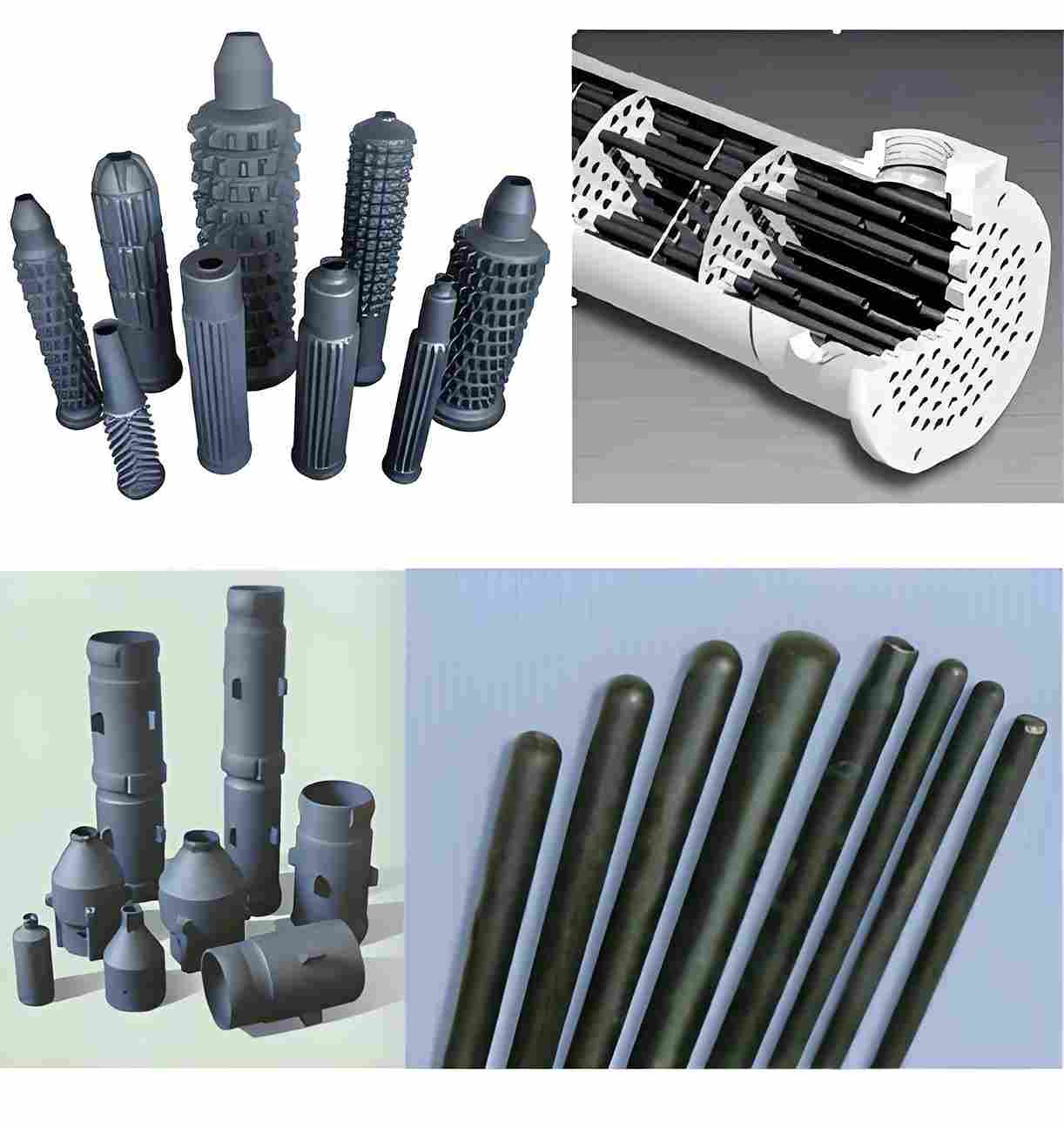
Free silicon in SiC materials refers to elemental silicon that is not chemically bonded to carbon within the crystal lattice, existing as isolated silicon phases or inclusions that can influence mechanical, thermal, and electrical behavior.
Quick Summary
- Free silicon is elemental Si present in SiC ceramics.
- Typical content ranges from 0.5% to 5% by weight, depending on raw‑material purity and sintering regime.
- Higher free‑Si levels reduce high‑temperature strength but improve thermal shock resistance.
- Measuring free silicon is done by X‑ray diffraction (XRD), Raman spectroscopy, and chemical leaching.
- ZIRSEC can tailor free‑Si levels to match your application’s performance and cost targets.
Why You’re Asking About Free Silicon
Engineers designing furnace tubes, seal rings, or burner nozzles often see specifications such as “SiC with ≤0.5% free Si.” The hidden concern is whether the material will survive the temperature cycles in a chemical‑aggressive environment without premature cracking or wear. In practice, uncontrolled free silicon can cause:
- Reduced flexural strength at >1300 °C.
- Unexpected oxidation pathways that accelerate material loss.
- Variations in dielectric properties that affect sensor integration.
Answering these questions up front prevents costly redesigns and production downtime.
What Exactly Is Free Silicon?
During the conventional carbothermal reduction of silica (SiO₂) to silicon carbide, the reaction does not go to completion. The overall stoichiometry is:
SiO₂ + 3C → SiC + 2CO
If the carbon excess or temperature profile is not carefully controlled, excess silicon remains as free Si, often coating grain boundaries or forming isolated nodules. This free silicon is metallic and exhibits a melting point of 1414 °C, considerably lower than SiC’s >2700 °C decomposition temperature.
Typical Sources of Free Silicon
- Low‑purity silicon powder (≤98% SiC purity).
- Insufficient dwell time at peak sintering temperature.
- Rapid cooling that prevents full reaction.
How Free Silicon Is Measured
Industrial labs rely on a combination of techniques:
- XRD: Detects the characteristic 111 diffraction peak of metallic Si at 28.4° 2θ.
- Raman spectroscopy: Gives rapid qualitative insight, especially for surface‑visible Si particles.
- Acid leaching (HF/HNO₃): Dissolves SiC while leaving free Si behind for gravimetric quantification.
ZIRSEC’s quality‑control flow includes all three methods, delivering a Certificate of Analysis (COA) that lists free‑Si content with ±0.05 % accuracy.
Impact on Material Properties
Mechanical Strength
Free silicon acts as a ductile phase that can blunt crack propagation at low temperatures, but at high temperatures it softens, creating weak planes. Tensile tests on SiC with 0 % free Si typically achieve 180 MPa flexural strength at 1500 °C, whereas material with 3 % free Si drops to around 120 MPa under the same conditions.
Thermal Shock Resistance
Paradoxically, a modest amount of free Si improves thermal shock resistance because the metallic phase can absorb localized expansion mismatches. Engineers designing rapid‑quench burners often specify 1–2 % free Si to balance strength and shock tolerance.
Oxidation Behavior
Free silicon oxidizes to SiO₂ at a faster rate than SiC, forming a protective silica layer that can be beneficial up to ~1200 °C. Above that, the silica layer volatilizes, exposing underlying SiC to rapid oxidation. Consequently, high‑temperature furnace components usually require <0.5 % free Si.
Industrial Scenarios Where Free Silicon Matters
Below are three real‑world cases where the free‑Si level made a decisive difference:
- High‑temperature furnace tubes: A European steel plant reported a 20 % drop in tube lifespan when free Si rose from 0.3 % to 2 % after a change in raw‑material supplier. Re‑qualification of the ceramic batch restored expected service life.
- SiC burner nozzles for waste‑heat recovery: In a U.S. power‑generation retrofit, engineers deliberately selected 1.5 % free Si to achieve a 30 % improvement in thermal‑shock resistance, allowing faster start‑up cycles.
- Seal rings in aggressive acid environments: A chemical‑processing client needed <0.2 % free Si to avoid premature corrosion of the sealing surface when exposed to hot hydrochloric acid.
How ZIRSEC Controls Free Silicon for Your Application
Our 20‑year manufacturing expertise gives us three levers to tailor free‑Si content:
- Raw‑material selection: We source high‑purity SiC powders (>99.5 % SiC) and grade‑controlled silicon.
- Optimized sintering cycle: Precise temperature ramps and dwell times are programmed for each product family (e.g., furnace tubes vs. wear rings).
- Post‑sintering anneal: A low‑oxygen anneal can reduce residual free Si by up to 80 % for critical dimensions.
Because we also offer silicon carbide tubes from stock and custom runs, you can request a sample with a specific free‑Si target and evaluate it in‑situ before committing to a full order.
Choosing the Right Supplier
When evaluating potential partners, keep these checkpoints in mind:
- Transparency of COA: Do they provide free‑Si percentages with measurement methodology?
- Customization capability: Can they adjust the sintering profile to meet your exact free‑Si requirement?
- Lead‑time reliability: Look for suppliers offering 24‑hour standard‑stock dispatch and a clear escalation path for urgent orders.
- Technical support: Access to application engineers who can interpret free‑Si data relative to your operating envelope.
Frequently Asked Questions
Is free silicon the same as silicon impurity?
No. Impurities refer to foreign elements (e.g., Al, B). Free silicon is elemental Si that originated from incomplete reaction of SiC precursors.
Can I remove free silicon after sintering?
Selective chemical etching can dissolve SiC while leaving metallic Si, but this is rarely practiced at scale because it damages geometry. Controlling it during fabrication is far more cost‑effective.
Does free silicon affect electrical insulation?
Yes. Free Si introduces conductive pathways, reducing volume resistivity from >10¹² Ω·cm to as low as 10⁸ Ω·cm at 25 °C. For high‑voltage sensor housings, keep free Si <0.1 %.
What free‑Si level is ideal for SiC wear‑resistant rollers?
For rollers operating below 1200 °C, 1–2 % free Si provides a good balance of toughness and wear resistance.
Bottom Line and Next Steps
Free silicon is a controllable variable that directly shapes the high‑temperature strength, oxidation resistance, and electrical behavior of SiC components. By understanding the chemistry, measuring it accurately, and partnering with a supplier who can fine‑tune the level, you eliminate guesswork and protect your downstream equipment.
If you need SiC parts with a specific free‑Si content—whether it’s a stock silicon carbide ceramic or a custom‑engineered tube—contact ZIRSEC today. Our engineering team will review your process specifications, provide a free sample, and outline a delivery schedule that matches your project timeline.