When you design equipment for high-temperature service, “ceramic” is not a single material. The choice between silicon carbide and alumina has a direct impact on lifetime, thermal behaviour, energy consumption and even safety margins.
Both materials are proven in industry, but they behave very differently under heat, mechanical load and thermal cycling. Using alumina where silicon carbide is needed (or the other way round) often explains why certain components crack early, warp or eat energy.
This article gives a practical comparison of silicon carbide (SiC) vs alumina (Al2O3) for high-temperature applications and suggests where each material makes most sense.
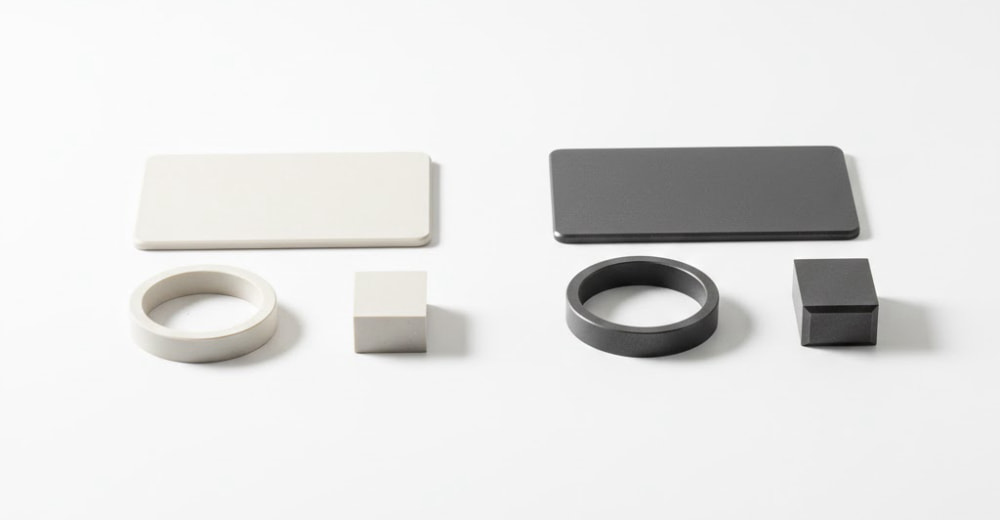
Silicon Carbide and Alumina – The Basics
Before comparing details, it helps to define what we mean by each material.
Silicon Carbide Ceramics
Silicon carbide ceramics are typically engineered as:
- Sintered SiC (SSiC): very high purity, high strength, excellent corrosion and thermal shock resistance.
- Reaction-bonded SiC (RBSiC/SiSiC): good strength, very good thermal shock resistance, widely used in kiln furniture and structural parts.
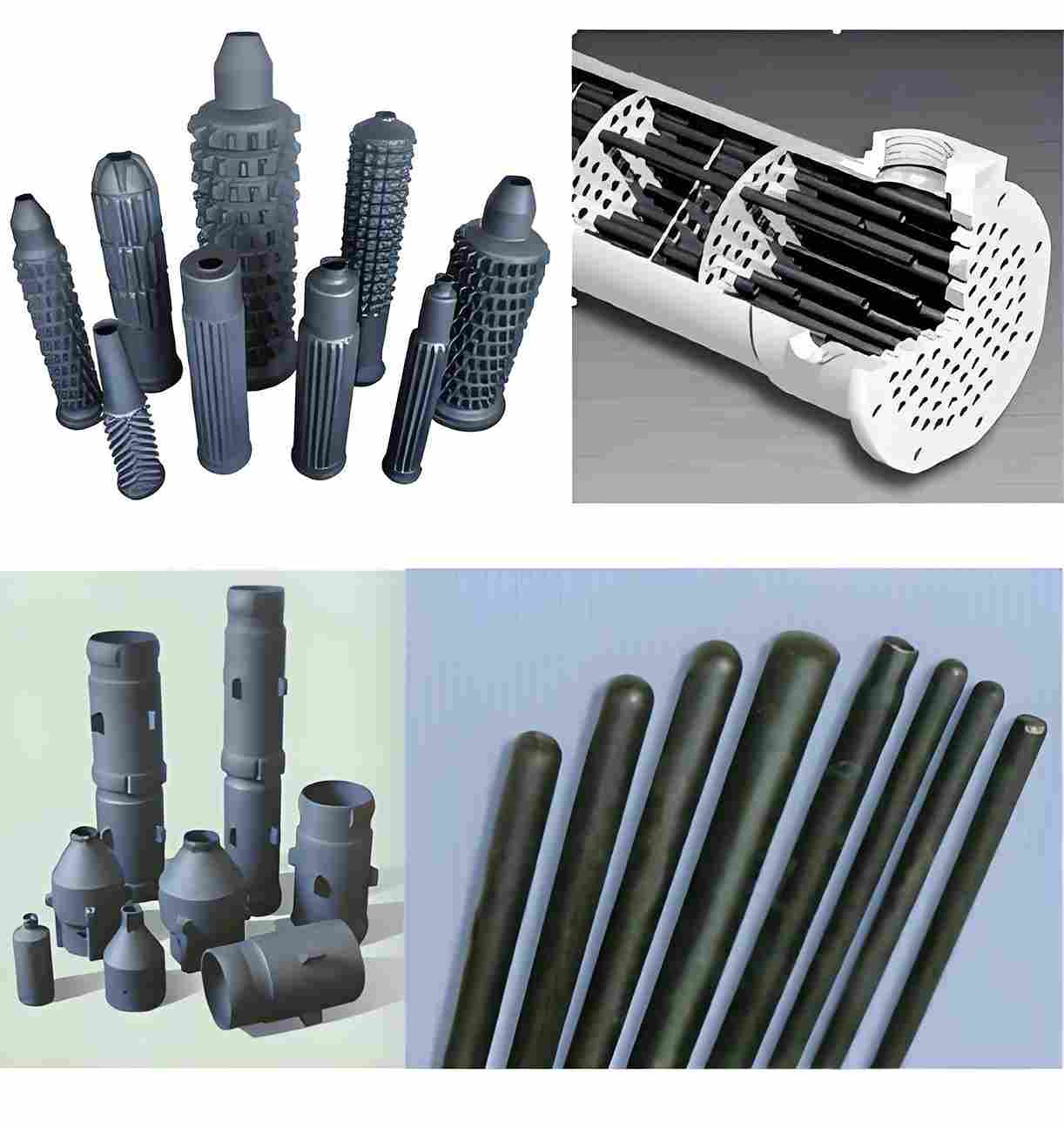
Typical Zirsec components include silicon carbide tubes, plates, kiln furniture, burner parts and custom mechanical parts for high-temperature and corrosive environments.
Alumina Ceramics
Alumina ceramics (aluminium oxide) cover a range of grades, typically defined by purity:
- 80–92% alumina: cost-effective, general industrial use.
- 95–99.7% alumina: higher strength and temperature capability, used in electrical insulators and wear parts.
Alumina is widely used where electrical insulation, reasonable wear resistance and moderate to high temperatures are required, but not at the extremes of thermal shock or corrosion that favour SiC.
Key Property Comparison: Silicon Carbide vs Alumina
The table below summarises typical trends (exact values depend on grade and manufacturer):
| Property | Silicon Carbide (SiC) | Alumina (Al2O3) | What It Means in Practice |
|---|---|---|---|
| Max service temperature (°C) | Approx. 1,600–1,800 | Approx. 1,400–1,700 | Both handle high temperature; SiC is favoured where load + temperature + cycling combine. |
| Thermal conductivity | High (often 80–120 W/m·K) | Moderate (often 15–30 W/m·K) | SiC spreads heat faster; better for fast firing, thermal shock and uniform temperature. |
| Thermal shock resistance | Excellent | Moderate | SiC tolerates fast heating/cooling; alumina prefers slow, controlled cycles. |
| Flexural strength at temperature | High, good retention at heat | High at room temp, drops more at heat | SiC shelves, beams and tubes sag less under load at high temperature. |
| Hardness / wear resistance | Very high | High | Both are good; SiC is usually better for extreme abrasion and erosive flow. |
| Chemical / corrosion resistance | Excellent in many acids, alkalis and hot gases | Good, but more sensitive to certain slags and alkalis | SiC is often chosen in very aggressive chemical or slagging conditions. |
| Electrical insulation | Semiconductive at high temperatures | Excellent insulator | Alumina wins if electrical insulation is critical. |
| Density | Approx. 3.0–3.2 g/cm³ | Approx. 3.7–3.9 g/cm³ | SiC is lighter; helpful in moving assemblies and kiln furniture. |
| Typical component cost | Higher | Lower to moderate | Alumina is usually cheaper; SiC must earn its keep via performance. |
In short: alumina is a flexible “workhorse” technical ceramic, while silicon carbide is the specialist for extreme combinations of temperature, thermal shock, wear and aggressive gases or liquids.
When Silicon Carbide Is Usually the Better Choice
1. Fast Firing, Thermal Shock and Cycling
If your process involves fast heating and cooling or frequent cycling, thermal shock kills components quickly. Typical situations:
- Fast-fire kilns and high-temperature furnaces with rapid ramps.
- Burners and radiant tubes exposed directly to flame or hot gas.
- Heat-treatment fixtures that see repeated thermal cycling under load.
Silicon carbide’s high thermal conductivity and low thermal expansion help it survive these swings. This is why kiln furniture, SiC tubes and burner components are so often based on SiC rather than alumina.
2. Severe Abrasion and Erosive Flow
In sliding, slurry or particle-laden flows, surface wear drives maintenance costs:
- Sandblasting and descaling nozzles.
- Slurry, ash or powder handling lines.
- Mechanical seal faces in abrasive service.
Silicon carbide’s higher hardness and wear resistance make it the default choice for nozzles, wear plates and seal rings in harsh flow conditions.
3. Chemically Aggressive High-Temperature Environments
Where high temperature, corrosive gases and slag or ash come together, alumina bricks or tiles often suffer unexpected chemical attack. Silicon carbide performs better in many:
- Waste incineration throats and boiler inlets.
- Chemical and petrochemical furnace linings in selected zones.
- High-temperature gas and combustion zones with corrosive species.
Here, SiC tiles, plates and blocks are used as hot-face or impact linings to protect more conventional refractories behind them.
When Alumina Still Makes More Sense
1. Electrical Insulation
If the component must remain an electrical insulator across a range of temperatures, alumina is the safer choice:
- High-voltage bushings and insulators.
- Sensor housings and feedthroughs where insulation is critical.
- Certain RF and microwave components.
Silicon carbide will not match alumina’s insulating performance in these roles.
2. Moderate Thermal Shock, High Volume, Cost-Sensitive Parts
When conditions are tough but not extreme, and price pressure is very high, alumina often wins on cost:
- Wear parts with moderate abrasion and moderate temperatures.
- High-volume insulators, guides and spacers run in stable thermal profiles.
In many cases, alumina does “well enough” if firing curves are gentle and the application is not right on the limits of thermal shock or corrosion.
Design Implications: How Material Choice Affects Your Equipment
Component Thickness and Mass
Because silicon carbide is stronger at temperature and has better thermal conductivity, you can usually:
- Design thinner shelves and plates for the same load.
- Reduce thermal mass in kilns and furnaces, cutting energy use and cycle time.
Alumina designs tend to be thicker and heavier to achieve similar strength and deflection limits.
Service Life and Maintenance Windows
The real cost is not just the component; it is downtime and labour:
- Silicon carbide typically delivers longer service life in severe conditions.
- Alumina may need more frequent replacement when pushed close to its limits.
If your shutdown windows are tight or expensive, silicon carbide often pays back its higher unit cost by reducing emergency interventions.
Thermal Profile and Product Quality
In firing and heat-treatment, uniform temperature and stable fixtures translate directly into product consistency:
- SiC plates and setters heat more evenly, reducing cold spots and gradients.
- SiC beams and supports sag less, preserving geometry and clearances.
Alumina can deliver good results in well-controlled, gentler profiles, but it is less forgiving when processes are pushed faster or hotter.
Practical Selection Guide: Silicon Carbide vs Alumina
Use the following questions as a quick filter:
- Is thermal shock a constant problem? Cracking on fast heat-up or cool-down → favour silicon carbide.
- Is severe abrasion or erosive flow the main failure mode? Nozzles, slurry lines, aggressive seals → favour silicon carbide.
- Is the component mainly an electrical insulator? High voltage or sensitive electronics → favour alumina.
- Is cost the main constraint and conditions are moderate? Stable temperature, limited abrasion → alumina may be sufficient.
- Are shutdowns very expensive or difficult to schedule? Fewer replacements and more predictable life → silicon carbide often makes more sense.
For many high-temperature systems, a hybrid approach works best: use alumina or conventional refractories in bulk areas and insert silicon carbide tiles, plates or tubes only in the most critical zones.
Example: Using SiC and Alumina Together in a High-Temperature Furnace
Background
An industrial furnace used alumina-based bricks and plates throughout the hot zone. As firing curves were pushed faster, shelves cracked and linings failed early in the most exposed areas.
Approach
- Keep alumina bricks as the main structural lining where conditions were moderate.
- Replace high-stress shelves and impact areas with silicon carbide plates and kiln furniture.
- Optimise the firing curve to take advantage of SiC’s thermal shock resistance.
Results
- Cracking and warping in critical zones decreased significantly.
- Average campaign length increased, with fewer unplanned repairs.
- Energy consumption per unit of product fell due to lower thermal mass and more efficient heating.
FAQ – Silicon Carbide vs Alumina for High-Temperature Service
Q1. Is silicon carbide always “better” than alumina?
No. Silicon carbide is better for extreme combinations of temperature, thermal shock, wear and corrosion. Alumina is the better option where electrical insulation is critical or where conditions are moderate and cost is the main concern.
Q2. Can I drop in silicon carbide parts into an alumina-based system without redesign?
Sometimes, but not always. Silicon carbide has different thermal expansion and thermal conductivity, so support conditions, joints and neighbouring materials should be reviewed. Many upgrades start with plates, tiles or tubes sized to fit existing fixtures, then are refined based on field experience.
Q3. Does switching from alumina to SiC reduce energy use?
It can. Thinner, lighter SiC plates and kiln furniture reduce thermal mass, and higher thermal conductivity can shorten soak times once the process is optimised. The actual saving depends on how conservative your current firing schedule is.
Q4. Are alumina components easier to machine and source than SiC?
Alumina is widely available and often easier to source for standard shapes. Silicon carbide requires more specialised production and finishing, but for critical high-temperature components, the performance difference justifies that extra effort.
Q5. What information should I prepare before asking Zirsec for a material recommendation?
Summarise operating temperature, heating/cooling rate, atmosphere, main failure modes (cracking, sagging, wear, corrosion), expected lifetime and basic dimensions or drawings. With this, Zirsec can suggest whether silicon carbide, alumina or a combination offers the best balance of performance and cost for your specific high-temperature application.
In short: use alumina where conditions are demanding but controlled and price-sensitive; deploy silicon carbide where the environment is unforgiving and downtime is expensive. Choosing correctly at the design stage is cheaper than treating your furnace or pump as a materials test lab.