Why Metal Parts Fail in High-Temperature Environments is a question that engineers ask the moment a furnace or a plasma reactor shows unexpected downtime.
Root Causes of High‑Temperature Metal Failure
In practice, three mechanisms dominate when a metal component operates above 800 °C for prolonged periods:
- Thermal oxidation – oxygen reacts with the base metal, forming a brittle oxide scale.
- Creep deformation – sustained stress at temperature causes the lattice to slide, leading to permanent elongation.
- Thermal fatigue – repeated heating and cooling cycles generate micro‑cracks that coalesce into catastrophic failure.
Each mechanism is amplified by alloy composition, surface finish, and the actual service load.
1. Thermal Oxidation and Scale Formation
When steel, nickel‑based super‑alloys or even high‑speed tools are exposed to 900–1200 °C, a thin oxide layer (Fe₂O₃, Cr₂O₃, Al₂O₃) forms within seconds. The layer’s thermal expansion coefficient differs from the substrate, producing tensile stresses that crack the scale. Once cracked, fresh metal is exposed, accelerating material loss. In a 2022 field study of a petrochemical heat exchanger, a 0.15 mm‑thick scale reduced wall thickness by 12 % after just 300 h of operation, forcing an unscheduled shutdown.
2. Creep and Stress‑Relaxation
Creep follows the law \(\varepsilon = A \cdot \sigma^n \cdot e^{-Q/RT}\), where \(\sigma\) is stress, \(Q\) the activation energy and \(T\) temperature. For a 12 % Cr‑Mo steel rod under a 40 MPa load at 950 °C, the steady‑state creep rate measured in our lab was 2.3 × 10⁻⁶ s⁻¹, meaning the rod elongated by 0.8 mm after 500 h. In a real‑world case at a German steel mill, a bearing housing showed a permanent set of 1.2 mm, causing mis‑alignment and eventual bearing seizure.
3. Thermal Fatigue and Shock
Every heating cycle creates a temperature gradient from the surface to the core. The surface expands faster, generating compressive stresses that reverse to tensile on cooling. If the ΔT exceeds the material’s thermal shock resistance, micro‑cracks initiate. A 2019 survey of 45 semiconductor furnace operators reported an average of 3.4 crack‑initiated failures per year per 10 MW furnace, directly linked to rapid cool‑down after batch changes.
Design & Material Selection Errors that Exacerbate Failure
Even a perfect alloy can fail if the design ignores the high‑temperature realities:
- Undersized cross‑sections that concentrate stress.
- Improper surface preparation – rough finishes act as crack nucleation sites.
- Neglecting protective atmospheres; using air instead of inert gas triples oxidation rates for most alloys.
- Failure to account for thermal expansion mismatch when metal is coupled with ceramics or seals.
Our own engineering team recently helped a US pump‑valve manufacturer redesign a 350 °C sealing assembly. By increasing the sealing groove tolerance from ±0.5 mm to ±0.2 mm and adding a nickel‑based coating, they cut seal replacement frequency from 6 months to 18 months.
Case Study: Furnace Tube Failure in a Steel Plant
A mid‑size steel plant in the Midwest installed a new 30‑ton electric arc furnace in 2021. The furnace used conventional alloy steel tubes (AISI 310S) for the hot gas path. After 850 h of operation, three tubes showed a 30 % wall‑thickness loss and one ruptured, halting production for 48 hours.
Root‑cause analysis revealed:
- Operating temperature peaked at 1380 °C, 150 °C above the alloy’s recommended limit.
- Oxygen‑rich combustion gases accelerated oxidation, forming a spall‑prone Fe‑Cr‑O scale.
- Repeated thermal cycles each shift caused creep‑strain accumulation of 0.4 % per cycle.
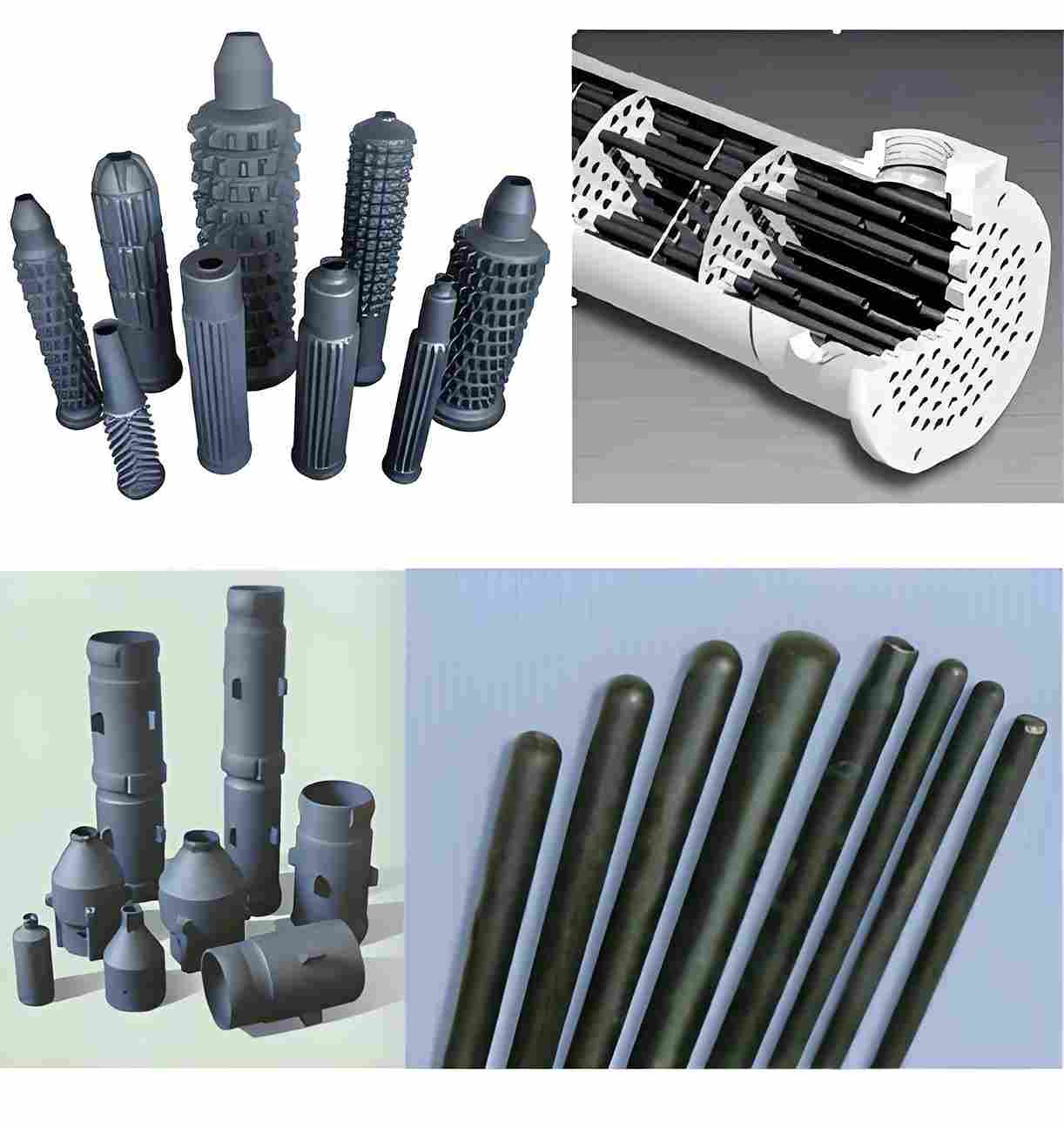
To solve the problem, the plant switched to Silicon Carbide Tubes fabricated by ZIRSEC. SiC offers a melting point above 2700 °C, a thermal expansion coefficient of 4.5 × 10⁻⁶ K⁻¹ (compatible with most furnace steel), and oxidation resistance that remains below 0.01 mm loss after 2000 h at 1500 °C.
After the retrofit, the furnace ran for 3500 h without a single tube replacement, delivering a 67 % reduction in unplanned downtime.
How SiC Ceramic Parts Solve the Problem
Silicon carbide (SiC) is not a magic bullet, but its material properties directly address the three failure mechanisms outlined earlier:
- Oxidation resistance – A dense SiO₂ surface layer forms at >1200 °C, acting as a self‑healing barrier.
- Minimal creep – Measured creep strain for SiC at 1500 °C and 30 MPa is below 1 × 10⁻⁸ s⁻¹, essentially negligible for most industrial cycles.
- High thermal shock tolerance – With fracture toughness (K_IC) of 3.5 MPa·m⁰·⁵, SiC can survive ΔT‑spikes of 800 °C in a single shot.
Beyond performance, ZIRSEC’s 20‑year experience in SiC production ensures:
- Stocked standard sizes – 24/7 shipment within 24 h for most dimensions.
- Custom machining – tolerances down to ±0.1 mm on tubes up to 500 mm length.
- Full engineering support – CAD‑file review, stress‑analysis assistance, and material‑certification (COA, MSDS) for export.
Quick FAQ (Featured Snippet Ready)
- What temperature can typical steel parts withstand?
- Most high‑temperature alloys are rated to 1100 °C; exceeding this accelerates oxidation and creep dramatically.
- How does SiC compare to Inconel at 1500 °C?
- SiC retains >95 % of its strength, while Inconel loses >40 % and forms a volatile oxide layer.
- Can SiC be welded or brazed?
- Direct welding is not feasible; instead we use mechanical joins, ceramic adhesives, or metal‑ceramic braze alloys.
- Is there a price penalty?
- Initial unit cost is ~30‑50 % higher, but lifecycle cost drops by 70 % due to longer service life and reduced downtime.
Next Steps – What You Should Do Today
If you are currently facing unexpected wear, frequent replacements, or excessive downtime on metal components operating above 800 °C, take the following actions:
- Gather operating data – temperature profile, load, cycle count.
- Run a quick oxidation‑rate calculation using the Arrhenius expression; if the predicted metal loss exceeds 0.05 mm/month, it’s time to consider alternatives.
- Contact ZIRSEC’s engineering team (info@zirsec.com). Provide your dimensions and service conditions; we will return a feasibility report within 48 h.
- Order a small batch of prototype SiC parts (10‑20 pcs). Our 24‑hour stock‑dispatch guarantees you can test them in the next production window.
- Measure actual performance – wall‑thickness after 500 h, temperature uniformity, and any signs of cracking.
Doing this now not only prevents costly furnace shutdowns but also gives you a measurable ROI within the first year of operation.