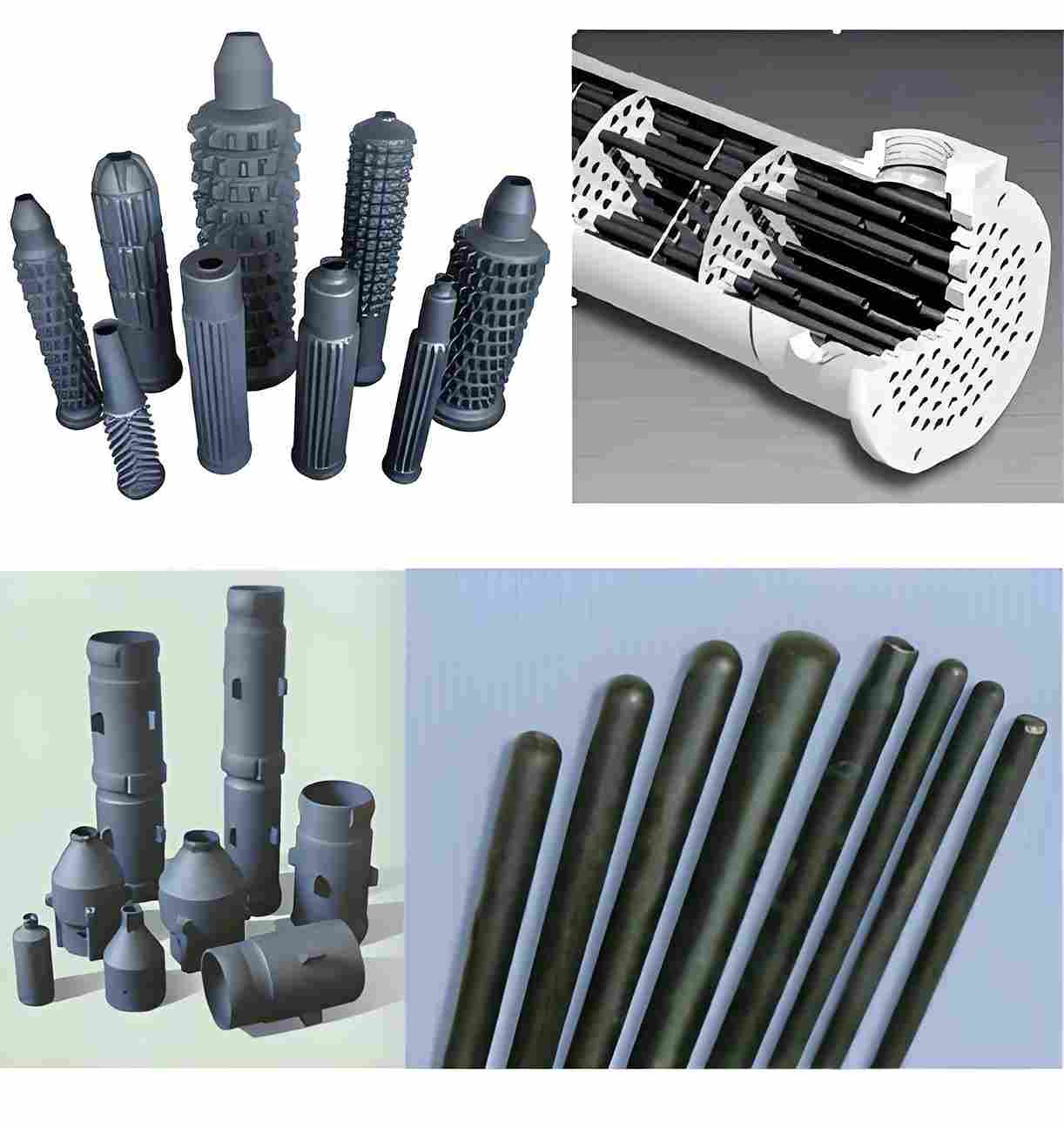
Silicon carbide components are increasingly used in pumps, furnaces, heat exchangers and chemical equipment where metals and polymers reach their limits. However, silicon carbide is not a “drop-in metal replacement.” It has different mechanical and thermal behaviour, and ignoring those differences is the fastest way to crack expensive ceramics.
This article provides practical design tips for engineers who want to incorporate silicon carbide components into industrial equipment in a controlled, repeatable way instead of learning only from field failures.
Start with the System, Not the Single Part
Silicon carbide will usually enter your design as a “problem solver” in one hot or highly loaded zone. If you only swap one part to SiC and leave the rest untouched, you risk moving the weak point rather than removing it.
Before detailing the ceramic part, clarify:
- Function: Is the SiC part carrying load, sealing, guiding, protecting from wear, or moving heat?
- Interfaces: Which metals, elastomers and other ceramics touch the SiC component?
- Failure modes today: Wear, corrosion, distortion, thermal shock, leakage, or all of the above?
- Target lifetime: What “success” actually means in operating hours, cycles or tonnes of throughput.
For example, introducing a silicon carbide tube into a furnace as a protective or radiant element affects burner layout, expansion allowances and support design, not just the tube itself. Zirsec’s silicon carbide tubes are often part of a wider system upgrade, not an isolated hardware change.
Design for Ceramic Behaviour, Not Metal Behaviour
Silicon carbide is strong and stiff, but it behaves like a brittle ceramic, not a ductile metal. Design rules must reflect that.
Control Stress Concentrations
- Avoid sharp internal corners and notches; use generous radii wherever space allows.
- Design gradual transitions in wall thickness instead of sudden steps.
- Minimise local contact points and point loads; use broad, flat support surfaces.
Limit Bending and Eccentric Loading
- Long tubes, beams and plates should be supported at multiple points to reduce bending stress.
- Align loads through the centroid of cross-sections where possible.
- For rotating parts, control runout and unbalance to avoid cyclic bending.
For complex or highly loaded structures, numerical assessment methods such as the finite element method are often used to identify peak stresses and adjust geometry before tooling and production.
Respect Thermal Expansion and Thermal Shock
Silicon carbide has lower thermal expansion than many steels and alloys and good thermal shock resistance, but that does not mean you can ignore temperature effects.
Match or accommodate thermal expansion
- Check thermal expansion mismatches between SiC and metals at operating temperature.
- Use sliding or floating interfaces where large temperature gradients exist.
- Support SiC parts so they can expand and contract without being locked between rigid points.
Reduce thermal shock risk
- Avoid sudden temperature jumps, especially during start-up and shutdown.
- Design process flow and burner layout to avoid extreme hot spots on specific areas of the SiC part.
- Consider preheating cycles or controlled ramping for sensitive equipment.
In furnaces and kilns, combining silicon carbide beams, rollers and plates into a coherent support system is often more robust than upgrading only one element. Zirsec offers silicon carbide plates that are used alongside tubes and other SiC components to build complete high-temperature structures.
Design Interfaces and Mounting Carefully
Most failures in silicon carbide components do not originate in the middle of a uniform section. They start at interfaces: flanges, clamps, tube sheets, seal housings and bolted joints.
Support and clamping
- Use compressive loading where possible; ceramics handle compression much better than tension.
- Avoid rigid metal clamps that “bite” into the SiC surface. Use soft interlayers or shaped seats to distribute load.
- Design supports that remain effective at operating temperature and do not create unintended point loads during expansion.
Sealing and gaskets
- Use gasket materials compatible with both SiC and process media.
- Ensure gasket compression does not generate bending or twisting in the ceramic part.
- In mechanical seals and static seals, carefully balance surface finish, flatness and gasket pressure.
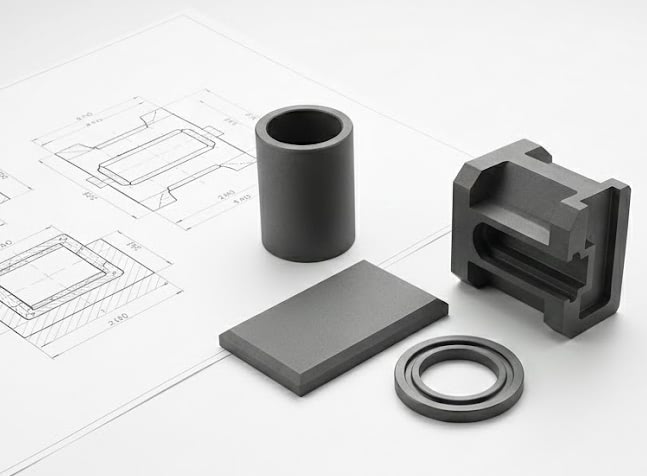
For components like silicon carbide seal rings, sleeves or flanges, Zirsec’s customisation service can help adapt geometries so that clamping and sealing loads are well-controlled.
Specify Practical Tolerances and Surface Requirements
Overly tight tolerances drive cost; vague tolerances generate assembly problems. Both waste engineering effort.
Identify critical dimensions
- Mark shaft fits, sealing faces, bearing seats and locator features as critical.
- Assign realistic tolerance bands for ceramics; very tight fits may require extra grinding and lapping.
- For non-critical surfaces, allow standard manufacturing tolerances.
Surface finish
- Define roughness for contact surfaces: seal faces, sliding bearings and precision guides.
- Accept “as-fired” or simple ground finishes where surfaces do not affect performance.
- Ensure that drawings distinguish between sealing and non-sealing areas on the same face, where applicable.
A clear drawing package with explicit tolerance and surface requirements significantly reduces iteration time between engineering and production.
Choose the Right Silicon Carbide Grade and Process Route
Different silicon carbide grades and sintering processes give different property profiles. For industrial equipment, the main families are:
- SSiC – Sintered silicon carbide: dense, high-purity material with excellent corrosion resistance and high strength, often used in mechanical seals and aggressive chemical services.
- RBSiC / SiSiC – Reaction-bonded silicon carbide: very good strength and thermal shock resistance, well suited for tubes, beams and structural components.
- RSiC – Recrystallized silicon carbide: good high-temperature and cycling behaviour, often used for kiln furniture and furnace parts.
Selection should be made based on media, temperature, mechanical loads and required reliability, not only catalogue labels. Discuss grade options early in the design phase so dimensions and support concepts match the chosen material.
Think in Families of Components, Not One-Off Parts
Once silicon carbide enters your design, you rarely stop at a single part. It usually spreads to adjacent areas where the same failure modes appear.
- In pumps: combine SiC sleeves, bearings and seal rings into a coherent wet-end design.
- In furnaces: use SiC tubes, beams and plates to support and protect critical zones.
- In chemical equipment: integrate SiC liners, nozzles and inserts around the most aggressive flow paths.
Coordinating these components through a single supplier simplifies material matching, thermal expansion management and spare parts strategy.
Case Example: Integrating SiC into a High-Temperature Process Line
Background
A process line handling hot, mildly corrosive gases suffered repeated failures in metal radiant tubes and wear at certain duct transitions. Maintenance intervals were short, and thermal distortion caused misalignment problems.
Approach
- Replace metallic radiant tubes with silicon carbide tubes designed for the existing burner layout.
- Introduce SiC wear plates at the most erosive duct bends.
- Redesign tube supports and expansion joints to account for ceramic behaviour.
Result
- Tubes and plates reached significantly longer operating times without cracking or severe wear.
- Temperature profile became more stable due to better geometric stability at high temperature.
- Maintenance shutdowns were less frequent and more predictable.
FAQ – Design Tips for Using Silicon Carbide Components
Q1. Can I simply copy my existing metal part geometry in silicon carbide?
Usually no. Direct copies often carry over thin sections, sharp corners and unsupported spans that are acceptable in metals but risky in ceramics. Some parts may work, but systematic redesign for ceramic behaviour is strongly recommended.
Q2. How early should I involve a silicon carbide supplier in my project?
Ideally at the concept or pre-design stage, once you know where metal or polymer parts are struggling. Early discussions help avoid designs that are difficult to manufacture or mount, and they reduce the number of redesign loops later.
Q3. Do I always need finite element analysis when designing SiC parts?
Not always. Simple parts with well-understood loads can often be designed using standard engineering rules. However, for complex geometries, large spans or safety-critical components, numerical analysis is often the best way to identify stress concentrations and temperature effects before committing to tooling.
Q4. What information should I send with my first enquiry?
Provide application description, operating temperature and media, mechanical loads, known failure modes of existing parts and any preliminary drawings or sketches. This allows your silicon carbide supplier to give meaningful design feedback instead of generic comments.
Q5. How can Zirsec help with integrating silicon carbide into existing equipment?
Zirsec supports engineers with application review, material and grade selection, geometry and tolerance suggestions, and production of both samples and series parts. By treating silicon carbide tubes, plates, seals and other components as part of a single system, Zirsec helps you introduce SiC into equipment with fewer surprises and a clearer path to stable operation.
Planning to incorporate silicon carbide components into your next equipment design or upgrade? Share your operating conditions and preliminary drawings with Zirsec, and use these design tips as a checklist to move from “idea” to robust, manufacturable SiC solutions.