Most “mystery failures” in critical process equipment are not mysterious at all. Bearings seize, seals leak, tubes crack, linings erode, and suddenly your mean time between failures (MTBF) is a number nobody wants to present in a reliability review. When temperature, corrosion and wear stack up, conventional metals and basic refractories simply run out of margin. That is where silicon carbide (SiC) ceramics quietly start to move MTBF in the right direction.
This article looks at how silicon carbide ceramics improve MTBF in critical process equipment, what actually changes in failure modes, and how OEM designers and MRO teams can specify SiC components in a structured way instead of guessing. The focus is on equipment where unplanned downtime is painful: chemical pumps, high-temperature furnaces, scrubbers, reactors, and associated handling systems.
What MTBF Really Means in Critical Process Equipment
MTBF (mean time between failures) is not a magic number. In real plants it usually means:
- How often a line is unexpectedly down due to a component failure, and
- How predictable those failures are for planning spares and shutdowns.
For critical equipment, low MTBF shows up as:
- frequent emergency maintenance on the same few “bad actor” components,
- expensive safety margins (extra standby equipment, oversizing),
- lost production and missed delivery commitments,
- friction between engineering, maintenance and operations.
Improving MTBF is not just about “stronger parts.” It is about changing dominant failure mechanisms so that wear, corrosion and thermal damage slow down and become predictable. Silicon carbide ceramics are attractive because they do exactly that in the high-stress zones where metals and simpler ceramics struggle.
Why Conventional Materials Limit MTBF
Before looking at silicon carbide, it helps to be honest about why conventional materials often cap MTBF in harsh service.
- Metals creep and corrode at temperature: heat-resistant alloys sag, oxidize and pit in hot, corrosive environments. Wall thickness erodes until cracks and leaks appear.
- Basic ceramics crack under cycling: oxide refractories and simple kiln furniture often fail under rapid heat-up and cool-down even when average temperature is within rating.
- Soft materials wear fast under abrasion: slurry, crystallizing salts and catalyst fines chew through softer metals, coatings and polymer linings.
- Coatings hide problems instead of solving them: organic and metallic coatings delay failure but introduce new modes: blistering, undercut corrosion, spallation.
- Local “hot spots” and stress concentrations: complex geometries and mixed materials create local peaks in stress and temperature where conventional materials fail early.
The result is a familiar pattern: promising MTBF on paper, followed by scattered early failures, then a long tail of unpredictable behavior that makes it hard to standardize shutdown intervals.
How Silicon Carbide Ceramics Change Failure Modes
Silicon carbide is a high-performance ceramic built around strong covalent Si–C bonds. It combines:
high hardness, high thermal conductivity, low thermal expansion, and excellent chemical and oxidation resistance. In practice, this changes how components behave in service and how MTBF behaves over time.
1. Slower Wear and More Stable Surfaces
In pumps, mixers, guides and kiln furniture, the first step toward better MTBF is simply slowing down wear:
- High hardness: SiC components resist abrasion from slurries, powders and hard particles far better than steels and many refractories.
- Dense, smooth surfaces: limit micro-cutting, reduce turbulence and hold geometry longer under sliding and erosive wear.
- Lower wear rate: means performance drifts slowly and predictably instead of collapsing after one bad upset event.
For mechanical seal faces, bushings and wear liners, this slower, more uniform wear translates almost directly into higher MTBF and fewer sudden failures.
2. Resistant to Corrosion + Temperature at the Same Time
Many critical processes force you to choose: metals that handle corrosion but hate temperature, or alloys that handle temperature but corrode quickly. Silicon carbide ceramics tolerate both more gracefully:
- Chemical resistance: SiC forms a protective silica layer in many oxidizing and acidic environments, drastically reducing material loss rates.
- High-temperature stability: microstructure and strength remain stable well above temperatures where many alloys start to creep, oxidize or scale heavily.
- Combined resistance: high-temperature corrosive gases, hot acids and reactive atmospheres stress SiC far less than equivalent alloys.
When corrosion and temperature are no longer co-driving failure, MTBF stops being dominated by “unexpected” material loss and becomes more a question of general design and maintenance discipline.
3. Better Thermal Shock Behavior
Thermal cycling is the quiet MTBF killer in high-temperature equipment. Here, properly selected silicon carbide grades help by:
- tolerating rapid heat-up and cool-down better than many oxide ceramics,
- surviving short upset events like door openings and burner excursions,
- maintaining flatness and alignment under repeated cycling.
For kiln plates, beams, radiant tubes and burner components, this means fewer early-life cracks and a narrower spread of lifetimes across identical parts – a direct boost to MTBF and planning accuracy.
4. Lower Risk of Catastrophic, Leak-Driving Failures
In critical process equipment, the expensive failures are usually the ones that cause leaks or force full shutdowns. Silicon carbide:
- does not thin by general corrosion the way metals do,
- does not rely on organic coatings that can fail suddenly,
- retains “load bearing capacity” at temperature better than many alternatives.
Failures can still occur (for example, due to mechanical impact or gross overload), but they are less likely to creep up silently through wall loss and undercutting. That reduces surprise leaks and unplanned outages.
Where Silicon Carbide Components Make the Biggest MTBF Impact
Not every part needs silicon carbide. MTBF gains are concentrated where the environment is harsh and failure is expensive.
1. Mechanical Seals and Bearings in Chemical Pumps
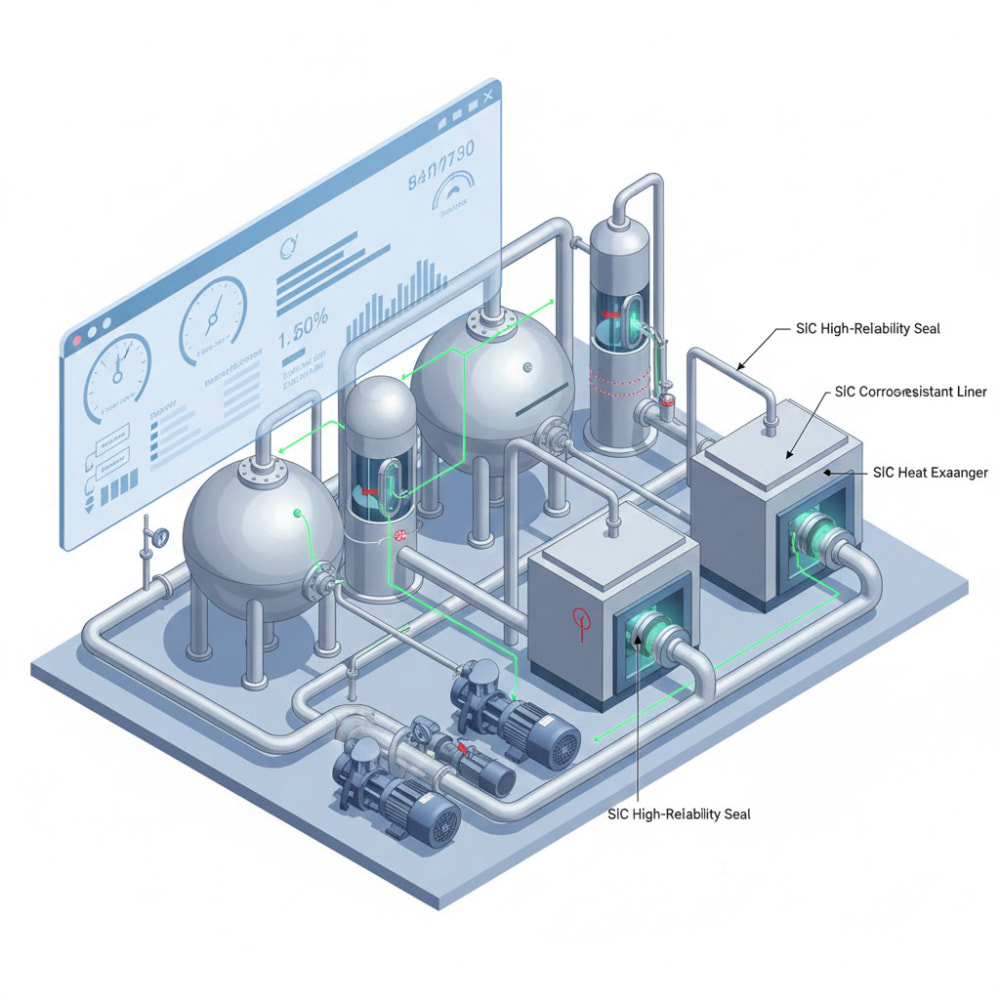
Mechanical seals and bearings are classic low-MTBF components in process plants. Replacing conventional faces and bushings with SiC can:
- extend seal life in aggressive acids, caustics and solvents,
- reduce leakage due to pitting, wear and thermal cracking,
- stabilize performance across different batches and campaigns.
Zirsec’s SiC sealing rings are designed with exactly this in mind: higher MTBF in chemical processing applications where standard materials underperform.
2. Kiln Furniture and High-Temperature Furnace Components
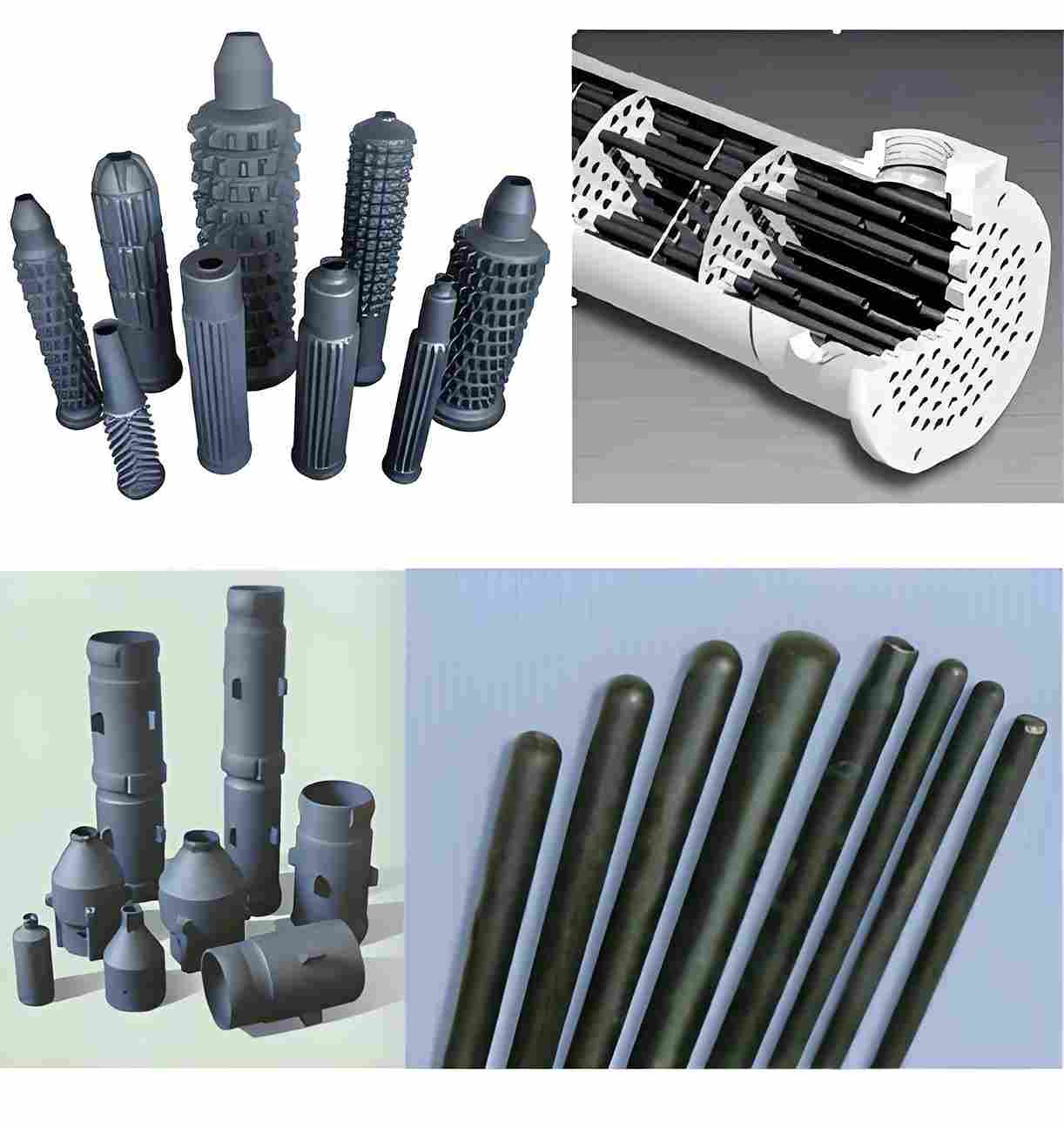
In kilns and furnaces, MTBF often looks like “how long until plates warp, beams crack or radiant tubes sag enough to cause quality problems.” Silicon carbide plates, beams and tubes:
- carry high loads with lower mass, reducing thermal lag,
- resist creep and warping at temperature,
- tolerate thermal cycling better than many conventional refractories.
Applied correctly, SiC kiln furniture supports more cycles per campaign and fewer unexpected breakages, which translates directly into higher MTBF for the entire kiln car or furnace zone. These roles are described in Zirsec’s High-Temperature Furnace Applications overview.
3. Nozzles, Liners and Launders Under Slurry or Erosive Flow
Wherever high-velocity, particle-laden flow hits walls and nozzles – scrubbers, FGD systems, slurry lines, launders – metallic components tend to erode fast. SiC nozzles and liners:
- maintain outlet geometry and flow pattern longer,
- resist combined erosion-corrosion better than steels,
- reduce the frequency of unexpected leaks and performance loss.
Here MTBF shows up in fewer plugged or eroded nozzles, less frequent liner replacement and more stable operating conditions over each campaign.
4. Structural Supports in Hot Zones
Support beams, posts and complex structural parts in hot zones often define how long a furnace or kiln can run between major rebuilds. Silicon carbide beams and posts:
- hold flatness and alignment under load at high temperature,
- avoid creep and permanent sagging seen in metallic supports,
- keep hot-zone geometry consistent across more campaigns.
Higher MTBF at the structural level means fewer “partial rebuilds” and more predictable shutdown scheduling, which is exactly what operations and maintenance teams want.
Design and Selection: Turning Material Advantages into MTBF Gains
The material alone does not deliver MTBF. Design details decide whether SiC’s advantages actually show up in service.
1. Choose the Right SiC Grade for the Failure Mode
“Silicon carbide” covers several material families, including sintered, reaction-bonded, recrystallized and nitride-bonded grades. A simple rule of thumb:
- Sintered SiC (SSiC): best for extreme sliding wear and corrosion (mechanical seals, bearings, high-end wear parts).
- Reaction-bonded SiC (RBSiC / SiSiC): best for larger, thermally cycled structural parts (kiln plates, beams, burner blocks, radiant tubes).
- High-purity or specialized grades: for clean applications and aggressive gas or liquid chemistries.
Selecting the wrong grade can eat into MTBF gains quickly, especially in borderline chemistries or violent thermal cycles.
2. Design to Avoid Stress Concentrations and Impact
SiC is strong but still a ceramic; it does not like sharp tensile stress peaks or point impacts. To protect MTBF:
- avoid sharp corners, thin unsupported sections and sudden section changes,
- use generous radii at transitions and hole edges,
- ensure loads are distributed (line or area contact) rather than concentrated on small points.
Good design turns potential brittle failures into long, benign wear-out behavior, which is exactly what you want for predictable MTBF.
3. Manage Interfaces with Steel and Other Materials
Most SiC components sit inside steel structures, refractory linings or polymer systems. At these interfaces:
- allow for differential thermal expansion between SiC and metals,
- use sliding or compliant supports where necessary,
- avoid rigid “clamping” that traps the SiC part and builds stress during heating.
Many early-life failures blamed on the material are actually interface design mistakes. Fixing those turns SiC into a reliable MTBF lever rather than a finicky special material.
4. Align Operating Practice with Material Limits
Even with SiC, operating practice matters:
- follow defined heat-up and cool-down curves for furnaces and kilns,
- avoid dry-running seals beyond specified limits,
- control solids loading and filtration in slurry systems,
- monitor chemistry and pH where corrosion is close to known limits.
When operators know where SiC is strong and where it is not, abuse events drop and MTBF starts to reflect material capability instead of plant habit.
How to Quantify MTBF Gains with Silicon Carbide
To justify a change to silicon carbide, you need more than “it’s better.” You need numbers. A simple MTBF-oriented comparison can include:
- Baseline: current material, average time to failure, failure modes and variability.
- Target: desired MTBF (hours, cycles, campaigns) and maximum acceptable unplanned failures per year.
- SiC scenario: expected MTBF range based on similar applications and material data, including confidence intervals.
- Cost impact: part cost, downtime cost, maintenance labor, scrap and rework, safety and environmental risk reduction.
In many real cases, a switch to SiC components turns MTBF from “a few months with wide variability” into “multi-year or multi-campaign operation with a much tighter distribution,” even if the exact numbers differ by plant and duty cycle.
FAQs: Silicon Carbide Ceramics and MTBF
1. Can silicon carbide ceramics completely remove failures?
No. They can shift the dominant failure modes from rapid wear, corrosion and thermal cracking to slower, more predictable wear-out mechanisms. You still need good design and operating discipline, but the probability of sudden, material-driven failures drops significantly.
2. Where do silicon carbide ceramics deliver the fastest MTBF improvement?
Typically in high-wear, high-temperature and high-corrosion components that are already on the maintenance “bad actor” list: seal faces, bushings, furnace tubes, kiln plates, beams, nozzles and liners. These are the components that benefit most from SiC’s strength, hardness and chemical stability.
3. Do I always need the highest-grade SiC to improve MTBF?
Not necessarily. Sintered SiC is often justified for critical sliding contacts and harsh chemistries, while reaction-bonded SiC can deliver excellent MTBF improvements for larger furnace and kiln components at lower cost. Grade selection should match failure modes and business priorities.
4. How long can I expect SiC components to last?
There is no universal number. In many critical services, switching to SiC moves components from months of life to years or multi-campaign service, with fewer random early failures. The real gain is not just a higher average MTBF, but a narrower and more predictable lifetime distribution.
5. Are SiC components harder to integrate into OEM designs?
They require different design rules, especially around supports, interfaces and tolerances, but they are not inherently “difficult.” Treat them as engineering-grade components with defined limits, and work with suppliers on supports, expansion allowances and surface requirements during the design phase.
6. How do I know whether MTBF gains justify the higher part cost?
Build a simple lifecycle model:
- compare part cost per operating hour or per ton processed,
- quantify avoided emergency shutdowns and maintenance interventions,
- estimate improvements in product yield and energy use where relevant.
In most harsh services, silicon carbide pays back through fewer unplanned failures and longer campaigns, even when unit cost is significantly higher than for traditional materials.
Get a Silicon Carbide MTBF Upgrade Plan for Your Equipment
If you are trying to improve MTBF in critical process equipment, the fastest progress usually comes from focusing on a short list of high-stress components where silicon carbide can change the failure story. Combining your own failure history with the SiC product families in the Zirsec Types overview and application pages such as High-Temperature Furnace Applications and Chemical Processing Applications is usually enough to define a realistic upgrade roadmap.
Once temperatures, chemistries, loads and lifetime targets are clear, silicon carbide ceramics stop being “exotic materials” and become precise tools for pushing MTBF upward in the parts of your process where failures hurt the most.