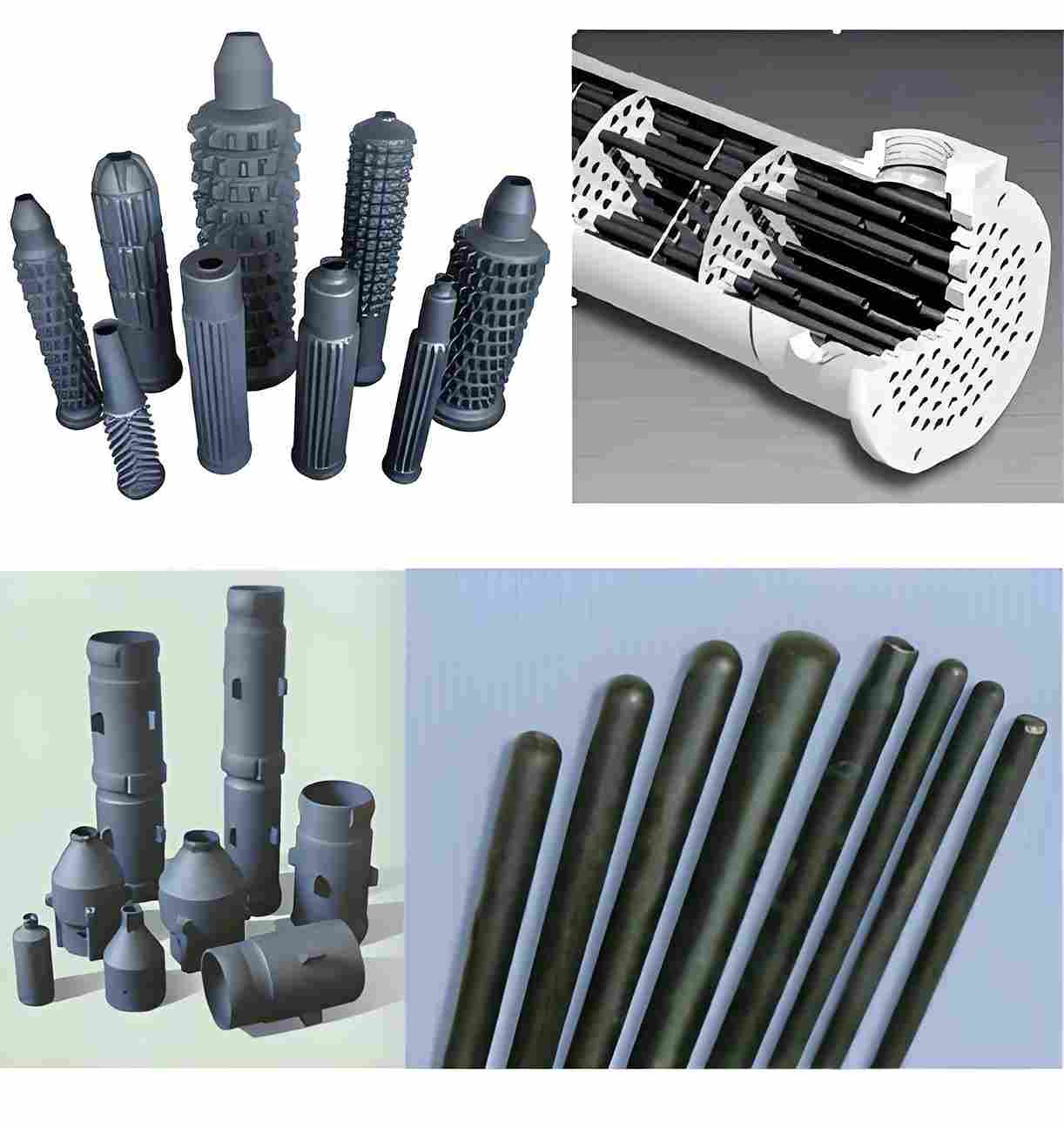
The mechanical properties of silicon carbide are the key reasons it dominates high‑temperature, high‑stress industrial applications such as furnace tubes, seal rings, and wear‑resistant rollers.
Quick Summary (FAQ)
- What is the typical flexural strength of SiC ceramics? 300–600 MPa for dense, hot‑pressed grades; up to 800 MPa for optimized nano‑structured variants.
- How hard is silicon carbide? Vickers hardness ranges from 22–28 GPa (≈2200–2800 HV).
- What is the fracture toughness? 3–5 MPa·√m for conventional SiC; 6–7 MPa·√m for SiC‑Al₂O₃ composites.
- Can SiC replace alumina in corrosive environments? Yes—SiC offers superior thermal shock resistance and chemical inertness above 1200 °C.
- Where can I source custom SiC components? Contact ZIRSEC for standard stock or fully engineered parts (silicon carbide tubes).
1. Core Mechanical Metrics of Silicon Carbide
Engineers usually focus on four numbers when evaluating a ceramic for load‑bearing service:
1.1 Flexural Strength (Modulus of Rupture)
Measured by three‑point bending, dense SiC typically delivers 300–600 MPa. The variation stems from grain size, porosity, and residual stresses introduced during sintering. Hot‑isostatic pressing (HIP) can push values above 800 MPa, which is why many aerospace‑grade furnace tubes come from HIP‑treated billets.
1.2 Vickers Hardness
Hardness correlates with wear resistance. For commercial grades, Vickers hardness sits between 22 and 28 GPa (≈2200–2800 HV). Nanocrystalline SiC shows the upper end of this spectrum, making it ideal for slurry‑jet nozzles and abrasive‑resistant liners.
1.3 Fracture Toughness
Silicon carbide is inherently brittle, with a K_IC of 3–5 MPa·√m for monolithic material. Adding 10–15 % Al₂O₃ or Y₂O₃ can raise toughness to 6–7 MPa·√m, a figure often quoted by manufacturers for “high‑toughness” grades used in pump seals.
\n
1.4 Elastic Modulus
The Young’s modulus of SiC ranges from 380 to 420 GPa, roughly 1.5× that of alumina. This high stiffness translates into minimal elastic deformation under load, which is critical for maintaining tight clearances in ceramic‑to‑metal interfaces.
2. How These Values Are Determined
Reliability starts with proper testing. The most common standards are ASTM C1161 for flexural strength, ASTM C1327 for hardness, and ASTM C1421 for fracture toughness. In‑house labs at ZIRSEC run these tests on every production batch and provide a full test report (COA) to the customer.
2.1 Sample Preparation
Samples are cut to 3 × 4 × 40 mm bars, ground to ±0.02 mm, and polished to a mirror finish to eliminate surface flaws. Porosity is limited to <0.5 % for high‑strength grades; any higher and the Weibull modulus drops significantly.
2.2 Statistical Treatment
Because ceramics fail from critical flaws, a Weibull analysis is mandatory. Typical Weibull modulus (m) for dense SiC is 8–12, indicating relatively uniform strength distribution. When m falls below 6, you’ll see a higher scatter in field performance—a red flag for OEMs.
3. Real‑World Factors That Influence Mechanical Performance
Even the best‑rated SiC can underperform if you ignore the following variables.
3.1 Grain Size & Distribution
Fine grains (<0.5 µm) improve hardness but may lower fracture toughness. Coarse grains (2–5 µm) enhance toughness but can reduce strength if the grain boundary strength is insufficient.
3.2 Porosity & Density
Closed‑porosity below 0.2 % is ideal for high‑strength applications. Open porosity introduces stress concentration sites that cut flexural strength by roughly 30 % per 0.1 % increase in pore volume.
3.3 Residual Stresses
Cooling from sintering temperatures (>2000 °C) induces thermal gradients. If the cooling rate exceeds 5 °C/min, tensile stresses develop on the surface, which can trigger premature crack initiation.
3.4 Environmental Attack
At temperatures above 1300 °C, SiC slowly oxidizes to SiO₂. In oxidative atmospheres, a protective silica layer forms, but cyclic thermal shock can spall this layer, exposing fresh SiC to rapid degradation. Adding small amounts of boron or nitrogen can improve oxidation resistance.
4. Silicon Carbide vs. Competing Ceramics
| Property | SiC | Al₂O₃ (Alumina) | Si₃N₄ (Silicon Nitride) |
|---|---|---|---|
| Flexural Strength (MPa) | 300‑800 (HIP) | 350‑500 | 500‑900 |
| Vickers Hardness (GPa) | 22‑28 | 15‑20 | 13‑17 |
| Fracture Toughness (MPa·√m) | 3‑5 (up to 7 with additives) | 3‑4 | 5‑7 |
| Thermal Conductivity (W/m·K) | 120‑200 | 30‑35 | 70‑90 |
| Max Service Temp (°C) | 1600‑1800 (in inert) | 1000‑1100 | 1300‑1500 |
SiC outperforms alumina in hardness and thermal conductivity, making it the preferred choice for wear‑critical, high‑heat zones. Silicon nitride offers higher toughness but falls short on hardness and oxidation resistance at >1500 °C.
5. Design Tips for Engineers Working With SiC
5.1 Allow for Thermal Expansion
SiC’s coefficient of thermal expansion (CTE) is ~4‑5 ×10⁻⁶/K. When mating with metals (CTE ~12 ×10⁻⁶/K for stainless steel), incorporate compliant metal‑ceramic joints or use a graded seal ring to avoid excessive stress during heating cycles.
5.2 Target Surface Roughness
For sealed interfaces, aim for Ra 0.8–1.2 µm. Rougher surfaces increase friction and wear, while overly smooth surfaces can lead to galling under high‑pressure fluid flow.
5.3 Specify Tolerances Early
Typical industrial tolerance for SiC tubes is ±0.2 mm; high‑precision applications (e.g., burner nozzles) may require ±0.1 mm. Communicate these tolerances upfront with the supplier—ZIRSEC can machine to ±0.05 mm on short‑run orders.
5.4 Consider Post‑Processing
Polishing, laser trimming, or plasma etching can improve surface quality and reduce micro‑crack density. However, each additional step adds cost and potential for introducing subsurface damage; weigh the benefit against budget constraints.
6. Common Pitfalls and How to Avoid Them
- Over‑designing for strength. SiC’s high modulus means a small cross‑section can still carry large loads. Oversized components increase material cost without performance gains.
- Neglecting oxidation protection. In service above 1300 °C, apply a protective coating (SiC‑CVD, Al₂O₃, or YSZ) to extend life by up to 30 %.
- Assuming isotropic behavior. Grain orientation during hot‑pressing can cause anisotropic strength; request orientation‑averaged data from the supplier.
- Ignoring the Weibull modulus. A low Weibull modulus (<6) signals high variability; verify batch‑to‑batch consistency with the supplier’s quality reports.
7. Why Choose ZIRSEC for Your Silicon Carbide Needs
ZIRSEC has operated a dedicated SiC ceramic line for 20 years, producing both stocked standard parts and fully custom components. Our advantages include:
- In‑house hot‑press and HIP facilities delivering densities >99.5 %.
- Engineering team that assists from CAD drawing to final FEM verification.
- 24‑hour inventory of common tube diameters (6‑100 mm) and seal rings, guaranteeing <48 h shipment.
- Small‑batch capability (minimum 20 pcs) without compromising tolerances.
- Full documentation package – MSDS, COA, Weibull analysis – ready for export compliance.
Whether you need a 150 mm furnace tube rated to 1650 °C or a precision‑ground SiC roller for abrasive handling, we can deliver a qualified part on a schedule that matches project milestones.
8. Frequently Asked Questions (Expanded)
- What is the typical lifespan of a SiC furnace tube?
- Under continuous operation at 1500 °C with an inert atmosphere, a dense SiC tube can exceed 20 000 h before a 10 % loss in flexural strength is observed. Oxidative environments reduce life proportionally; protective coatings can reclaim up to 70 % of the original lifespan.
- Can SiC be brazed to metal?
- Direct brazing is not recommended due to CTE mismatch. Use a compliant metal‑ceramic braze alloy (e.g., Ag‑Cu with a thin SiC interlayer) and perform a vacuum‑atmosphere brazing cycle at ≤850 °C.
- How does SiC behave under shock loading?
- Thanks to its high thermal conductivity, SiC dissipates localized heat quickly, reducing thermal shock risk. However, mechanical shock must stay below 0.5 % of the flexural strength; otherwise, micro‑cracks will nucleate at surface flaws.
- Is machining SiC expensive?
- Ceramic machining requires diamond tooling and coolant control. ZIRSEC’s CNC‑diamond turning centers can machine to ±0.02 mm at $12‑$18 per part, depending on geometry. For large batches, we recommend ordering near‑net‑shape blanks to minimize post‑machining.
9. Take the Next Step
If your design calls for a material that can survive 1600 °C, resist corrosive slags, and maintain micron‑level tolerances, silicon carbide is the logical answer. Contact our technical sales team at info@zirsec.com or request a free quote through our website. Let ZIRSEC turn your engineering challenge into a reliable, long‑lasting solution.