Mechanical seals live in the worst possible place of a system: right between rotating shafts and aggressive fluids, under pressure, with zero tolerance for failure. For decades, carbon graphite has been the standard material for one side of the seal pair. As operating conditions became harsher, silicon carbide (SiC) emerged as a hard-face option with far higher wear and corrosion resistance.
This guide compares carbon graphite vs silicon carbide mechanical seals, explains their pros and cons, and shows when it makes sense to upgrade to SiC seal rings in pumps, compressors, and other rotating equipment.
Carbon Graphite and Silicon Carbide in Mechanical Seals
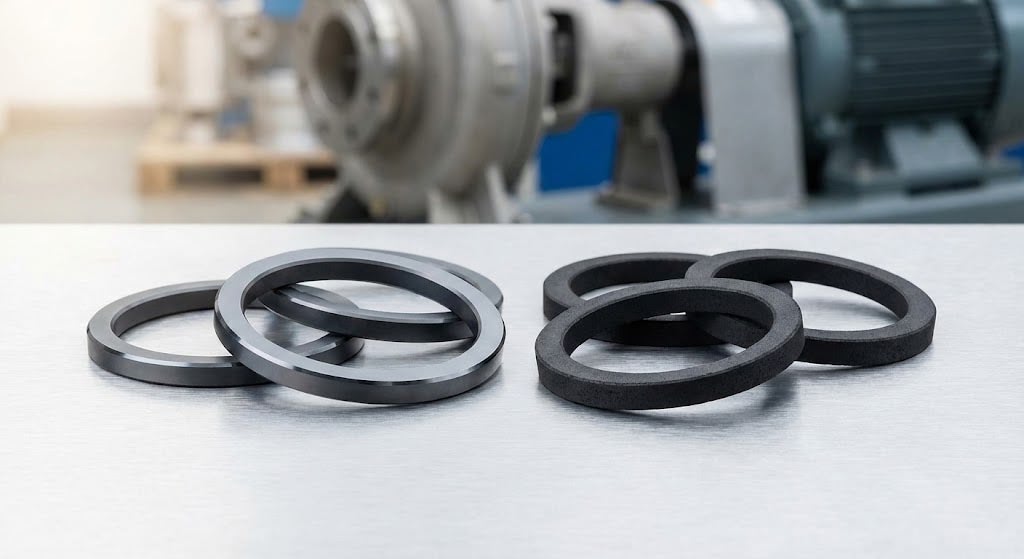
A typical mechanical seal uses a pair of faces running against each other: usually one softer, self-lubricating face (often carbon graphite) and one harder, wear-resistant face (ceramic, SiC, tungsten carbide, etc.).
The logic is simple:
- Carbon graphite provides good conformability, emergency running capability, and lubrication in boundary or dry-running situations.
- Silicon carbide provides high hardness, excellent wear resistance, and strong chemical/thermal stability.
You rarely choose between “all carbon” vs “all SiC.” Instead, you choose which face is carbon and which is SiC, or whether to use SiC–SiC pairs in aggressive duties.
Key property comparison: carbon graphite vs silicon carbide
At the material level, carbon graphite and SiC are very different:
| Property | Carbon Graphite | Silicon Carbide (SiC) | Practical impact in seals |
|---|---|---|---|
| Hardness | Low to medium | Very high | SiC resists abrasion; carbon runs in and conforms to the counterface. |
| Self-lubrication | Excellent (graphitic structure) | None by itself | Carbon survives brief dry-running; SiC surfaces rely on fluid film. |
| Thermal shock resistance | Good | Excellent (grade-dependent) | Both can handle rapid changes; SiC maintains higher strength. |
| Chemical resistance | Good, but depends on binder and fluid | Very high in many acids, alkalis, and hot fluids | SiC is preferred in highly aggressive media. |
| Wear resistance | Moderate; can wear faster under solids | Excellent, even with solids and high PV | SiC extends seal life in dirty or abrasive services. |
| Thermal conductivity | Medium | High | SiC conducts heat away from the interface more efficiently. |
| Density | Low | Higher (still lower than many metals) | Both are fine for rotating parts; inertia rarely limits choice. |
| Typical cost level | Lower | Higher | Carbon is cheaper per ring; SiC wins where downtime is costly. |
Put simply: carbon graphite is forgiving; silicon carbide is durable. The right combination depends on what actually kills seals in your equipment.
Pros and cons of carbon graphite mechanical seals
Advantages of carbon graphite
- Self-lubricating: Graphite’s layered structure gives excellent dry-running and boundary lubrication.
- Good emergency running capability: Carbon can survive short periods of poor lubrication better than hard ceramics.
- Conformability: It can run in against the harder face, accommodating minor misalignment or distortion.
- Lower friction coefficient: Carbon vs hard face often yields low friction under typical seal conditions.
- Lower cost: Both raw material and finished rings are generally cheaper than advanced ceramics.
Limitations of carbon graphite
- Wear rate: In dirty, abrasive, or high-PV service, carbon faces can wear quickly.
- Strength: Mechanical strength is limited, especially at higher temperatures.
- Chemical sensitivity: Some binders and impregnations are attacked by certain chemicals.
- Contamination risk: Worn carbon can add particles into the process fluid.
Carbon graphite works well in clean, well-lubricated, moderate-duty seals, and as the softer face against a hard counterface.
Pros and cons of silicon carbide mechanical seals
Advantages of silicon carbide
- Extreme hardness: Excellent wear resistance, even with solids in the fluid.
- High-temperature capability: Suitable for hot pumps and aggressive services.
- Outstanding chemical resistance: Especially in acids, alkalis, and mixed media.
- High thermal conductivity: Helps to dissipate heat from the seal interface.
- Dimensional stability: Maintains flatness and geometry under load and temperature.
Limitations of silicon carbide
- Brittle fracture mode: Not tolerant of hard mechanical impact, misalignment, or severe vibration.
- No self-lubrication: Relies on proper fluid film and seal design to avoid dry-running damage.
- Higher cost: Material and finishing (precision lapping) are more expensive than carbon.
For harsh chemical, high-temperature, or abrasive applications, SiC seal rings usually deliver much longer service life than carbon-only solutions. Zirsec provides custom silicon carbide components that can be integrated into existing seal designs through its customization program.
Common face pair combinations
In practice, most seals use material pairs rather than “pure carbon” or “pure SiC” on both sides:
- Carbon vs Silicon Carbide
The most common industrial pairing. Carbon provides conformability and lubrication; SiC provides a hard, wear-resistant counterface. - Carbon vs Tungsten Carbide
Used where very high mechanical shock or load is expected; tungsten carbide is tougher but heavier. - SiC vs SiC
Used in highly abrasive or very corrosive service, often with carefully controlled lubrication and alignment. - Carbon vs Carbon
Selected for some low-pressure, clean services where cost and emergency running capability are key.
For aggressive industry environments, SiC almost always appears as at least one of the faces in the final design.
When carbon graphite is the better choice
Despite the hype around ceramics, carbon graphite still has a strong role in mechanical seals. It is often the better choice when:
- Process fluid is clean and lubricating (e.g. light oils, some water-based fluids).
- Operating conditions are moderate in pressure, speed, and temperature.
- Short periods of dry-running or starved lubrication are likely during start/stop.
- Seals are relatively easy and cheap to access for planned maintenance.
- Project is cost-sensitive and downtime impact is limited.
In such cases, a carbon vs hard-face design remains a cost-effective, robust solution.
When silicon carbide outperforms carbon graphite
Silicon carbide starts to show clear advantages in harder operating envelopes:
- Abrasive slurries and dirty fluids: Solids quickly wear carbon; SiC maintains a flat, hard surface for much longer.
- High-PV (pressure × velocity) duty: High sliding speed and pressure favor a hard, thermally conductive surface.
- Hot and corrosive media: Where chemistry plus temperature attack carbon or its binder.
- Critical service where failure is very costly: Production-critical pumps, hazardous fluids, or remote installations.
For chemical processing, petrochemicals, power plants, and seawater systems, upgrading seals to silicon carbide faces (or SiC–SiC pairs with appropriate design) often reduces total failures and unplanned outages.
Real-world example: upgrading a chemical pump seal
Consider a chemical process pump handling a hot, slightly abrasive, and corrosive medium:
- Original seal: carbon vs ceramic or carbon vs metal face.
- Observed problems: rapid wear of the carbon face, increased leakage, frequent seal replacement.
After upgrading to a carbon vs SiC or SiC vs SiC configuration:
- Wear rate of the hard face drops dramatically.
- Seal life extends to match planned maintenance cycles.
- Emergency seal failures and leakage incidents are reduced.
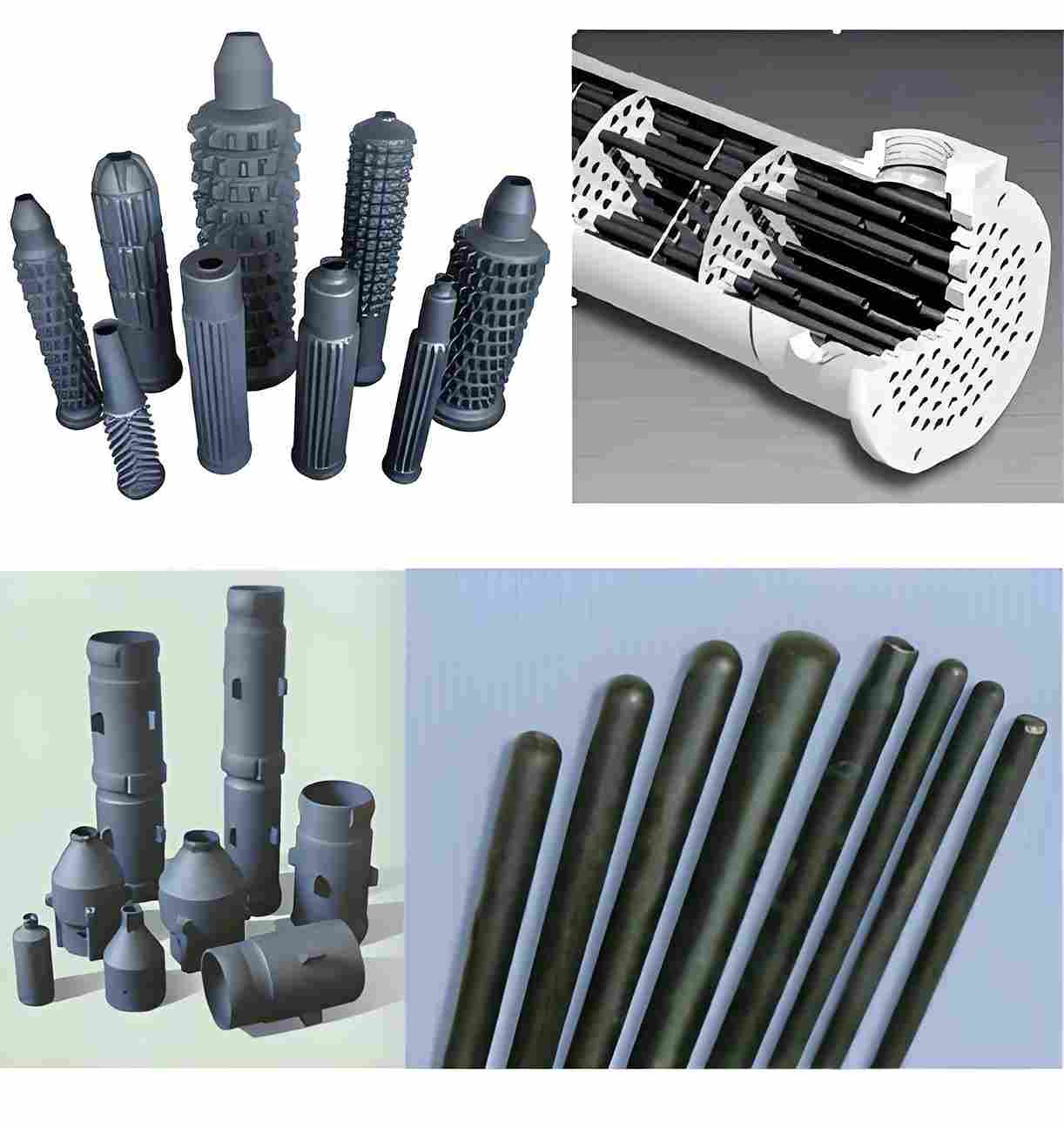
For even higher reliability, related components (such as sleeves and bushings) can also be converted to SiC, similar to how silicon carbide tubes are used in high-temperature and corrosive systems for better lifetime.
Decision checklist: carbon graphite vs silicon carbide seals
Use this checklist before locking in seal face materials:
- Does the fluid contain hard solids or fine abrasives?
- Is the seal subject to high sliding speeds and pressures (high PV)?
- Are temperatures elevated enough to risk carbon degradation or binder breakdown?
- Is the fluid chemically aggressive (acids, alkalis, solvents, hot brine, etc.)?
- How expensive is an unplanned seal failure in terms of downtime and cleanup?
- Is occasional dry-running unavoidable during start-up or shutdown?
As a rough rule:
- If conditions are mild to moderate and dry-running risk is high → carbon graphite must remain part of the pair.
- If conditions are harsh, abrasive, or critical → silicon carbide should be strongly considered for at least one face, and sometimes both.
How Zirsec supports SiC seal ring projects
Moving from standard carbon-based seals to silicon carbide is not just about buying a different ring. You need:
- Correct SiC grade (sintered, reaction-bonded, etc.) for your fluid and temperature.
- Proper geometry and flatness for your seal design.
- Clear understanding of running conditions, including possible dry-running.
Zirsec supports this with:
- Engineering consultation based on your pump data and failure history.
- Custom-machined SiC rings adapted to existing seal cartridges.
- Fast sampling and small-batch production so you can validate the upgrade in the field.
If your current carbon graphite seals are wearing out too fast, or you are fighting repeated leakage and unplanned maintenance, it is a strong sign that silicon carbide mechanical seal rings should be evaluated. Starting with one critical pump and tracking the lifetime improvement is usually the most efficient way to prove the case.