OEM designers do not get judged on how stylish their drawings look. They get judged on uptime, warranty claims, and how often the field service team calls them at 3 a.m. That is exactly where silicon carbide ceramic components start to matter: higher temperature windows, more predictable life, and fewer ugly surprises in harsh service. This overview is written for OEM design engineers and product managers who want a realistic, system-level view of where SiC components make sense, where they do not, and how to specify them without guesswork.
We will look at what silicon carbide ceramic components are, how they compare to metals and basic refractories, selection criteria, main product families, and integration best practices. Throughout, the focus is on components typically used in high-temperature furnaces, chemical processing, pumps, and industrial machinery.
What Are Silicon Carbide Ceramic Components in OEM Design?
Silicon carbide (SiC) is a high-performance ceramic material combining very high hardness, high thermal conductivity, low thermal expansion, and excellent chemical and oxidation resistance. As an engineered material, it has been used in technical applications for decades, from abrasives to high-temperature structural parts. A good general introduction to the material itself can be found in the silicon carbide article.
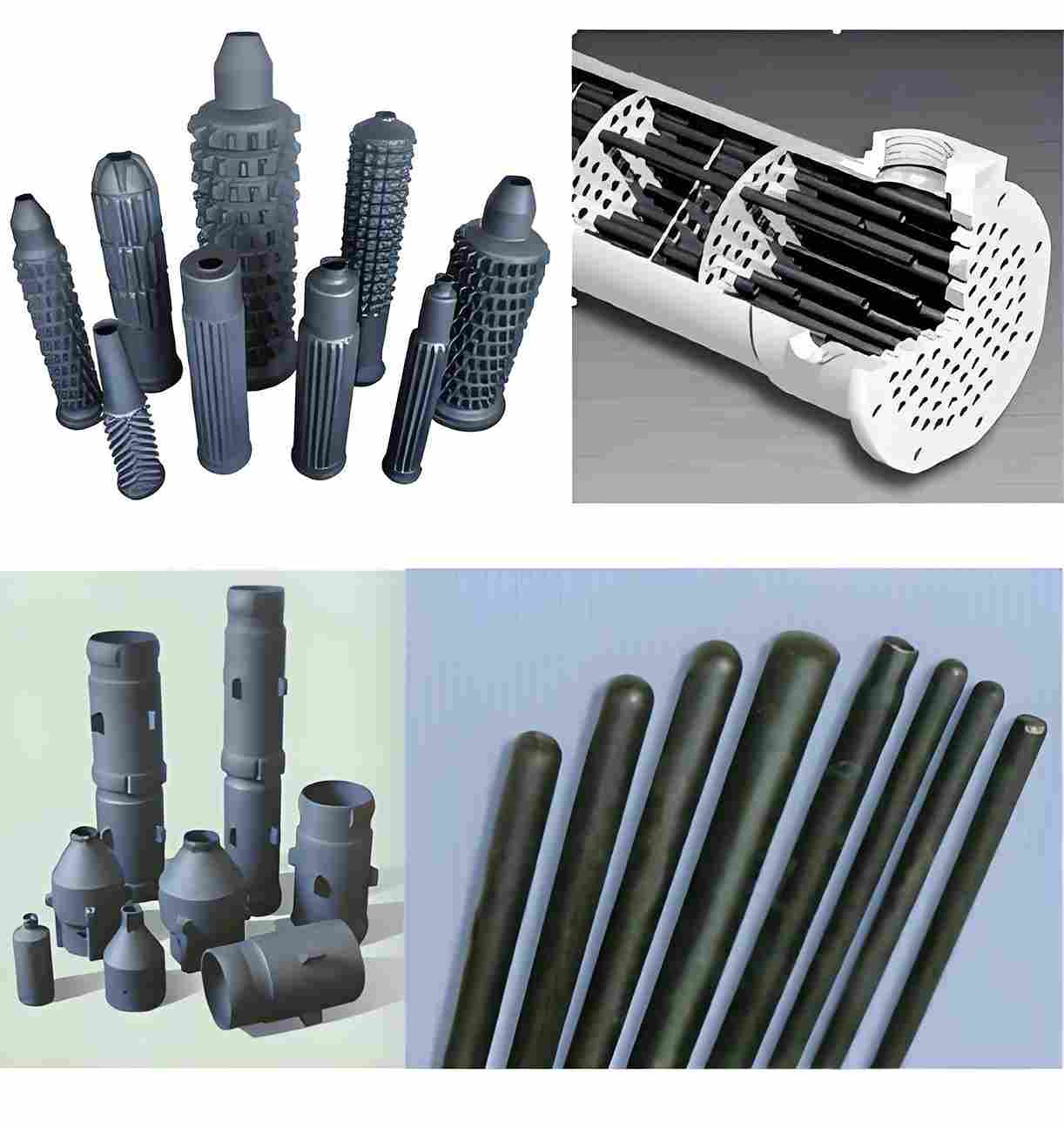
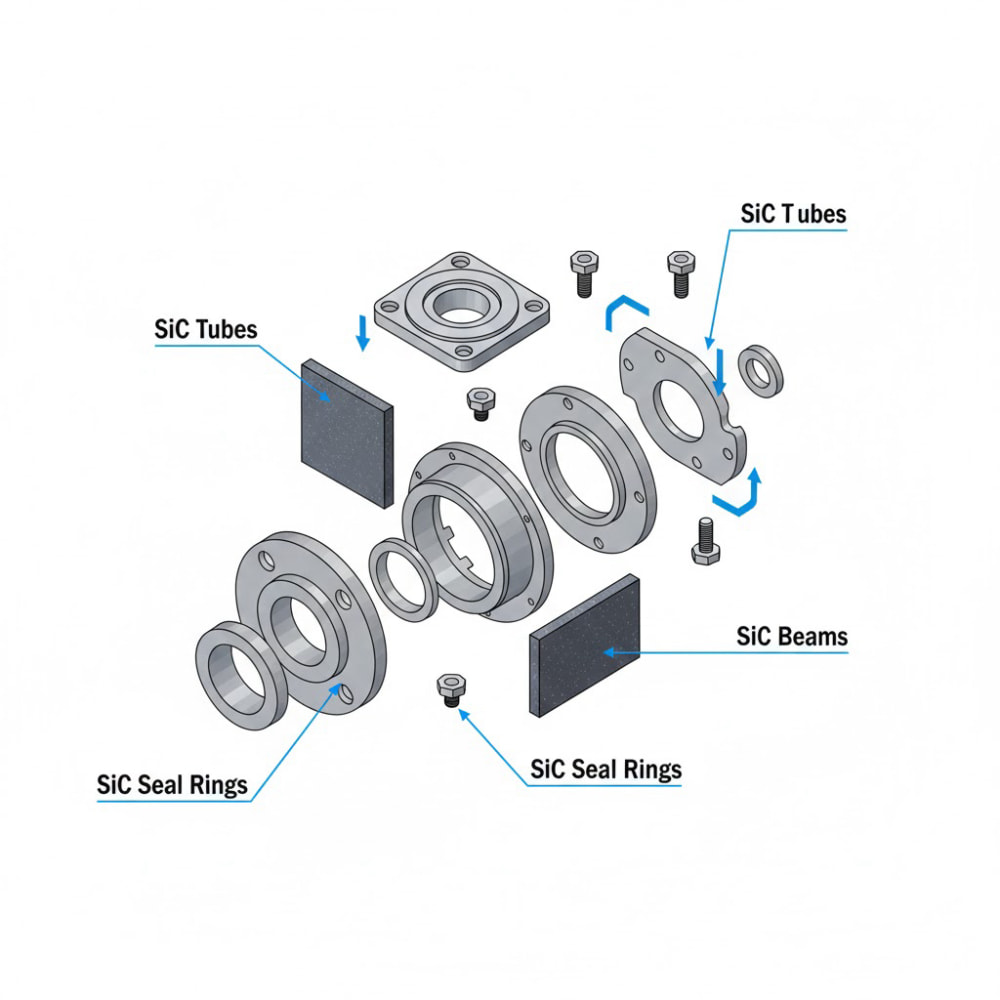
For OEM designers, “silicon carbide ceramic components” usually means a family of parts including:
- tubes and radiant tubes for high-temperature industrial furnaces,
- plates, beams, and posts for kiln linings and kiln furniture,
- seal rings and faces for pumps and rotating equipment,
- burner nozzles, burner blocks, and flame tubes,
- rollers, guides, and wear parts for handling hot products,
- custom structural parts in aggressive thermal and chemical environments.
Zirsec groups these products into dedicated SiC types and application families on the Zirsec Types overview and related application pages for high-temperature furnaces and chemical processing. The components are not “decorations” for a design; they are structural and functional parts that directly influence performance, lifetime, and safety.
Where Traditional Metals and Basic Ceramics Struggle
Before choosing silicon carbide, it is useful to be very clear about what usually goes wrong with conventional materials in demanding environments:
- Creep and sagging: heat-resistant alloys and low-grade ceramics deform gradually under load at high temperature, changing geometry, clearances, and heat distribution.
- Oxidation and scaling: metallic components in oxidizing or carburizing atmospheres form scale that reduces heat transfer, contaminates product, and accelerates crack initiation.
- Thermal shock failure: basic refractories and standard ceramics crack when exposed to aggressive heat-up and cool-down cycles or local hot spots.
- Chemical attack and corrosion: aggressive process gases, fluxes, slags, or liquids attack metals and simple ceramics, leading to thinning, leakage, or dimension loss.
- Wear and abrasion: sliding contact with solids, slurries, or product under high temperature causes rapid wear on softer materials.
- Unstable service life: the same design behaves very differently from one line or plant to another, making it difficult to predict replacement intervals and warranty exposure.
Silicon carbide components exist precisely to push past these limits. They offer a different trade-off: higher material and manufacturing cost, in exchange for higher performance, longer and more predictable lifetime, and higher safe operating windows.
Key Benefits of Silicon Carbide Components for OEM Designers
From an OEM perspective, silicon carbide is not just “stronger” or “more heat resistant.” It offers specific advantages that map directly to design and business metrics.
- Higher temperature capability: SiC components remain mechanically reliable at temperatures where many alloys and basic ceramics cannot operate safely.
- Better thermal shock resistance: correctly selected SiC grades survive frequent thermal cycles and upset conditions without the sudden cracking seen in brittle oxide ceramics.
- High thermal conductivity: efficient heat transfer enables shorter cycle times in furnaces and more uniform temperature profiles.
- Low thermal expansion: reduced thermal stress and distortion as the component heats and cools, supporting tighter tolerances at temperature.
- Excellent wear and corrosion resistance: high hardness and chemical stability make SiC ideal for abrasive and corrosive services (for example, seal rings in chemical pumps).
- Lower mass for a given stiffness: SiC plates and beams can be made thinner and lighter than traditional refractory equivalents while carrying similar or higher loads.
- Predictable, documentable life: when design and operating windows are clearly defined, SiC components often deliver consistent, repeatable campaigns, making it easier to plan service intervals.
For OEM designers, these benefits translate into longer warranty periods, fewer field issues, higher efficiency, and stronger differentiation in the market.
Selection Criteria for Silicon Carbide Ceramic Components
Choosing SiC components should follow a structured, engineering-driven process. The checklist below can be used across tubes, plates, beams, seal rings, and other parts.
1. Application, Function, and Environment
- Component function: structural support, thermal barrier, radiant element, seal, wear surface, or fluid conduit.
- Operating environment: furnace hot zone, chemical reactor, pump seal chamber, external atmosphere, or submerged service.
- Atmosphere and media: air, oxidizing or reducing gases, process gas mixtures, molten metal, chemical liquids, slurries, or solids.
Clarifying what the component actually does in the system is the starting point. A radiant tube, a kiln plate, and a pump seal ring all use SiC, but are optimized very differently.
2. Temperature, Heat Flux, and Thermal Cycling
- Maximum temperature: realistic operating maximum and possible excursions.
- Temperature gradients: between hot face and cold face, along the length, and through thickness.
- Heat flux: power per unit area, especially for radiant tubes and furnace elements.
- Cycling profile: continuous or batch, number of cycles, ramp rates, and emergency conditions.
Different SiC grades (reaction-bonded, recrystallized, sintered, nitride-bonded) handle temperature and thermal shock differently. Matching grade to real thermal conditions is essential.
3. Mechanical Loads and Structural Design
- Static loads: self-weight, product weight, internal pressure, and external pressure.
- Dynamic loads: vibration, acceleration, movement of kiln cars, flow-induced forces.
- Supports and spans: distances between supports, support stiffness, and how loads are applied (line vs point contact).
Silicon carbide has excellent strength, especially at high temperature, but it is still a ceramic. Structural design must avoid tensile stress peaks and point loads; plates and beams should be designed for controlled deflection, not zero deflection.
4. Geometry, Tolerances, and Interfaces
- Dimensions and complexity: simple tubes and plates vs. complex 3D geometries.
- Tolerances: dimensional tolerances at ambient and at operating temperature.
- Interfaces: joints to metal structures, seals, or other ceramics; differential expansion between materials.
OEM designers must consider how SiC components are anchored into the larger system. Allowing for thermal expansion of surrounding steel structures, and avoiding rigid over-constraints, is critical for long life.
5. Surface Finish, Purity, and Cleanliness
- Surface roughness: smoother surfaces for seal faces and wear parts; defined textures where bonding or friction is required.
- Material purity: high-purity SiC for clean applications (e.g., technical ceramics, battery materials) vs. standard grades for general furnace duty.
- Contamination risk: interaction with product (for example, metal pick-up, carbides, or unwanted reaction layers).
Zirsec can adjust SiC grades and surface conditions to align with contamination and cleanliness requirements, especially in high-value product lines.
6. Cost and Lifecycle Metrics
- Target lifetime: required hours, cycles, or campaigns per component set.
- Impact of failure: safety risk, product scrap, and downtime cost.
- Total cost of ownership: including energy, maintenance, and lost production, not just part price.
Silicon carbide components make the most sense where lifetime, uptime, and performance matter more than lowest initial cost. OEM proposals can reflect this by explicitly comparing lifecycle cost scenarios for metal vs. SiC designs.
Product Families and Specifications in the Zirsec Portfolio
Zirsec organizes silicon carbide ceramic components into focused product families. A subset is highlighted here; a fuller picture is available on the Zirsec Types overview.
Silicon Carbide Crucibles and Plates
SiC crucibles and plates are used in non-ferrous metal melting, holding furnaces, and high-temperature process lines. Typical components include:
- low-mass crucibles for aluminum and copper alloys, optimized for thermal efficiency and life,
- kiln plates and shelves for kiln car decks and kiln furniture, balancing low mass and high stiffness.
A dedicated overview of SiC crucibles is available on the silicon carbide crucibles page.
Silicon Carbide Beams, Posts, and Structural Parts
Beams, posts, and complex structural components made from SiC are used to support kiln furniture, product loads, and furnace internals. Key characteristics:
- high strength and stiffness at temperature for long spans and heavy loads,
- good resistance to thermal shock and cycling,
- compatibility with plates and other furniture elements for complete kiln and furnace layouts.
Silicon Carbide Tubes
SiC tubes serve as radiant tubes in gas-fired furnaces, protection tubes for thermocouples, and process tubes for controlled atmospheres. Typical design targets:
- high allowable wall temperature and heat flux,
- controlled straightness and dimensional stability,
- material grades tuned for oxidation resistance and thermal shock behavior.
Silicon Carbide Seal Rings and Faces
In pumps and rotating equipment, silicon carbide seal rings provide robust sealing performance in aggressive liquids and slurries. Typical features:
- high hardness and wear resistance for abrasive and slurry services,
- excellent corrosion resistance in acids, alkalis, and solvents,
- precise flatness and surface finish for stable mechanical seal performance.
A more detailed description is available on the SiC sealing rings product page, with application details for chemical processing.
Custom Silicon Carbide Components
OEM designers frequently require shapes that do not exist in catalogues: integrated burner blocks, combined structural and radiant elements, complex wear parts, or multi-function fixtures. Zirsec can supply custom SiC components that:
- follow OEM drawings, including tight tolerances where needed,
- combine several functions into a single, optimized part,
- are validated with application-focused testing where life and safety are critical.
Applications and Use Cases Across Industries
Silicon carbide components are rarely used in isolation. They typically come as part of a system in specific applications. Common examples include:
- High-temperature industrial furnaces: SiC tubes, plates, beams, and burner components used in continuous and batch furnaces, as outlined in high-temperature furnace applications.
- Chemical processing equipment: SiC seal rings, liners, and structural parts in pumps, mixers, and reactors exposed to aggressive media, summarized under chemical processing applications.
- Non-ferrous metal processing: SiC crucibles, launders, and transfer components for melting and holding of aluminum, copper, and other non-ferrous metals.
- Advanced ceramics and materials: kiln furniture systems based on SiC plates and beams for technical ceramics, battery materials, and electronic substrates.
- Wear and guide components: rollers, guides, and wear blocks in environments where high temperature and abrasion come together.
Each of these application areas puts a different combination of thermal, mechanical, and chemical stress on the component set. The same base materials can be tuned to multiple roles, but only when selection criteria are handled carefully at the design stage.
Integration and Co-Design Support for OEM Designers
Silicon carbide components work best when they are part of the design from the beginning, not an afterthought. Zirsec supports OEM designers with:
- Concept and layout reviews: assessing how SiC components integrate into furnace lines, pump designs, or process equipment, including expansion allowances and support conditions.
- Material and grade selection: mapping operating windows to specific SiC grades and bonding types.
- Prototyping and pilot runs: small-batch production for first builds and test lines, combined with basic monitoring plans (temperature, deformation, wear, and failure modes).
- Reliability and lifecycle modeling: translating material and test data into expected life distributions and replacement intervals for inclusion in OEM documentation.
- Documentation and quality: inspection records and certificates supporting OEM quality systems and customer approvals.
For OEMs, this kind of co-design support turns SiC components from a “special material purchase” into a documented, defensible design decision that can be explained to end users and internal stakeholders.
FAQs: Silicon Carbide Ceramic Components for OEM Designers
1. When does it make sense to switch from metal to silicon carbide components?
The switch usually makes sense when temperature, corrosion, wear, or thermal cycling push metals close to their limits, and when failures are costly in terms of downtime or safety. If your current design suffers from frequent tube failures, sagging supports, seal leakage, or unpredictable life, it is worth building a comparison based on lifecycle cost rather than part cost.
2. Can silicon carbide parts be machined like metals?
No. SiC is a hard ceramic and is not machined with standard metalworking tools. Geometry and tolerances are usually set during forming and firing, with grinding or lapping used where needed (for example, on seal faces). This means complex features and very tight tolerances should be discussed early in the design phase.
3. How do I handle joints between silicon carbide and steel structures?
The key principles are avoid over-constraint and allow relative movement. Joints should allow SiC to expand and contract without being clamped rigidly by steel. Sliding supports, compliant layers, and properly sized clearances are standard techniques to avoid stress concentrations at interfaces.
4. What information does Zirsec need to recommend a SiC component?
In practice, a simple data set is enough to start:
- component function and location in the system,
- temperature profile and atmosphere,
- mechanical loads and support conditions,
- required dimensions, tolerances, and lifetime targets,
- known failure modes of current designs (if any).
With this, Zirsec can quickly indicate whether SiC is a good candidate and which material families and geometries are most promising.
5. Are there minimum order quantities for custom SiC components?
There is usually a practical minimum, driven by tooling, forming, and firing economics. However, for strategic OEM projects and new furnace or equipment platforms, pilot-scale batches are common, especially when accompanied by a clear roadmap to serial production.
6. How should I present SiC components in OEM documentation and datasheets?
Treat SiC components as standardized, engineering-grade parts: list material grade, maximum operating conditions, and expected life in clear, conservative terms. Where needed, reference internal test data or supplier documentation. This approach helps sales and service teams explain the design choices and support warranty decisions.
7. How do I compare cost between SiC designs and conventional designs?
Build a simple model that includes:
- part cost per piece and per replacement event,
- expected lifetime and variability,
- downtime cost per failure,
- energy and efficiency impact (for thermal systems).
When you move from “price per part” to “cost per operating hour or per ton processed,” silicon carbide designs often become competitive or clearly superior, especially in harsh or high-value applications.
Get a Silicon Carbide Component Roadmap for Your Platform
If you are considering silicon carbide components for a new equipment platform or as an upgrade to existing designs, the most efficient path is to combine your real operating data with the Zirsec SiC portfolio. Start from the Zirsec Types overview and the relevant application pages such as High-Temperature Furnace Applications and Chemical Processing Applications, then align these with your own design requirements.
A short, structured design brief covering function, temperatures, loads, atmosphere, and lifetime targets is usually enough for Zirsec’s engineering team to sketch a practical silicon carbide component roadmap for your OEM platform. From there, the step to prototypes, pilot lines, and catalog-ready designs is an engineering exercise, not a gamble.