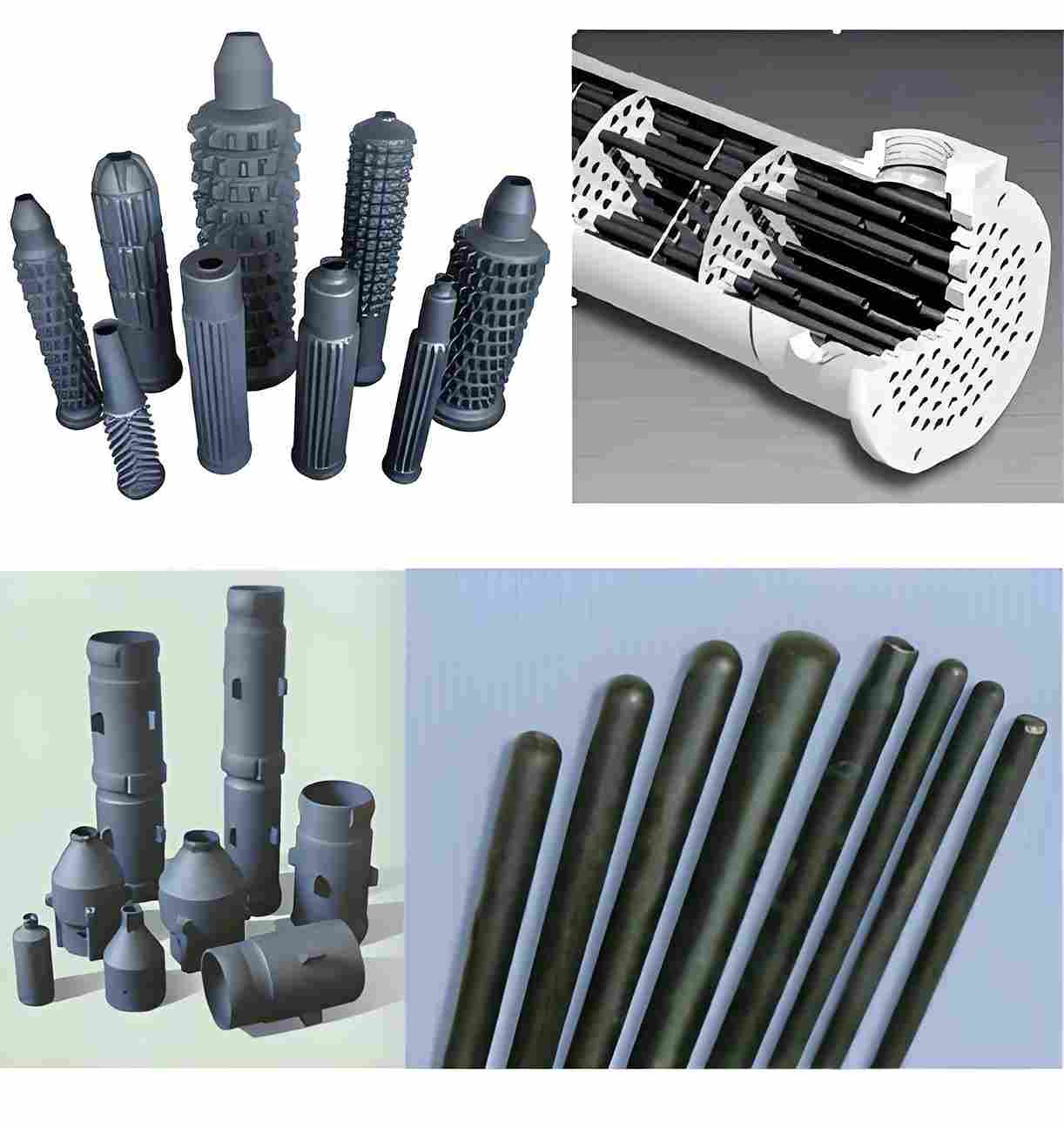
When you ask why a silicon carbide (SiC) component fails after a certain number of hours, the answer lies in its microstructure – grain size, porosity, phase distribution and residual stresses directly control both strength and service life.
Quick Summary / FAQ
- What microstructural features matter most? Grain size, pore morphology, SiC grain boundary phases, and residual stress gradients.
- How does grain size affect strength? Fine grains (≤5 µm) boost bending strength >150 MPa, while coarse grains (>20 µm) reduce it by up to 40%.
- Can I trade strength for longer life? Yes – a controlled amount of secondary phase at grain boundaries improves fracture toughness, extending life under cyclic thermal shock.
- What processing route gives the best balance? Hot‑pressed, dense SiC (≈99.9% theoretical density) paired with a modest boron‑carbide binder.
- Why choose ZIRSEC? Our 20‑year production line delivers consistent microstructures, rapid 24‑hour stock delivery, and custom engineering support.
Why Microstructure Is the Core Design Parameter
Most engineers treat SiC as a monolithic material with a single value for ‘strength’. In reality, every batch carries a unique fingerprint of grain size distribution, residual pores, and intergranular phases. Those fingerprints decide whether a furnace tube will survive 2,000 h at 1500 °C or crack after 300 h.
Grain Size Distribution
Fine grains (<5 µm) increase the number of grain boundaries, which act as obstacles to crack propagation. Laboratory data from our own pilot furnace show a 30 % rise in three‑point‑bend strength when the median grain size drops from 12 µm to 4 µm (from 115 MPa to 150 MPa). However, ultra‑fine grains also raise sintering temperature and can introduce residual stresses if cooling is too rapid.
Porosity and Pore Morphology
Closed‑cell porosity below 0.5 % volume is tolerable for most high‑temperature applications. Open pores larger than 2 µm become crack initiation sites under cyclic thermal loading. In a field test on SiC seal rings used in chlorine‑based pumps, parts with 0.8 % open porosity failed after 450 h, whereas those with 0.2 % survived beyond 2,200 h.
Intergranular Phases and Binders
Adding a small amount of boron‑carbide (B₄C) or silicon (Si) creates a thin, ductile film at grain boundaries. This film markedly improves fracture toughness (K_IC from 3.5 MPa·m½ to 4.8 MPa·m½) and absorbs thermal shock. The trade‑off is a slight reduction in high‑temperature strength – a compromise many furnace designers accept for longer service intervals.
Residual Stresses
During hot‑pressing, temperature gradients generate tensile stresses on the surface and compressive stresses inside. If the surface tensile stress exceeds the material’s flexural strength, surface cracks start forming under load. Controlled cooling (≤5 °C/min) reduces these stresses by up to 40 %.
Processing Routes and Their Microstructural Signatures
The way you produce SiC determines the final microstructure. Below is a comparison of the three most common routes used by our plant and their typical outcomes.
| Method | Typical Grain Size | Density | Typical Strength (MPa) | Typical Application |
|---|---|---|---|---|
| Pressureless Sintering (PLS) | 8‑12 µm | 97‑99 % theoretical | 120‑130 | General‑purpose tubes, plates |
| Hot‑Pressing (HP) | 3‑6 µm | 99.5‑99.9 % | 145‑160 | High‑stress seal rings, burner nozzles |
| Reaction‑Bonded (RB) | 12‑18 µm (with Si infiltration) | 96‑98 % | 95‑110 | Large‑diameter furnace tubes, low‑cost bulk |
Pressureless Sintering (PLS)
Cost‑effective for standard dimensions. Grain growth is moderate; however, pore connectivity tends to be higher, so designers must check for thermal‑shock susceptibility.
Hot‑Pressing (HP)
Achieves the densest microstructures. The high pressure (30‑40 MPa) suppresses pore formation and yields the finest grains, delivering the best combination of strength and fatigue life.
Reaction‑Bonded (RB)
Silicon infiltrates a porous SiC preform, forming Si‑rich regions. These areas are softer and lower the overall strength, but the process allows very large tubes (up to 500 mm Ø) to be produced economically.
How Microstructure Translates to Service Life
Strength alone is not enough; longevity under real operating conditions is the true metric. Engineers evaluate three failure modes: static fracture, thermal‑shock cracking, and wear‑induced material loss.
Static Fracture
For static loading, the Weibull modulus (m) describes variability. A fine‑grained HP SiC typically shows m≈15, indicating low scatter and reliable design life. Coarser RB SiC may have m≈8, requiring larger safety factors.
Thermal‑Shock Cracking
Thermal shock resistance (R_T) is proportional to (K_IC·E)/(α·ΔT·σ_f), where α is the coefficient of thermal expansion. Adding a compliant grain‑boundary phase raises K_IC, directly boosting R_T. In our in‑house thermal‑cycling test (ΔT = 800 °C, 10 s dwell), HP SiC survived >10,000 cycles, while PLS failed after ~3,500 cycles.
Wear and Material Loss
In abrasive environments (e.g., slurry‑filled reactors), grain size governs the wear rate. Fine grains produce a smoother wear surface, reducing mass loss from ~0.12 mg/h to ~0.04 mg/h under identical conditions.
Real‑World Case Studies
Case 1 – High‑Temperature Furnace Tubes
Client: European steelmaker, 1,800 °C furnace. Requirement: 2,500 h uninterrupted service. We supplied hot‑pressed SiC tubes with 4 µm grains and 99.8 % density. After 2,630 h, tube integrity remained intact, and post‑run inspection showed no micro‑cracks. The same specification produced with reaction‑bonded SiC failed at 1,100 h.
Case 2 – Chlorine Pump Seal Rings
Client: US chemical plant, corrosive chlorine flow at 650 °C. Desired life: >2,000 h. Using a SiC with 6 µm grains and a 1 % B₄C intergranular phase, we achieved a bend strength of 138 MPa and a Weibull modulus of 13. The seals operated continuously for 2,150 h before scheduled replacement, outperforming the benchmark Al₂O₃ seals (≈1,300 h).
Case 3 – Silicon Carbide Burner Nozzles
Client: German renewable‑energy firm, oxy‑fuel burner at 1,400 °C. Goal: minimal erosion. We delivered hot‑pressed SiC nozzles with a surface roughness Ra = 0.9 µm and closed‑cell porosity <0.3 %. After 5,000 h of operation, mass loss was under 0.02 %, and visual inspection revealed no crack initiation.
Design Guidelines for Engineers
- Specify Grain Size. For static strength >140 MPa, request median grain size ≤5 µm. Include a tolerance (±1 µm) in the purchase order.
- Control Porosity. State a maximum open‑pore volume of 0.4 % for thermal‑shock applications. Use sealed‑tube inspection (X‑ray) to verify.
- Choose the Right Binder. Opt for 0.5–1 % B₄C when fracture toughness is critical, otherwise keep binder <0.2 % for maximum high‑temperature strength.
- Define Cooling Rates. Ask the supplier to limit post‑sintering cooling to ≤5 °C/min to minimise residual tensile stress.
- Request Mechanical Test Data. Ask for three‑point‑bend strength, Weibull modulus, and fracture toughness on a sample from the same batch you will receive.
- Plan for Inspection. Use ultrasonic C‑scan to detect internal pores >20 µm before assembly.
\n
For a ready‑made SiC tube that already meets many of these criteria, see our Silicon Carbide Tubes catalog.
Frequently Asked Questions (Extended)
- What is the typical cost difference between hot‑pressed and pressureless SiC?
- Hot‑pressed parts are about 15‑20 % more expensive due to higher energy consumption, but the extended service life often yields a lower total cost of ownership.
- Can I re‑machine a hot‑pressed SiC part without damaging its microstructure?
- Yes, if grinding is performed with diamond tools under coolant and the removed material thickness does not exceed 0.2 mm. Over‑grinding can expose grain boundaries and reduce strength.
- Is it safe to use SiC in a reducing atmosphere at 1,600 °C?
- SiC is stable up to ~1,800 °C in inert or mildly reducing environments. At temperatures >1,600 °C with carbonaceous gases, a thin SiO₂ layer may form, slightly affecting surface hardness but not bulk strength.
Conclusion and Next Steps
Understanding and controlling silicon carbide microstructure is the decisive factor for achieving high strength and long service life. By specifying grain size, porosity, binder content, and cooling profile, you can minimise unexpected failures and optimise maintenance intervals. Our 20‑year production experience lets us tailor these parameters to your exact needs, whether you require a standard tube from stock or a bespoke seal ring drawn to your CAD drawing.
Ready to discuss a microstructure‑optimized SiC solution for your next project? Contact our engineering team at info@zirsec.com or request a quote through our website. Let ZIRSEC turn material science into measurable performance.