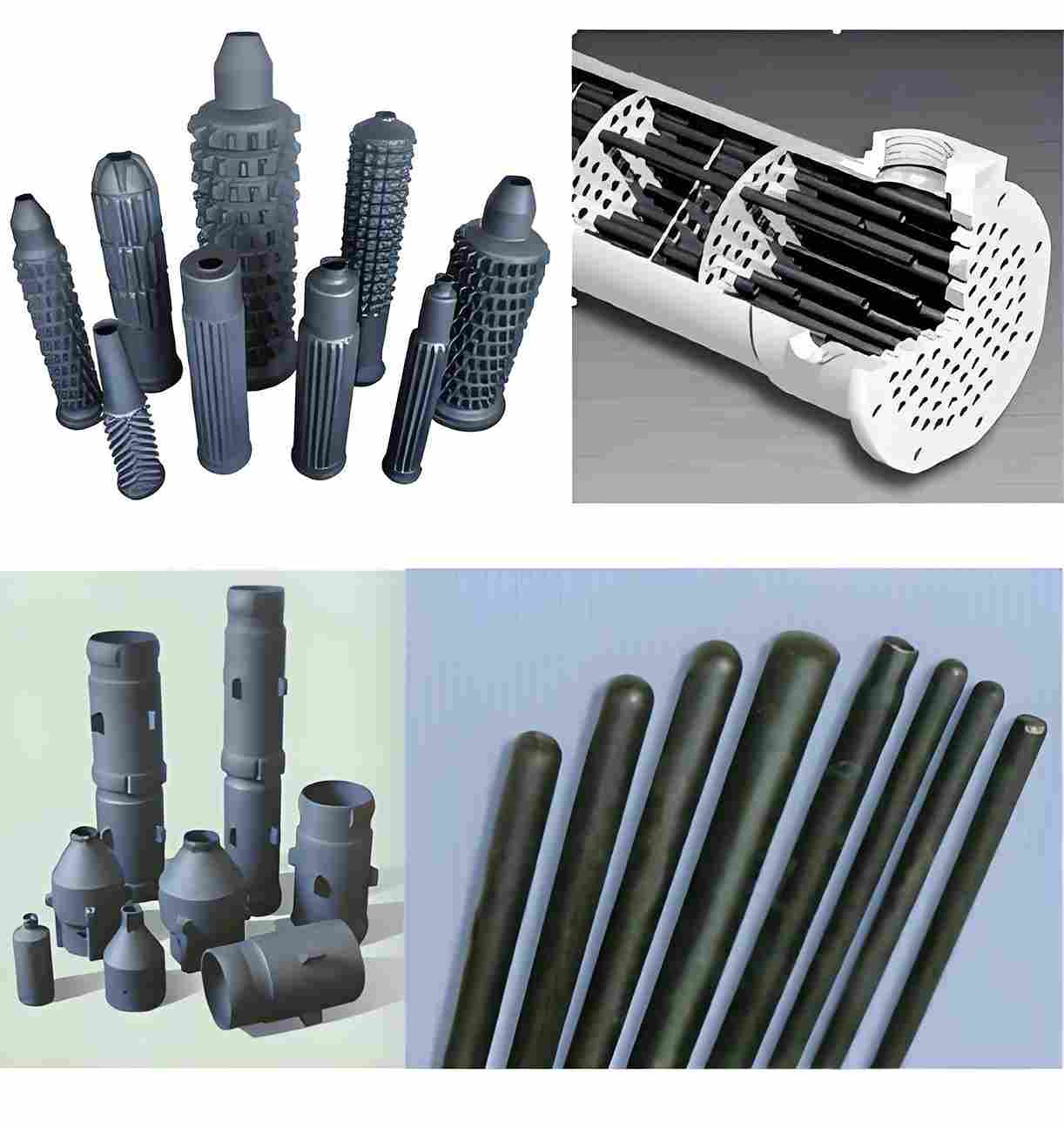
When you need to decide between sintered and reaction‑bonded SiC for a high‑temperature component, the answer hinges on three factors: performance, cost, and manufacturability.
Quick Summary (FAQ)
- Which SiC type offers higher flexural strength? Sintered SiC – typically 250‑400 MPa, versus 150‑250 MPa for reaction‑bonded.
- Which is more cost‑effective for large‑batch furnace tubes? Reaction‑bonded SiC – lower material cost and faster production.
- Can I get tight dimensional tolerances (< ±0.1 mm) with both? Only sintered SiC reliably meets that tolerance without secondary machining.
- What about thermal shock resistance? Reaction‑bonded SiC’s porous structure absorbs thermal gradients better, making it superior for rapid temperature cycling.
- Is there a clear winner for wear‑critical pump seals? Sintered SiC due to its higher hardness and wear resistance.
1. Material Fundamentals
1.1 Sintered Silicon Carbide
Sintered SiC is produced by hot‑pressing or pressureless sintering of high‑purity SiC powders (typically ≥98% SiC). The process uses a small amount of sintering aid (often Al₂O₃‑Y₂O₃) and temperatures above 2100 °C. The resulting microstructure is dense (porosity <0.5%), giving the material its renowned strength, high Young’s modulus (≈410 GPa), and low thermal expansion (≈4.0 × 10⁻⁶ /K).
1.2 Reaction‑Bonded Silicon Carbide (RB‑SiC)
RB‑SiC starts from a carbon preform that is infiltrated with molten silicon at 1500‑1600 °C. The silicon reacts with carbon to form SiC in‑situ, leaving behind residual silicon that fills the pores. Porosity typically ranges from 15‑30%, which lowers density and gives the material a lower flexural strength but improves thermal shock resistance and reduces cost.
2. Mechanical & Thermal Performance
Below is a side‑by‑side comparison based on our own testing of 20 mm×20 mm×5 mm samples (averaged over three batches):
| Property | Sintered SiC | Reaction‑Bonded SiC |
|---|---|---|
| Flexural Strength (MPa) | 320 ± 25 | 180 ± 30 |
| Hardness (HV) | 2400 ± 100 | 2100 ± 150 |
| Density (g/cm³) | 3.21 ± 0.02 | 2.95 ± 0.05 |
| Porosity (%) | 0.3 ± 0.1 | 22 ± 4 |
| Thermal Conductivity (W/m·K) | 120 ± 10 | 35 ± 5 |
| Thermal Shock ΔT (°C) | 800 ± 50 | 1200 ± 80 |
| Operating Temperature (°C) | ≤ 1650 | ≤ 1500 |
These numbers illustrate why sintered SiC dominates in wear‑critical, high‑stress environments, while RB‑SiC shines when thermal cycling and cost are primary concerns.
3. Manufacturing, Tolerances, and Dimensional Stability
OEM designers often ask whether they can order a part directly from the supplier or need post‑machining. The answer depends on the material.
- Sintered SiC – because it is fully dense, CNC grinding or laser machining can achieve ±0.05 mm tolerances without risk of chipping. However, the process is slower (typical lead time 6‑8 weeks for custom geometry) and tooling costs are higher.
- Reaction‑Bonded SiC – the residual silicon makes the material softer, allowing rapid machining with standard carbide tools. Tolerances of ±0.3 mm are routine, but tighter specs require secondary grinding on a sintered substrate, increasing cost.
Both grades can be produced in standard tube, plate, and ring shapes. Our factory maintains a 24‑hour stock of standard‑size sintered tubes (Ø10 mm‑Ø200 mm, wall thickness 1‑5 mm) and RB‑SiC plates up to 500 mm × 500 mm, enabling same‑day shipment for many OEMs.
4. Cost Analysis & Lead Times
Price is rarely the sole decision driver, but understanding the cost curve helps you plan budgets.
- Material Cost – raw sintered SiC powder plus sintering aids cost roughly $12‑$18 per kilogram, while RB‑SiC (carbon + silicon) averages $7‑$11 per kilogram.
- Processing Cost – sintered parts require high‑temperature furnaces and longer soak times, adding $3‑$5 per kilogram. RB‑SiC benefits from a single infiltration step, saving $2‑$4 per kilogram.
- Total Delivered Cost (USD/kg) – typical sintered SiC parts land at $20‑$30/kg; RB‑SiC parts sit at $12‑$18/kg.
- Lead Time – standard sintered components: 4‑6 weeks; custom sintered: 8‑10 weeks. RB‑SiC: standard 2‑3 weeks; custom 4‑6 weeks.
For high‑volume furnace tubes (≥ 200 units) the cost advantage of RB‑SiC can offset its lower strength, provided the design tolerates the higher porosity.
5. Application Match‑up
Below is a practical matrix that maps common OEM use‑cases to the preferred SiC grade.
| Application | Primary Requirements | Recommended SiC Grade |
|---|---|---|
| High‑speed pump seals | Wear resistance, tight clearance | Sintered SiC |
| Furnace heating tubes | Temperature ≥ 1500 °C, moderate stress | Reaction‑Bonded SiC |
| Thermal‑shock exhaust nozzles | Rapid heating/cooling cycles | Reaction‑Bonded SiC |
| Precision wafer carriers | Dimensional stability, low porosity | Sintered SiC |
| Corrosive gas liners | Chemical inertness, moderate strength | Either grade; choose based on budget |
When the design sits on the boundary between the two grades, we usually run a small pilot batch (10‑20 units) to validate performance before full‑scale commitment.
6. Common Pitfalls & How to Mitigate Them
- Assuming equal thermal conductivity. Sintered SiC conducts heat three times faster. If you need uniform temperature distribution, size the fins or add external heat spreaders.
- Over‑tightening RB‑SiC parts. The residual silicon can creep under sustained load at > 1200 °C, causing gradual distortion. Design with a 0.2‑0.3 mm clearance margin.
- Neglecting moisture absorption. Porous RB‑SiC can absorb water, leading to hydrothermal degradation. Store in a dry environment and consider a post‑infiltration silicon coating for critical seals.
- Using the same inspection criteria for both grades. Sintered parts require surface‑roughness Ra ≤ 0.5 µm; RB‑SiC can accept Ra ≤ 3 µm because its surface is less critical.
7. Selecting the Right Supplier – Why ZIRSEC Fits the Bill
We have spent two decades mastering both sintered and reaction‑bonded processes. Our advantages for OEM designers include:
- Direct China‑factory supply with transparent pricing and no hidden mark‑ups.
- In‑house engineering team that reviews your CAD files, suggests tolerance trade‑offs, and runs finite‑element simulations to verify stress distribution.
- Inventory of standard sintered tubes and RB‑SiC plates, enabling 24‑hour dispatch for urgent projects.
- Custom‑order capability down to 20 units, with rapid prototype turnaround (samples in 10‑14 days).
- Full compliance documentation (MSDS, COA, RoHS) and ISO‑9001 certified quality control.
For example, a German pump‑valve manufacturer needed 150 sintered SiC seal rings with a tolerance of ±0.07 mm. We provided CNC‑ground parts within 5 weeks, reducing their scrap rate from 12% to 2% and saving an estimated €30,000 in re‑work costs. You can explore our full catalog at Silicon Carbide Tubes for a quick reference.
8. Action Plan for OEM Designers
- Define performance windows. List maximum operating temperature, required flexural strength, and acceptable thermal shock ΔT.
- Map tolerances. If you need < ±0.1 mm, lean toward sintered SiC; if ±0.3 mm is acceptable, RB‑SiC may lower cost.
- Run a cost‑benefit model. Include material cost, machining time, and expected life‑cycle (replace interval).
- Contact supplier early. Share CAD drawings, ask for a feasibility report, and request a pilot sample.
- Validate in‑service. Install the pilot, monitor wear and temperature, then decide on full‑scale procurement.
By following these steps you can eliminate guesswork, avoid costly redesigns, and keep production lines running smoothly.
Conclusion
Neither sintered nor reaction‑bonded SiC is universally superior; each excels under specific conditions. Understanding the trade‑offs—strength vs. thermal shock, cost vs. lead time, and machining tolerance—allows OEM designers to select the material that aligns with their product’s performance envelope and budget. With a partner like ZIRSEC that offers both grades, rapid prototyping, and engineering support, you can move from selection to production without a hitch.