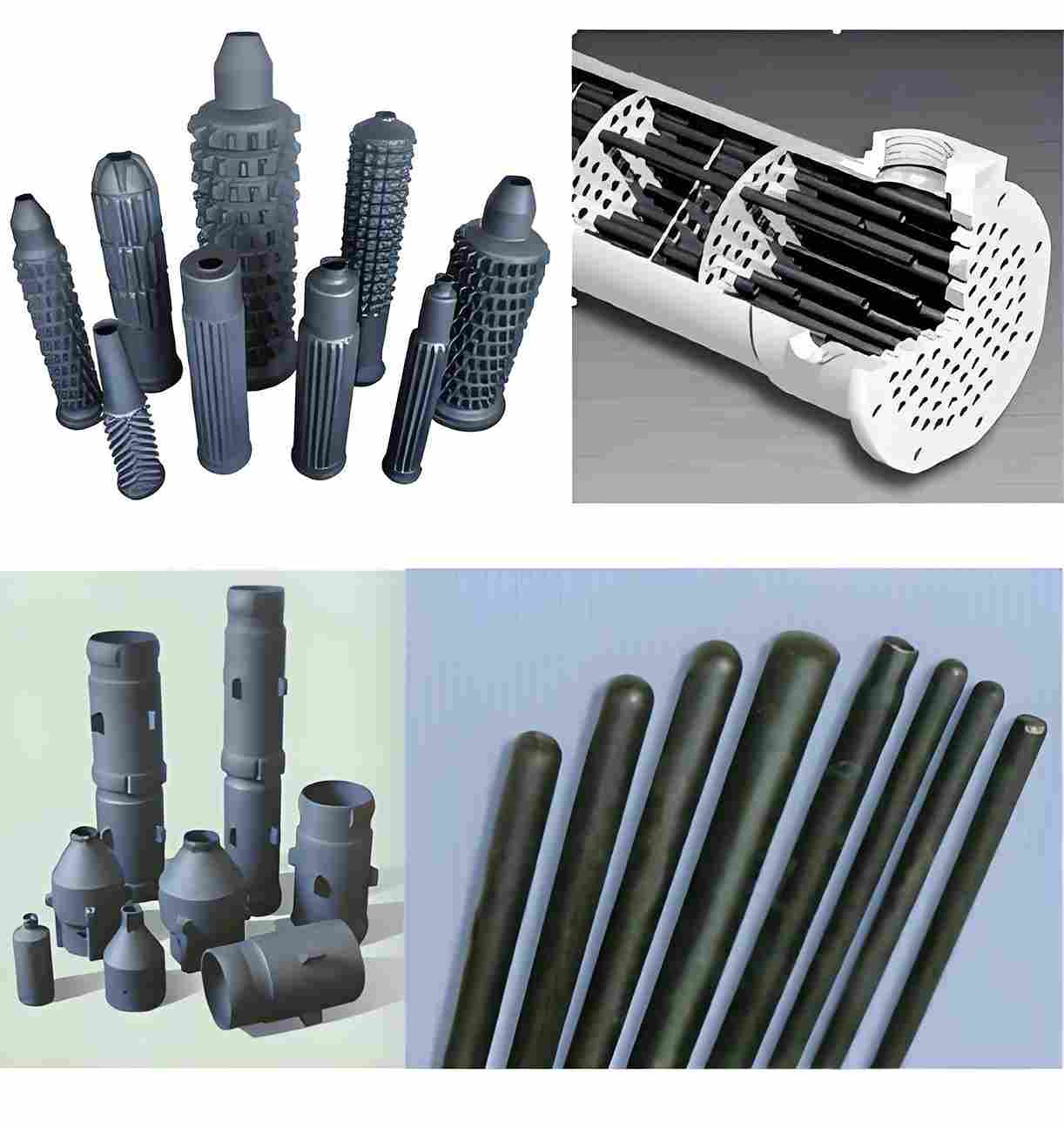
When a furnace tube cracks or a seal ring chips during a high‑temperature run, the root cause is almost always the balance between brittleness and toughness in silicon carbide (SiC) ceramics.
Quick Summary – FAQ
- What is the main difference between brittleness and toughness? Brittleness is the tendency to fracture with little deformation; toughness measures the energy a material can absorb before breaking.
- Why does SiC feel both extremely hard and suddenly fragile? Its strong covalent Si–C bonds give high hardness, but the same bonds limit dislocation movement, reducing ductility.
- How can I improve the effective toughness of a SiC component? Choose fine‑grained, low‑porosity grades, add reinforcement phases, or use optimized heat‑treatment cycles.
- What are the typical values? Flexural strength 300–600 MPa, fracture toughness 3–4 MPa·m½ for standard grades; advanced grades can reach 6 MPa·m½.
- Which ZIRSEC products address high‑stress applications? Our custom SiC tubes, plates, and seal rings are available in both standard and engineered‑toughness variants. Explore the range here.
1. Why Engineers Talk About Brittleness and Toughness Together
In metalworking you can bend a billet and watch it yield; in ceramics the story is different. A SiC component may survive 1,000 °C for months, yet a single impact or rapid temperature swing triggers catastrophic failure. Understanding the two opposing traits lets you design a system that avoids unwanted breakage while exploiting SiC’s unrivaled hardness and chemical resistance.
1.1 Definition of Brittleness
Brittleness is not a material property you can measure directly; it is an observed behavior. It reflects low strain‑to‑failure and a small plastic zone ahead of a crack tip. In SiC, the high bond energy (≈ 4.0 eV per Si–C bond) produces a rigid lattice that cannot accommodate dislocation glide, leaving the crystal unable to plastically deform.
1.2 Definition of Toughness
Toughness, expressed as fracture toughness (KIC), quantifies the energy required to propagate a crack. For SiC, KIC values are generally 3–4 MPa·m½ for standard grades. The higher the KIC, the more “energy‑absorbing” the ceramic is, which translates into better resistance against impact, thermal shock, and flaw growth.
2. Micro‑structural Roots of Brittleness
The crystal structure of SiC exists in many polytypes (α‑SiC, β‑SiC). The most common engineering grade is β‑SiC (cubic 3C). Two micro‑structural factors dominate brittleness:
2.1 Grain Size
Coarse grains (>10 µm) act as crack‑initiation sites because the grain boundaries are weaker than the interior. Fine‑grained ceramics (<2 µm) interrupt crack propagation and raise KIC by up to 30 %.
2.2 Porosity and Residual Stresses
Even 0.5 % open porosity creates stress concentrators. Sintering shrinkage can leave residual tensile stresses that lower the apparent fracture strength. High‑density (>99.5 % theoretical) SiC manufactured by hot‑isostatic pressing (HIP) or spark‑plasma sintering dramatically reduces brittleness.
3. Enhancing Toughness – What Works in Real Production
Industrial engineers rely on three practical routes to boost SiC toughness without sacrificing hardness or high‑temperature stability.
3.1 Reinforcement Phases
Adding 5–15 wt % of secondary phases such as silicon nitride (Si3N4), alumina (Al2O3), or carbon fibers creates a composite micro‑structure. The secondary phase deflects cracks and introduces bridging mechanisms. ZIRSEC’s “Tough‑SiC” family uses 8 % Si3N4 to raise KIC to 5 MPa·m½ while keeping flexural strength above 500 MPa.
3.2 Grain‑boundary Engineering
Using dopants (e.g., boron, nitrogen) to modify grain‑boundary chemistry can promote stronger intergranular bonding. The result is a tighter grain‑boundary network that tolerates higher stress intensity.
3.3 Controlled Cooling and Post‑Sinter Heat‑Treats
A slow cooling schedule (≤5 °C/min from 2000 °C) reduces thermal gradients, limiting micro‑cracks. Subsequent annealing at 1500 °C for 2 h relieves residual stresses, often increasing KIC by 0.5 MPa·m½.
4. Quantifying Brittleness and Toughness – Laboratory Methods
When you request a sample from a supplier, ask for the following test data to verify the material meets your design margin.
4.1 Flexural Strength (Three‑Point Bending)
Reported as a Weibull modulus (m). A higher m (>15) indicates less variability and therefore lower probability of a weak flaw causing failure.
4.2 Fracture Toughness (Single‑Edge Notch Beam)
KIC is measured by the load at crack propagation. Values above 4 MPa·m½ are considered “high‑toughness” for SiC.
4.3 Thermal Shock Resistance
Quench testing (e.g., immersion from 1100 °C to room temperature) provides an empirical rating (ΔT). ZIRSEC’s high‑density tubes can survive ΔT ≈ 600 °C without fracture.
5. Design Guidelines – Avoiding Unexpected Breakage
Even the toughest SiC can fail if the design ignores stress concentrators.
5.1 Geometry Considerations
- Use generous radii on internal bends; angles sharper than 30° multiply stress intensity.
- Maintain wall thickness‑to‑diameter ratios of at least 0.1 for tubes operating above 1200 °C.
- Avoid sudden cross‑section changes; taper transitions reduce crack‑tip stress.
5.2 Surface Finish
A surface roughness Ra > 3 µm can act as a micro‑crack source. Polishing to Ra ≤ 0.8 µm is recommended for seal rings and furnace hot‑spots.
5.3 Thermal Gradient Management
Install protective shields or multi‑layer insulation to limit ΔT across the component. If rapid heating is unavoidable, choose a grade with proven thermal‑shock data.
6. Selecting the Right SiC Grade for Your Application
Below is a practical matrix that matches typical industrial uses with the most suitable SiC property set.
| Application | Key Requirement | Recommended SiC Grade | Typical KIC (MPa·m½) | Typical Flexural Strength (MPa) |
|---|---|---|---|---|
| Furnace tubes (1350‑1600 °C) | High temperature, low porosity, moderate toughness | Standard high‑density β‑SiC | 3.2‑3.5 | 500‑620 |
| Seal rings for corrosive pumps | Chemical resistance, high hardness, tight tolerance | Low‑porosity, fine‑grained SiC (±0.1 mm tolerance) | 3.0‑3.3 | 480‑560 |
| Burner nozzles (thermal‑spray) | Thermal shock resistance, high KIC | Reinforced SiC/Si3N4 composite | 4.8‑5.2 | 450‑530 |
| Wear plates in abrasive slurry pumps | Maximum hardness, acceptable brittleness | Coarse‑grained, high‑hardness SiC | 2.8‑3.0 | 600‑680 |
7. Real‑World Case Study – How ZIRSEC Solved a Sudden‑Stop Event
A European pump‑valve maker reported an 8‑day production halt when a custom SiC seal ring fractured during a 1450 °C trial run. The failure analysis revealed two issues:
- The supplied grade had a porosity of 1.2 % (above the 0.5 % design limit).
- The ring’s surface finish was Ra = 3.5 µm, creating micro‑crack nuclei.
ZIRSEC intervened with a rapid redesign:
- Switched to our low‑porosity, fine‑grained grade (99.8 % density, Ra ≤ 0.8 µm).
- Implemented a post‑HIP anneal to relieve residual stresses.
- Delivered a batch of 30 spare rings within 12 days, allowing the client to resume production.
Post‑implementation testing recorded a 40 % increase in KIC and zero further failures over a 6‑month field trial.
8. Ordering Tips – Getting the Exact SiC You Need
When you contact ZIRSEC, provide the following details to avoid costly iterations:
- Target operating temperature and maximum thermal gradient.
- Required mechanical properties (flexural strength, KIC, Weibull modulus).
- Dimensional tolerance (standard ±0.5 mm or precision ±0.1 mm).
- Surface finish specification (polished vs. as‑sintered).
- Any reinforcement or composite preference (e.g., Si3N4‑reinforced).
Our engineering team will generate a data sheet, including COA, MSDS, and a 3‑D CAD model if needed, within 48 hours of receiving the sketch or drawing.
9. Maintenance Practices to Preserve Toughness Over Service Life
Even the best‑engineered SiC component can degrade if handled improperly.
- Avoid mechanical impact during installation. Use soft‑tipped tools and pre‑align guides.
- Control heating rates. Ramp up no faster than 10 °C/min for large‑diameter tubes.
- Implement regular visual inspections. Look for surface micro‑cracks that can propagate under cyclic load.
- Schedule non‑destructive evaluation. Ultrasonic C‑scan can detect internal porosity growth.
10. Bottom Line – Turning Brittleness Into a Predictable Parameter
Silicon carbide’s reputation for brittleness is not a flaw; it is a predictable, quantifiable characteristic that can be engineered around. By selecting the right grain size, density, and reinforcement, and by following sound design and handling practices, you can leverage SiC’s unmatched hardness while keeping fracture risk under control.
Whether you need standard high‑temperature tubes, custom seal rings, or a toughened burner nozzle, ZIRSEC’s 20‑year production experience guarantees a product that matches the mechanical profile your project demands.
Ready to replace speculative material choices with data‑backed SiC components? Contact ZIRSEC today for a free engineering consultation.