Modern automotive cooling and fuel systems run under tough conditions: high rotation speeds, variable temperatures, mixed fluids and long service life expectations with minimal maintenance. When pump seals fail early, the result is leaks, warranty claims and downtime for both OEMs and end users.
Silicon carbide seal rings give automotive pump designers a robust option for improving reliability and lifetime in water pumps, fuel pumps and auxiliary cooling systems. With excellent wear resistance, good thermal conductivity and strong chemical stability, silicon carbide (SiC) has become a standard material in many high-performance mechanical seals.
This article explains how silicon carbide seal rings are used in automotive manufacturing, why they work so well in cooling and fuel pumps, and what to consider when specifying them.
Automotive Pumps: Continuous Duty in a Compact Package
Automotive systems depend on a range of pumps, discussed more broadly in pump and automobile design:
- Engine coolant pumps: circulate coolant through the engine block, cylinder head and radiator.
- Fuel pumps: deliver fuel from tank to injectors at controlled pressure.
- Oil pumps: feed lubrication systems in combustion engines and some transmissions.
- EV and hybrid thermal management pumps: circulate coolant for batteries, power electronics and motors.
Across these applications, mechanical seals must handle:
- Continuous or frequent operation at high shaft speeds.
- Temperature changes from cold start to full load.
- Cavitation, pressure fluctuations and vibration.
- Exposure to coolant, fuel, oil and additives.
Material choice for seal rings is therefore a critical factor in pump reliability and warranty performance.
Why Silicon Carbide Seal Rings Fit Automotive Pumps
Silicon carbide, described in silicon carbide, offers a combination of properties that directly address automotive pump challenges:
- High hardness and wear resistance: excellent resistance to abrasion from fine particles and cavitation-related damage.
- Good thermal conductivity: helps dissipate heat generated at the seal interface.
- Chemical stability: compatible with water–glycol coolants, many fuels and oils when paired with suitable secondary seal materials.
- Dimensional stability: maintains flatness and geometry over long service periods.
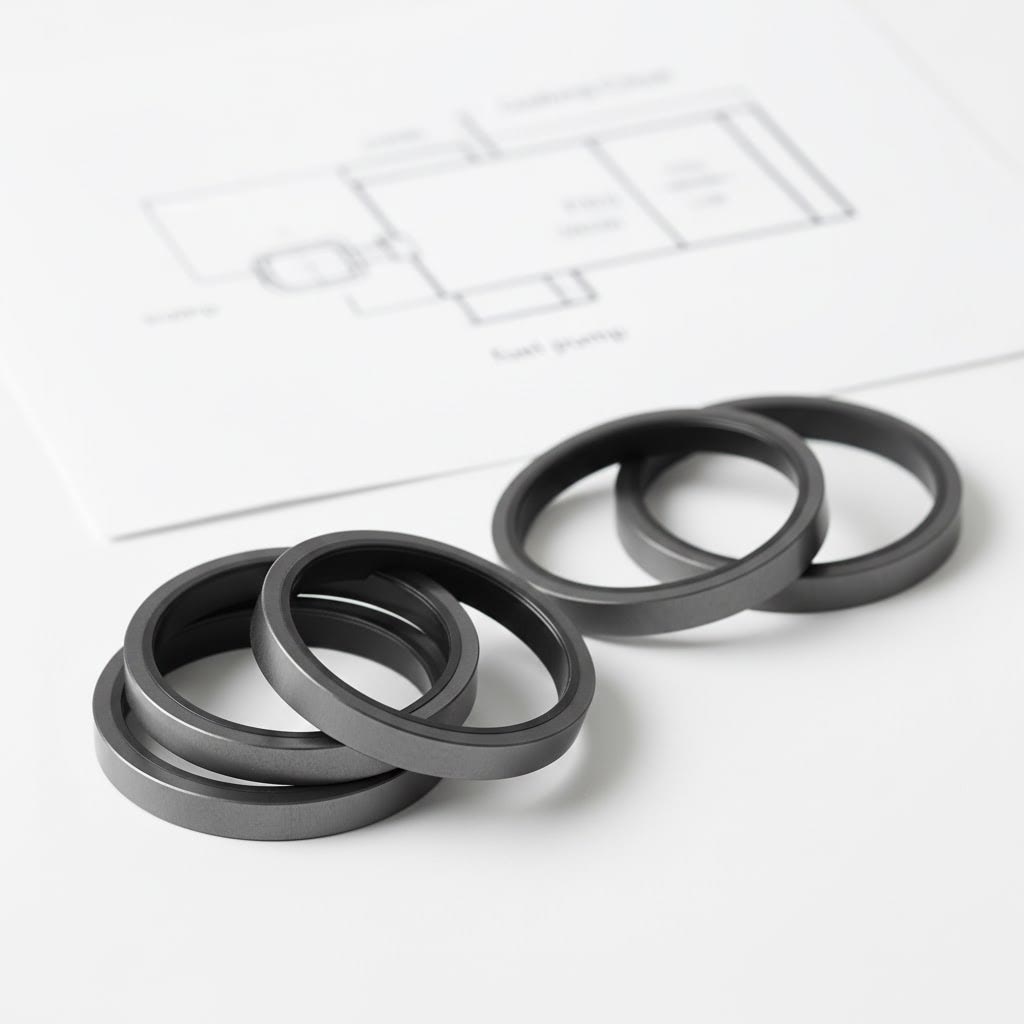
Zirsec provides precision silicon carbide seal rings designed for mechanical seals in industrial and automotive-style pumps, with tight tolerances and controlled surface finishes suitable for high-speed operation.
Key Automotive Applications for Silicon Carbide Seal Rings
1. Engine Coolant Pumps
Coolant pumps run for thousands of hours over the life of a vehicle, often at high shaft speeds and variable temperatures. Typical requirements include:
- Handling water–glycol coolant mixtures and additives.
- Surviving start–stop cycles and occasional dry-running events.
- Maintaining low leakage rates over long service intervals.
In these applications, silicon carbide seal rings are commonly used as one face of a mechanical seal pair (SiC vs SiC or SiC vs carbon/graphite), providing:
- High wear resistance against micro-abrasion from particles.
- Stable sealing performance at high rpm.
- Improved tolerance to boundary lubrication conditions.
2. Fuel Pumps (ICE and Hybrid Vehicles)
Fuel pumps must operate quietly and reliably while handling petrol, diesel or alternative fuels, sometimes with varying lubricity and additives. Silicon carbide seal rings help by:
- Reducing wear at the seal interface in low-lubricity fuels.
- Maintaining geometry with minimal distortion under temperature changes.
- Providing a hard, smooth surface for precise sealing.
When paired with compatible secondary seals and metals, SiC rings contribute to long service life and reduced risk of leakage that could impact emissions or safety.
3. EV and Hybrid Cooling Pumps
Electric vehicles and hybrids rely on multiple cooling loops for batteries, inverters and electric motors. These pumps often operate more frequently than traditional engine-driven pumps. Silicon carbide seal rings support:
- Quiet, efficient sealing under continuous or high-duty cycles.
- Long service life in compact pump designs with small envelopes.
- Consistent performance at varying coolant temperatures and flow rates.
As OEMs push for higher reliability in electrified platforms, durable SiC seal solutions become increasingly important.
How Silicon Carbide Seal Rings Impact Reliability and Warranty Cost
Choosing silicon carbide for seal rings influences both technical performance and business outcomes:
- Extended seal life: slower wear rates reduce early-life failures and leakage complaints.
- Stable leakage performance: flat, dimensionally stable faces maintain tight sealing over time.
- Reduced risk of catastrophic failures: robust seal pairs are less likely to fail suddenly under transient conditions.
- Lower warranty and recall risk: more predictable field performance reduces cost exposure for OEMs.
In high-volume automotive production, small improvements in seal reliability can translate into significant savings over millions of vehicles.
Design Considerations for Automotive Silicon Carbide Seal Rings
1. Face Pair Selection
Silicon carbide rings are typically part of a face pair in a mechanical seal:
- SiC vs SiC: very wear-resistant pair, suited for demanding coolant pumps with controlled lubrication.
- SiC vs carbon/graphite: common combination balancing robustness and emergency running capability.
The choice depends on fluid properties, speed, pressure and OEM targets for noise, efficiency and lifetime.
2. Surface Finish and Flatness
Seal performance depends strongly on surface finish and flatness:
- Faces must be lapped to tight flatness tolerances to control leakage.
- Surface roughness must support a stable lubrication film without promoting excessive wear-in.
- Consistent quality across production batches is critical for mass automotive manufacturing.
Zirsec’s precision machining and lapping processes are tailored to deliver SiC seal rings suitable for high-volume OEM and Tier 1 production.
3. Pump Environment and Fluid Compatibility
Even though silicon carbide is chemically stable, overall seal design must account for:
- Coolant or fuel composition, including additives and corrosion inhibitors.
- Operating temperature range and potential for thermal shock.
- Presence of particles from casting residues, corrosion products or manufacturing debris.
Seal face design, secondary seals and housing materials must work together with SiC to handle these conditions.
System-Level Integration in Automotive Pumps
Upgrading to silicon carbide seal rings is most effective when integrated into a system-level design review:
- Check shaft run-out and housing alignment to avoid edge loading.
- Review spring forces and closing pressures on the seal faces.
- Ensure adequate cooling and lubrication of the seal chamber.
- Validate noise, vibration and harshness (NVH) performance with the new seal configuration.
In practice, many OEMs and pump suppliers use silicon carbide as part of a broader engineering upgrade to meet higher durability and efficiency targets.
Case Example: Coolant Pump Seal Upgrade with Silicon Carbide Rings
Background
An automotive supplier experienced increased warranty claims related to coolant pump seal leakage in a high-volume engine platform. Analysis showed accelerated wear of conventional seal faces and sensitivity to coolant chemistry variations.
Approach
- Replace the existing hard face material with silicon carbide seal rings, lapped to tighter flatness tolerances.
- Optimise the mating ring material and lubricating film conditions.
- Validate performance across the expected coolant formulations and temperature cycles.
Results
- Seal life in durability tests increased, with leakage remaining within specification for longer.
- Field complaint rates related to coolant pump leakage decreased significantly.
- OEM warranty cost exposure on the affected platform was reduced.
FAQ – Silicon Carbide Seal Rings in Automotive Cooling and Fuel Pumps
Q1. Are silicon carbide seal rings only for high-end or performance vehicles?
No. Silicon carbide seal rings are used in both high-end and volume platforms where OEMs target longer service intervals, higher reliability and lower warranty risk. The decision is driven more by durability targets than by vehicle price alone.
Q2. Do silicon carbide seal rings increase friction losses in pumps?
When correctly specified and lapped, silicon carbide faces operate with a controlled lubrication film that keeps friction to acceptable levels. In many cases, the impact on pump efficiency is small compared with the gain in reliability and lifetime.
Q3. Can existing pump designs be upgraded to silicon carbide seals?
Often yes. Many pump designs can accept SiC seal rings as a drop-in or near drop-in replacement, provided that face dimensions, spring forces and housing tolerances are reviewed. In some cases, minor adjustments are needed to optimise performance.
Q4. What information should I provide when requesting SiC seal rings from Zirsec?
Provide pump type, fluid (coolant, fuel, oil), operating temperature range, shaft speed, pressure, target lifetime and current failure modes. Drawings of the mechanical seal assembly and face dimensions help define suitable silicon carbide ring specifications.
Q5. How does silicon carbide compare with other hard seal materials?
Compared with many conventional hard materials, silicon carbide offers higher hardness, better wear resistance and good thermal conductivity. It is particularly strong in abrasive or high-duty applications where seals run for long periods at high speed.
Designing or upgrading automotive cooling and fuel pumps? Integrating silicon carbide seal rings in the right locations gives you a practical route to more reliable pumps, lower leakage risk and reduced warranty cost in demanding vehicle platforms.