When engineers talk about advanced ceramics for demanding wear applications, silicon carbide and silicon nitride are usually at the top of the list. On paper they both look “hard, high temperature, chemical resistant” – but in the real world, the details decide whether your seals, nozzles or bearings survive or fail early.
Choosing between silicon carbide (SiC) and silicon nitride (Si3N4) in industrial wear conditions is not a matter of “which is best in general”, but which performs better in your specific combination of load, speed, temperature, lubrication and corrosion.
This guide provides a practical comparison for pumps, mechanical seals, nozzles, bearings and wear parts, and shows where silicon carbide ceramics from Zirsec are typically the stronger choice.
Silicon Carbide and Silicon Nitride – What Are We Comparing?
Silicon Carbide (SiC) for Industrial Wear Parts
Silicon carbide is a high-hardness, high-temperature ceramic used widely in industrial wear applications. Typical forms include:
- Sintered SiC (SSiC): very high hardness, excellent corrosion resistance, high thermal conductivity, low porosity.
- Reaction-bonded SiC (RBSiC/SiSiC): good strength, very good thermal shock resistance, widely used in structural and kiln furniture applications.
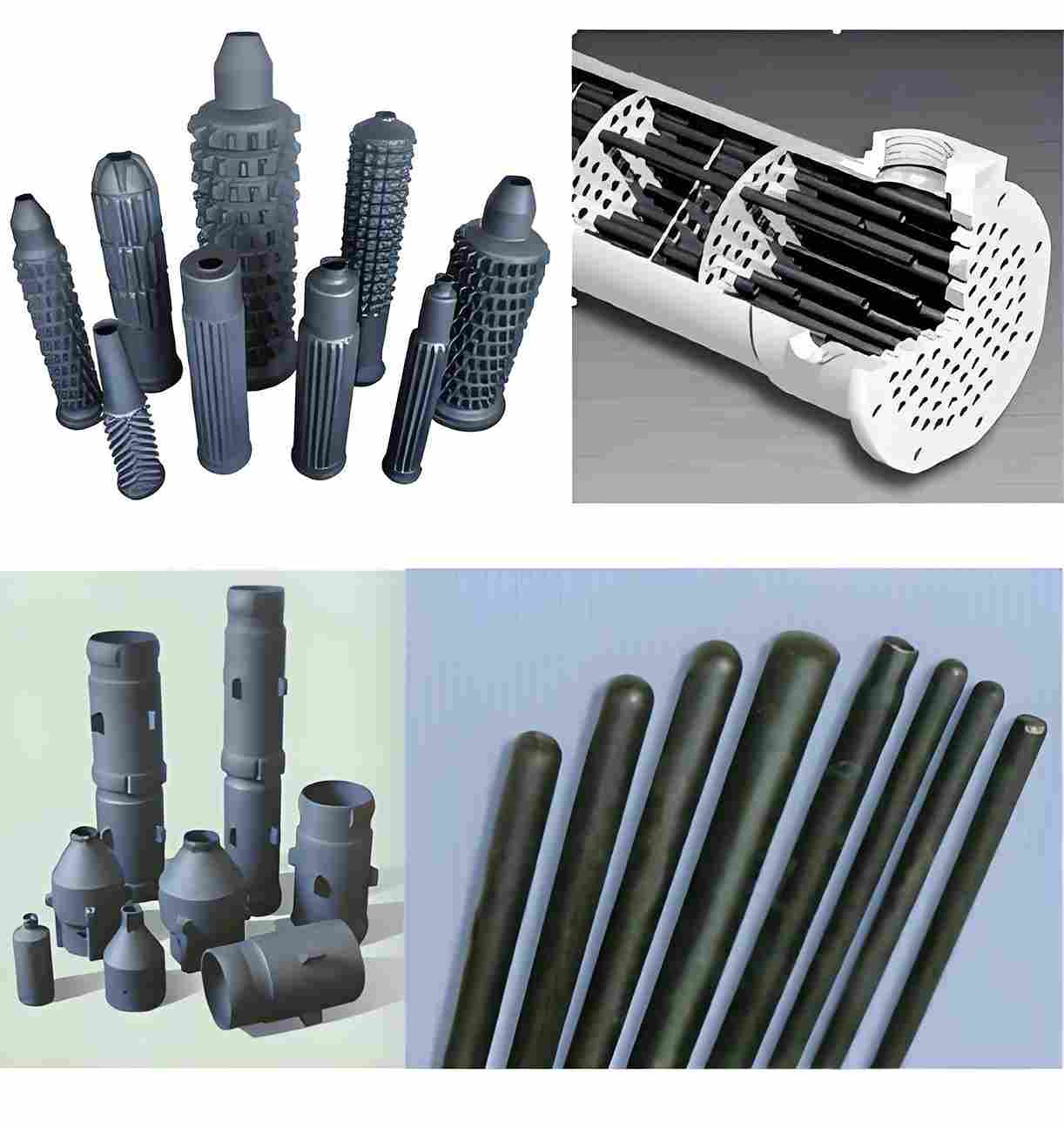
Zirsec supplies silicon carbide seal rings, nozzles, tubes and a wide range of custom mechanical parts for abrasive, corrosive and high-temperature service.
Silicon Nitride (Si3N4) for Rolling and Sliding Contacts
Silicon nitride is a tough, high-strength ceramic used in:
- Hybrid bearings: ceramic balls with steel races in high-speed spindles and motors.
- High-speed rolling elements: where low density and high fracture toughness are critical.
- Some wear parts where impact resistance is more important than corrosion extremes.
Compared with silicon carbide, silicon nitride is generally less hard but tougher (better fracture resistance), with lower thermal conductivity and density.
Key Property Comparison for Wear Conditions
The table below summarises typical trends (exact values depend on grade and manufacturer):
| Property | Silicon Carbide (SiC) | Silicon Nitride (Si3N4) | Impact on Wear Applications |
|---|---|---|---|
| Hardness | Very high | High | SiC generally offers better abrasion and erosion resistance. |
| Fracture toughness | Moderate | Higher | Si3N4 tolerates impact and edge chipping better. |
| Thermal conductivity | High | Lower | SiC removes heat from the contact zone more effectively. |
| Thermal shock resistance | Excellent | Good | Both are good; SiC usually wins where cycling is extreme. |
| Corrosion resistance | Excellent in many acids, alkalis and hot gases | Very good, but more sensitive in some environments | SiC often preferred where chemistry is aggressive and unknown. |
| Density | Approx. 3.0–3.2 g/cm³ | Approx. 3.2–3.3 g/cm³ | Both are lighter than steel; Si3N4 balls useful in high-speed bearings. |
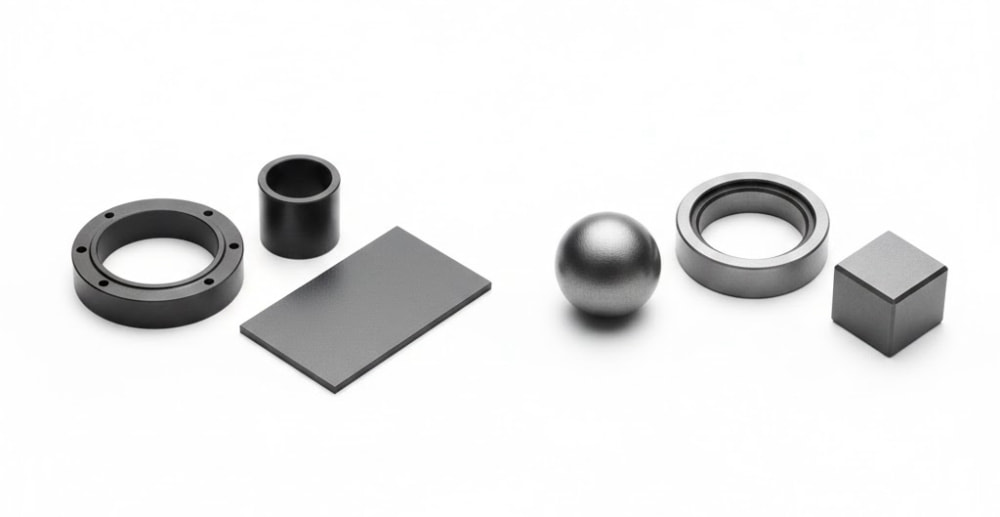
| Typical forms | Rings, sleeves, nozzles, plates, tiles, tubes | Balls, rollers, some rings and specialised parts | SiC dominates fixed wear parts; Si3N4 dominates bearing balls. |
| Cost | High, but widely used | High, often higher per unit volume | Selection driven by duty, not raw price. |
For most fixed wear components in pumps, valves, nozzles and liners, silicon carbide’s higher hardness, thermal conductivity and corrosion resistance make it the default choice. Silicon nitride comes into its own in rolling elements and some high-speed, impact-prone applications.
Where Silicon Carbide Usually Performs Better
Abrasive Slurries and Erosive Flow
If your main problem is continuous abrasion from particles, sand, slurry or ash, hardness is king. Typical examples include:
- Slurry and process pumps in mining, chemical and environmental plants.
- Descaling and sandblasting nozzles.
- Valve trims and seats in erosive flow.
Silicon carbide’s higher hardness and wear resistance mean:
- Slower wear rate at the same operating conditions.
- Better retention of surface finish on seal faces and seats.
- More stable clearances in sleeves and bushings over time.
This is why Zirsec focuses on SiC for mechanical seal rings, nozzles and other high-wear parts in harsh industrial circuits.
High-Temperature Wear with Thermal Cycling
In furnaces, kilns and hot gas paths, wear is mixed with high temperature and thermal cycling:
- Burner nozzles and tips in high-temperature furnaces.
- Wear tiles and impact plates in hot gas and ash ducts.
- Supports and guides inside high-temperature equipment.
Silicon carbide’s excellent thermal shock resistance and high thermal conductivity help avoid cracking and spalling from rapid temperature changes, while still offering strong wear resistance.
Corrosive Wear in Chemical and Petrochemical Service
Where wear is accompanied by aggressive chemicals – acids, alkalis, chlorides – materials can fail by erosion–corrosion. Silicon carbide typically offers:
- Better stability in a wide range of corrosive aqueous environments.
- Longer life for seal faces, sleeves and nozzles in chemical processing.
For many users, it is safer to specify a high-grade SiC and avoid guessing how complex process fluids will attack more sensitive materials over time.
Where Silicon Nitride Has an Edge
Rolling Elements in High-Speed Bearings
Silicon nitride is widely used for bearing balls in hybrid bearings because:
- It combines high fracture toughness with low density.
- It can handle high rotational speeds and dynamic loads.
- It resists fatigue in rolling contact better than many ceramics.
These are not typical “thick wear parts” like rings or tiles, but highly engineered rolling elements where Si3N4 performs very well.
Shock and Impact-Sensitive Locations
If the component sees occasional mechanical shocks or impact loading, silicon nitride’s higher fracture toughness can reduce the chance of catastrophic cracking compared with very hard but less tough ceramics. Examples might include:
- Specific bearing components exposed to vibration and shock.
- Certain impact-prone mechanical parts where rolling contact dominates.
However, even in these cases, many OEMs still favour silicon carbide where corrosion and abrasion are dominant and mechanical shock can be controlled by design.
Design Implications in Industrial Wear Conditions
Contact Pairing and Counterface Materials
Neither silicon carbide nor silicon nitride work alone; they always run against another surface:
- Mechanical seals: SiC vs SiC for maximum chemical and wear resistance, or SiC vs carbon when dry-running risk exists.
- Bearings and bushings: SiC against metals, polymers or compatible ceramics, with careful control of clearances and lubrication.
- Nozzles: SiC or Si3N4 nozzles against air, gas or slurry streams with varying particle loads.
For most sliding, sealing and erosive wear applications, silicon carbide provides a more robust combination of hardness, corrosion resistance and thermal behaviour than silicon nitride.
Heat Management in the Wear Zone
Wear accelerates as local temperature rises. Silicon carbide’s higher thermal conductivity helps:
- Move heat away from the contact zone in seals and bushings.
- Reduce local thermal gradients that drive thermal cracking.
- Stabilise friction behaviour under marginal lubrication conditions.
Silicon nitride, with lower thermal conductivity, may run hotter locally in comparable geometries, which can limit its use in some heavily loaded sliding contacts.
Component Geometry and Thickness
Because silicon carbide is very hard and strong at temperature, designers can often:
- Use slimmer cross-sections in rings, plates and liners for the same mechanical capacity.
- Reduce overall mass of kiln furniture and wear tiles.
Silicon nitride can also support demanding geometries, but its production focus and cost structure make it more common in smaller, highly stressed rolling or speciality parts rather than large fixed wear components.
Practical Selection Guidance: SiC vs Si3N4 in Wear Duty
Use the following filters when deciding:
- Main failure mode is abrasion / erosion + corrosion? → Silicon carbide is usually the better starting point.
- Main duty is high-speed rolling contact? → Silicon nitride balls in hybrid bearings may be the optimal choice.
- Environment is very hot and thermally cycled? → Silicon carbide’s thermal shock resistance and conductivity are strong advantages.
- Component is a thick ring, nozzle, plate or tile in hard service? → Silicon carbide dominates most industrial designs.
- Component is a small, high-speed rolling element with impact risk? → Silicon nitride may have the edge.
In many systems, the practical answer is not either/or, but using each ceramic where it makes the most sense: silicon nitride in specialised bearings, and silicon carbide in the seals, sleeves, nozzles and liners that face the worst wear and corrosion.
Example: Upgrading a Chemical Slurry Pump with Silicon Carbide Wear Parts
Background
A plant handling aggressive chemical slurries experienced frequent failures in mechanical seals, sleeves and internal wear surfaces. Earlier ceramic trials (including silicon nitride elements) reduced some failure modes but did not fully solve erosion–corrosion issues.
Approach
- Upgrade seal faces to high-grade silicon carbide rings with optimised surface finish.
- Replace key sleeves and fixed wear parts with custom SiC components from Zirsec.
- Keep existing bearing arrangements but improve flushing and cooling of the seal chamber.
Results
- Wear rate on critical sealing surfaces dropped significantly.
- Mean time between overhauls increased, reducing unplanned downtime.
- Corrosion-related failures in the upgraded parts were effectively eliminated.
FAQ – Silicon Carbide vs Silicon Nitride in Industrial Wear Applications
Q1. Is silicon nitride harder than silicon carbide?
No. Silicon carbide is usually harder than silicon nitride, which is why it tends to perform better in pure abrasion and erosion conditions such as slurries and sand-laden flows.
Q2. Why is silicon nitride so common in bearings but not in large wear plates or nozzles?
Silicon nitride combines good strength, relatively low density and higher fracture toughness, which is ideal for small rolling elements in high-speed bearings. For larger, thick wear parts like plates, tiles and nozzles, silicon carbide’s hardness, thermal conductivity and corrosion resistance make it the more common choice.
Q3. If I already use alumina, should I switch to silicon carbide or silicon nitride?
If the main issues are abrasion, erosive flow and chemical attack, upgrading from alumina to silicon carbide usually brings the biggest gain. Silicon nitride is more relevant if rolling contact fatigue or impact is the dominant problem.
Q4. Can I mix silicon carbide and silicon nitride parts in the same system?
Yes, as long as each material is used in a suitable role and contact pairs are carefully planned. For example, high-speed bearings may use silicon nitride balls, while the same system’s mechanical seals, sleeves and nozzles use silicon carbide for maximum wear and corrosion resistance.
Q5. What information should I prepare before asking Zirsec for a recommendation?
Describe the medium (liquid, slurry, gas, particles), temperature range, pressure, sliding or rolling speed, lubrication or flushing conditions, current failure modes and target lifetime. With this, Zirsec can recommend silicon carbide ring, nozzle, sleeve or custom part designs that match your industrial wear conditions and help you decide whether any role remains for silicon nitride in the system.
Bottom line: silicon nitride is excellent for highly engineered rolling elements, but for most real-world industrial wear components – seals, sleeves, nozzles, plates and liners – high-grade silicon carbide is usually the more effective and robust choice.