Silicon carbide (SiC) crucibles are designed for demanding metal melting applications and can significantly outlast traditional materials. When problems appear – cracks, excessive wear, slag buildup, or leaks – they are usually symptoms of operating or handling issues, not simply “bad crucibles.”
This guide provides a structured approach to troubleshooting common issues with silicon carbide crucibles, so you can identify root causes, take corrective action, and extend service life in your melting operations.
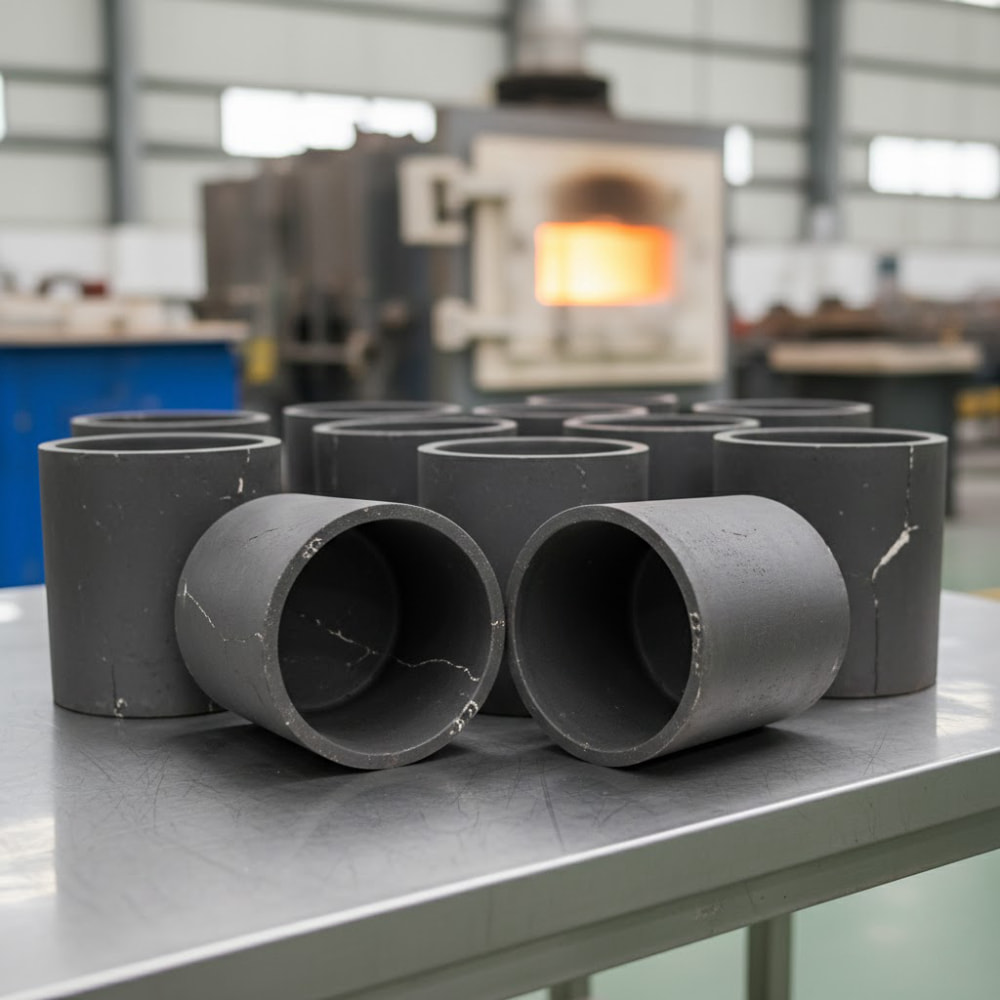
Typical failure modes in silicon carbide crucibles
Most problems fall into a few repeatable patterns:
- Cracking – thermal shock, mechanical impact, or structural overstress
- Wear and erosion – abrasion from charge materials or molten metal flow
- Slag and buildup – thick deposits that reduce effective volume or damage walls
- Metal penetration and leaks – through-wall failure or joint breakdown
- Deformation – out-of-round or bulging at high temperature
- Discoloration and surface changes – linked to atmosphere, fluxes, or contamination
Understanding which pattern you are seeing is the first step toward a solution.
Issue 1: Cracks in silicon carbide crucibles
Typical symptoms
- Vertical cracks from rim toward base
- Horizontal cracks around a particular height
- Star-shaped cracks in the base area
- Cracks appearing after start-up or after rapid cooling
Likely causes
- Thermal shock from rapid heating, rapid cooling, or uneven temperature distribution
- Mechanical impact from dropping charge material or hitting the crucible with tools
- Non-uniform support at the base, creating stress points during expansion
- Flame impingement or localized hot spots in fuel-fired furnaces
Corrective actions
- Implement controlled heat-up with defined ramp rates, especially for new or cold crucibles.
- Avoid charging large, cold, or wet scrap directly into a hot crucible; use smaller pieces or preheat.
- Check and correct the support surface: flat, level, and free of hard point contacts.
- Adjust burners to prevent flames striking one area of the wall or base.
- Train operators to avoid impact with tools and to use proper lifting and charging methods.
Issue 2: Excessive wear and erosion
Typical symptoms
- Noticeable wall thinning, especially at metal level or pour lip
- Rough internal surface, grooves, or scalloped patterns
- Accelerated wear on one side of the crucible
Likely causes
- Abrasive charge materials or slag stirring against the wall
- High-velocity metal flow or turbulent pouring, impinging on a specific zone
- Use of hard metal tools for cleaning or scraping
- Excessive chemical attack from fluxes or melt chemistry
Corrective actions
- Adjust charging practices so heavy or sharp scrap is placed gently, not dropped.
- Review pouring and stirring techniques to reduce direct jetting onto the wall.
- Replace metal scraping tools with softer tools (wood, plastic, or softer refractory) for cleaning.
- Optimize flux type and dosage; avoid over-fluxing and check chemical compatibility with SiC.
Issue 3: Slag buildup and accretion
Typical symptoms
- Thick slag rings at the metal–air interface area
- Reduced effective capacity due to deposits on walls and rim
- Difficult or unsafe slag removal between heats
Likely causes
- Inadequate skimming or skimming too late, after slag has solidified strongly
- Flux chemistry that promotes hard, adherent slag layers
- Repeated overheating of the upper wall region and inconsistent fill levels
Corrective actions
- Skim slag while it is still fluid, not after full solidification.
- Use appropriate skimming tools shaped to follow the crucible contour without digging into the wall.
- Review flux composition and temperature profile to reduce slag adhesion.
- Keep fill levels within recommended range to avoid frequent exposure of the same band to oxidizing conditions.
Issue 4: Metal penetration and leaks
Typical symptoms
- Metal stains or frozen metal on the outer wall
- Small beads or drips at the base, progressing to through-wall leaks
- Unexpected metal level drop during a heat
Likely causes
- Through-cracks from thermal shock or mechanical damage that went unnoticed
- Severe wall thinning from erosion, reaching critical thickness
- Localized chemical attack at the metal–slag–air triple line
Corrective actions
- When a leak is observed, retire the crucible as soon as safely possible; do not attempt to repair for critical service.
- Improve inspection routines to catch cracks and wall thinning earlier.
- Analyze slag and melt chemistry for aggressive conditions that attack SiC at specific heights.
- Review heat patterns and flux practice in the affected section of the crucible.
Issue 5: Deformation, bulging, or out-of-round crucibles
Typical symptoms
- Crucible shape visibly distorted after service
- Difficulty fitting lids or covers due to out-of-round rims
- Base no longer sits flat on the support block
Likely causes
- Uneven support or high point loads at the bottom
- Excessive overheating of the wall in certain zones
- Mechanical loading from improper lifting or clamping during hot handling
Corrective actions
- Check the hearth or base blocks for flatness and appropriate support pattern.
- Adjust burner tuning or coil position if fired or induction heating is creating local hot spots.
- Review lifting procedures; do not clamp hot crucibles tightly in metal frames without expansion allowance.
Issue 6: Discoloration, glazing, or surface changes
Typical symptoms
- Strong color changes (e.g. whitish or glassy zones) on the hot face
- Glassy or shiny layers on parts of the internal surface
- Localized roughness, pitting, or surface crust
Likely causes
- Interaction with fluxes, slags, or atmosphere at high temperature
- Oxidizing or reducing conditions outside recommended limits
- Deposition of process contaminants from the melt or combustion products
Corrective actions
- Review your process atmosphere (oxidizing, neutral, reducing) vs crucible recommendations.
- Check flux usage and slag composition for reactions with SiC or protective layers.
- Adapt furnace tuning to minimize extreme local conditions at the hot face.
Step-by-step troubleshooting approach
When a silicon carbide crucible fails earlier than expected, use a structured approach instead of guessing:
- Document the failure: photos, location in the furnace, number of heats, operating temperatures, melt type, and fluxes used.
- Identify the dominant failure mode: crack, leak, erosion, slag buildup, deformation, or combination.
- Correlate with history: start-up and shutdown practices, process upsets, unusual batches, or operator changes.
- Inspect related equipment: burner alignment, supports, flux handling, charging methods.
- Adjust one set of variables at a time (e.g. charge practice + ramp rate) and monitor the next crucible’s performance.
In many cases, optimizing procedures around the crucible allows you to recover the expected lifetime without changing the crucible grade itself.
When to retire a silicon carbide crucible
Running crucibles “to destruction” is a false economy if leaks or catastrophic failures risk safety or major downtime. Retire a crucible when you see:
- Through-wall cracks or visible seepage of metal
- Severe wall thinning in one or more areas
- Bulging or serious geometric distortion
- Repeated patching or cleaning damage on the same spots
At that point, replace the crucible and use the failure as a data point to improve operating conditions for the next one.
Linking troubleshooting back to crucible selection
Some issues are related not only to how the crucible is operated, but to whether the correct design and grade was selected for the job.
- If thermal shock cracks are frequent even with good practice, consider a crucible design optimized for cycling duty.
- If chemical attack is dominant, review compatibility between melt chemistry, fluxes, and crucible grade.
- For severe abrasion, evaluate crucible profiles that reduce flow impact and consider operating changes.
Working with a supplier like Zirsec to match silicon carbide crucibles to your metal, temperature, and duty profile often reduces troubleshooting to fine-tuning rather than constant firefighting.
FAQ: Troubleshooting silicon carbide crucible issues
1. Why do new crucibles sometimes crack during the first few heats?
Early cracks are usually caused by thermal shock or moisture. If a new crucible is heated too quickly, or if residual moisture flashes to steam inside surrounding refractories, stress spikes can produce cracks. Controlled heat-up and proper drying before first use are essential.
2. How can I tell if a crack is serious or only superficial?
Hairline surface marks that do not propagate under service may be harmless, but cracks that penetrate through the wall, reach the base, or grow with each heat are serious. Any sign of metal seepage, distortion, or audible “ring change” when gently tapped suggests internal damage and justifies retirement.
3. Our crucibles wear fastest at the metal line. Is that normal?
Yes, the metal–slag–air interface is typically the most aggressive zone. However, extreme wear at that height often indicates issues with slag chemistry, fill level control, or atmosphere. Improving slag practice and keeping metal levels within recommended ranges usually slows this wear.
4. What is a realistic lifetime for a silicon carbide crucible?
There is no universal number; life depends on metal type, fluxes, temperature, cycle frequency, furnace design, and handling. Plants that optimize both crucible selection and operating practice often achieve significantly more heats than with standard crucibles, but benchmarking must be based on your own data.
5. Can we repair cracked SiC crucibles with coatings or patch materials?
Field repairs can sometimes extend life for non-critical or low-risk duties, but they generally do not restore original structural integrity. For core melting operations, the safer approach is to treat cracked crucibles as end-of-life and focus on preventing the same failure mode in the next unit.
6. Why does slag stick more on some crucibles than others?
Slag adhesion depends on slag chemistry, temperature, atmosphere, and surface condition. Changes in flux, metal composition, or furnace tuning can make slag more or less sticky, even with the same crucible supplier. Monitoring these variables is key to understanding differences between heats.
7. We see more crucible failures after production upsets. Is that expected?
Yes. Upsets such as overheating, abnormal flux addition, off-spec chemistry, or emergency shutdowns impose extra stress on crucibles. Recording when these events happen and correlating them with failures helps you see patterns and justify procedure changes.
8. How often should crucibles be inspected?
At minimum, perform a visual check each shift for cracks, leaks, or distortions, and a more detailed inspection during every planned shutdown. High-value or high-risk furnaces may justify formal inspection after a set number of heats or operating hours.
9. Does cleaning method really affect crucible lifetime?
Yes. Aggressive cleaning with steel tools or thermal shock during cleaning can remove more life than one or two normal heats. Using controlled methods (soft tools, gradual cooling, compatible chemistry) is an easy way to reduce avoidable damage.
10. How can Zirsec help with crucible troubleshooting?
Zirsec provides industrial-grade silicon carbide crucibles along with engineering support to review failure patterns, operating conditions, and furnace setups. By combining appropriate crucible design with better start-up, operation, and cleaning practices, you can reduce unplanned failures and stabilize your melting costs over the long term.