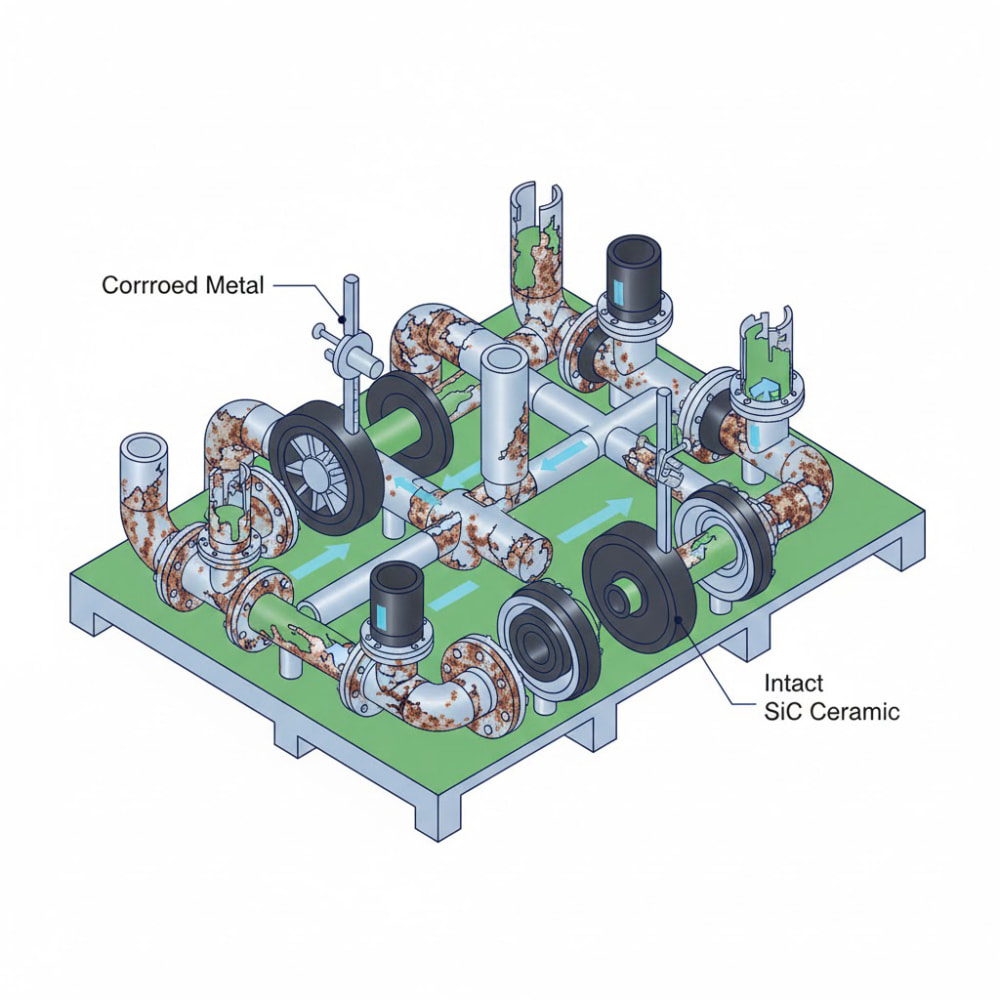
In corrosive industrial service, metals usually lose the fight in slow motion: pitting grows, wall thickness disappears, leakage starts, and “temporary fixes” become the normal operating mode. For process, mechanical and reliability engineers, the question is not whether corrosion happens, but whether the material buys enough safe, predictable life. In many of these environments, silicon carbide ceramics outperform metals by a wide margin.
This guide explains why silicon carbide ceramics outperform metals in corrosive industrial service, where they make the most sense, where their limits are, and how to select and integrate them into real equipment. The focus is on pumps, reactors, scrubbers, heat exchangers, and high-temperature systems where corrosion and erosion are constant threats.
What Do We Mean by Silicon Carbide Ceramics in Corrosive Service?
Silicon carbide (SiC) is a high-performance ceramic built on strong covalent bonds between silicon and carbon atoms. As a material, it combines:
high hardness, high thermal stability, low thermal expansion, and excellent chemical and oxidation resistance. In many corrosive environments, SiC forms a stable, protective silica (SiO2) layer on its surface, which slows further attack.
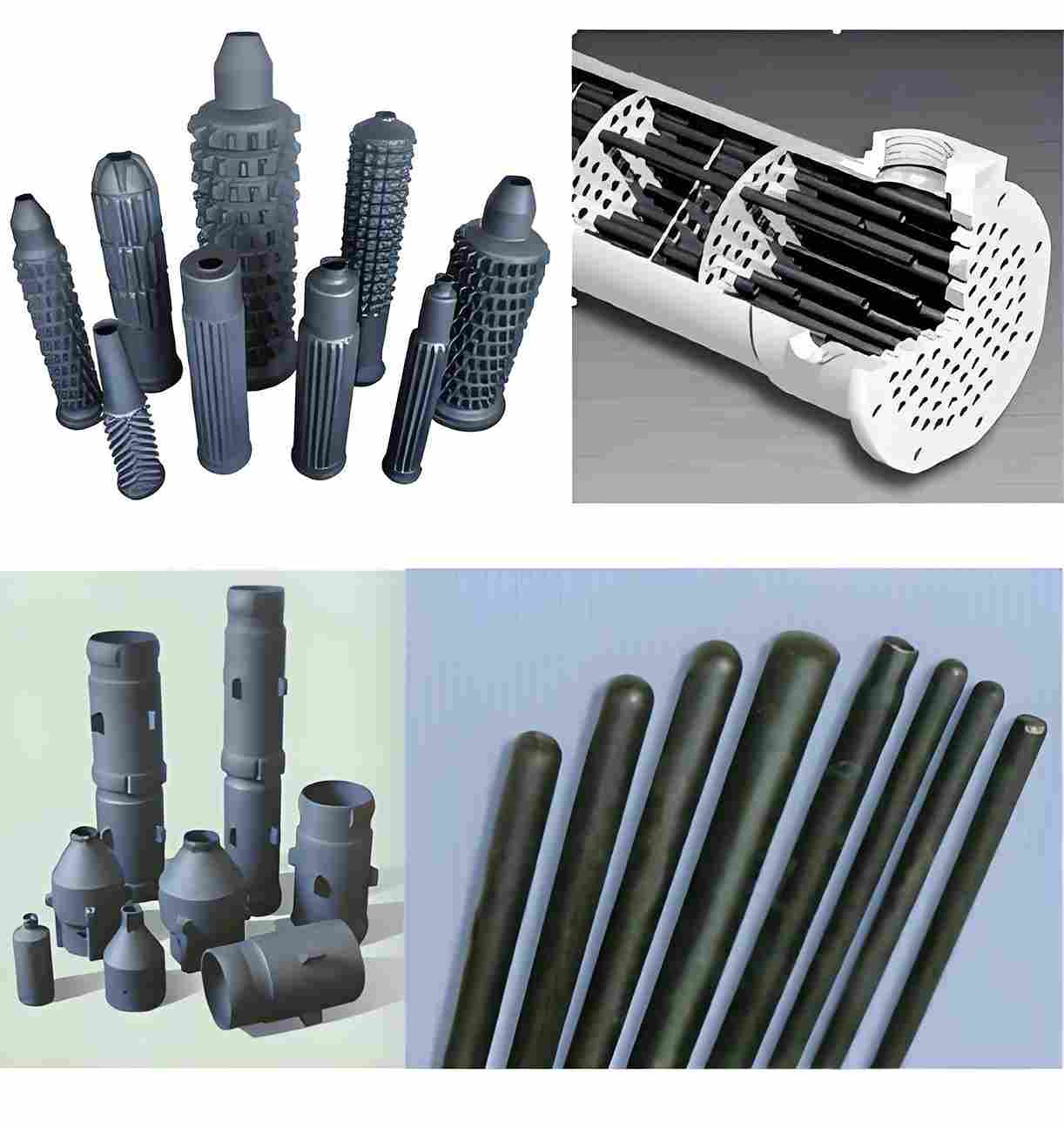
In industrial equipment, “silicon carbide ceramics” typically include:
- mechanical seal rings and bushings in chemical pumps and mixers,
- liners and tiles in corrosive piping, scrubbers and reaction vessels,
- tubes, plates and structural parts in high-temperature corrosive furnaces,
- custom wear and corrosion parts where metals and simple refractories fail too quickly.
These components are not lab curiosities. They are working parts in real equipment, selected because metallic solutions are either at their limit or already failing too often.
Why Metals Struggle in Corrosive Industrial Service
Metals are attractive because they are tough, weldable and familiar. In corrosive service, the same materials that work perfectly in non-aggressive utilities become liabilities.
- General corrosion: steel and many alloys slowly lose wall thickness in acids, alkalis, and salt-rich environments, shortening service life and raising leak risk.
- Pitting and crevice corrosion: common in chloride-bearing and stagnant regions, pitting can perforate walls locally long before average corrosion rates suggest danger.
- Stress corrosion cracking: combinations of tensile stress, specific ions and temperature trigger sudden cracking in stressed metal components.
- High-temperature corrosion: at elevated temperatures, metals oxidize, carburize or sulfidize, producing brittle scales that spall and accelerate degradation.
- Erosion-corrosion: suspended solids, bubbles or high-velocity fluids strip away protective films and passive layers, leaving fresh metal exposed.
- Coating dependence: many metallic systems rely on organic or metallic coatings that can chip, blister or undercut in harsh service.
In low to medium severity service, judicious choice of stainless steels, nickel alloys or liners can be enough. Once you cross into high-acid, high-alkali, mixed oxidizing/reducing or hot corrosive gas regimes, metals start to look fragile and very expensive to keep alive.
Why Silicon Carbide Ceramics Outperform Metals in Corrosive Service
Silicon carbide ceramics do not “rust” and do not depend on the same electrochemical mechanisms as metals. Their behavior in corrosive environments is driven by ceramic chemistry and passive surface layers rather than metallic passivation.
1. Chemical Inertness and Protective Surface Films
In many aggressive industrial environments, silicon carbide behaves as a chemically inert substrate with a protective silica-rich surface. Key points:
- Strong covalent bonds: the Si–C crystal lattice is difficult for corrosive species to penetrate, slowing reaction rates dramatically compared with metals.
- Protective SiO2 film: in oxidizing and many acidic environments, a thin silica layer forms on SiC surfaces and acts as a diffusion barrier to further attack.
- Low solubility: in many acids and neutral environments, material loss rates are extremely low, giving very long service life.
By contrast, metallic corrosion usually accelerates once protective scales crack or spall. Silicon carbide’s ceramic oxide layer tends to be more adherent and stable at temperature.
2. High Temperature + Corrosion Resistance in One Material
Many industrial processes combine high temperature and corrosive chemicals. Metals that are corrosion-resistant at ambient temperature may lose that resistance at elevated temperatures. Silicon carbide ceramics:
- maintain structural integrity well above 1,000 °C,
- resist oxidation and hot gas attack in a wide range of atmospheres,
- offer stable properties in environments where alloys creep, oxidize and crack.
This ability to handle both temperature and corrosion in one material is a key reason SiC is used in high-temperature furnaces, flue gas components and aggressive chemical reactors.
3. Wear and Erosion Resistance in Corrosive Flows
Many corrosive services also involve abrasive particles or high-velocity flow (for example, slurries, catalyst fines, crystallizing salts). In these cases:
- SiC’s very high hardness limits material removal by abrasion,
- smooth, dense surfaces help maintain laminar flow and avoid localized turbulence,
- combined wear + corrosion rates are often far lower than in metallic components.
This combination is especially useful in pump seal faces, bushings, liners and nozzles that see both chemical attack and mechanical wear.
4. No Galvanic Corrosion Risk in Multi-Material Systems
When metals are combined in conductive electrolytes, galvanic corrosion can accelerate attack on less noble components. As an electrical insulator in most liquid-phase conditions, silicon carbide:
- does not act as a sacrificial or attacked partner in galvanic couples,
- can safely interface with multiple metals without creating new galvanic paths.
This simplifies material selection in complex assemblies with multiple metallic alloys and fasteners.
5. More Predictable, Documentable Lifetime
Because silicon carbide corrosion rates are often low and governed by diffusion through a stable surface layer, component life can be more predictable than for metals exposed to localized corrosion modes. That predictability is valuable for:
- planned shutdown scheduling,
- warranty and performance guarantees,
- lifecycle cost calculations in OEM proposals.
The result is not “infinite life” but a narrower, more manageable distribution of lifetimes compared with metallic components pushed near their limits.
Where Silicon Carbide Ceramics Still Have Limits
Silicon carbide ceramics are powerful, not magic. Good design still has to respect their limits.
- Highly alkaline environments: hot concentrated alkalis can attack the silica layer and underlying SiC, especially at high temperatures or under flow.
- Very strong reducing or halogen-containing atmospheres: specific high-temperature reduction/halogenation conditions can degrade SiC more rapidly.
- Brittleness: like other ceramics, SiC has limited fracture toughness compared with metals; impact loads and stress concentrations must be controlled.
- Complex machining and joining: geometry and tolerances must be designed with ceramic forming, sintering and grinding capabilities in mind.
- Higher piece price: unit cost is higher than commodity metals; the business case relies on longer life, better performance and reduced downtime.
The practical conclusion: use silicon carbide where corrosion, wear, temperature or some combination of the three are already causing real problems, and handle design, supports and interfaces carefully.
Selection Criteria for Silicon Carbide vs Metals in Corrosive Service
When you decide whether to use SiC or metal for a component, treat it as an engineering decision with a clear checklist.
1. Chemistry and Phase of the Corrosive Medium
- Liquids: strong mineral and organic acids, mixed acid streams, caustics, salt solutions, organic solvents, slurries.
- Gases: hot flue gases, chlorinated or sulfur-bearing gases, oxidizing or mildly reducing atmospheres.
- Molten phases: molten salts, molten metals, slags.
For each case, ask: is there a metallic alloy that can handle this service at the required temperature, or does it require constant upgrades and replacements? If the answer involves repeated failures or increasingly exotic alloys, SiC should be on the shortlist.
2. Temperature, Pressure and Cycling
- Maximum operating temperature and excursions,
- pressure and pressure fluctuations,
- thermal cycling and upset conditions.
SiC shows its strongest advantage when high temperature and corrosion occur together, especially under cycling. For purely ambient-temperature corrosion, polymers and composites may also be candidates.
3. Wear, Slurry and Erosion Components
- Presence of solids, crystallizing salts or catalyst fines,
- flow velocity and turbulence,
- impingement zones and sudden direction changes.
Where erosion-corrosion or slurry wear is part of the picture, silicon carbide’s hardness and wear resistance often turn a chronic failure point into a stable component.
4. Component Function and Failure Consequences
- Is this a non-critical, easy-to-replace part? Metals may still be adequate.
- Does failure cause leaks, environmental incidents or long downtime? SiC is more attractive, even with higher piece price.
- Is the component already on the “bad actor” list? Chronic failures justify a more aggressive material step.
5. Silicon Carbide Grade and Microstructure
“Silicon carbide” covers several material families:
- Reaction-bonded SiC: dense, strong and widely used in structural and corrosion components.
- Sintered SiC: very high corrosion resistance and strength, typically used where the environment is extreme and tolerances are tight.
- Nitride-bonded or recrystallized SiC: used where specific combinations of thermal shock resistance, strength and corrosion behavior are required.
Grade selection depends on chemistry, temperature, mechanical load and required lifetime. The right grade can provide a large performance margin over metallic alternatives.
Silicon Carbide Component Families Relevant to Corrosive Service
Zirsec provides silicon carbide products organized in focused component families, described on the Zirsec Types overview. For corrosive industrial service, typical component categories include:
- SiC sealing rings and faces: mechanical seal rings and bushings for chemical pumps and mixers, detailed on the SiC sealing rings page.
- SiC crucibles and linings: crucibles and lined components for corrosive molten metal and thermal process contact, as discussed for crucible products under SiC crucibles.
- SiC tubes and plates: tubes, plates and structural parts in high-temperature corrosive gas environments, integrated into high-temperature furnace applications.
- Custom SiC wear and corrosion parts: liners, nozzles, inserts and other shapes designed around specific pump, valve, scrubber or reactor geometries.
These component families allow OEMs and end users to address chronic corrosion and erosion problems without redesigning the entire system around exotic metallic alloys.
Applications and Use Cases in Corrosive Industrial Service
Silicon carbide ceramics are used wherever corrosion and wear undermine metallic solutions. Typical use cases include:
- Chemical pumps and mixers: SiC seal faces, bushings and liners handle acids, caustics, solvents and slurries in chemical processing applications.
- Gas scrubbers and flue gas desulfurization (FGD): SiC liners, tiles and nozzles withstand hot, corrosive gas-laden streams, droplets and slurries.
- Heat exchangers and reactor internals: SiC tubes and inserts handle corrosive fluids at elevated temperature where alloy tubes suffer rapid attack.
- High-temperature furnaces with corrosive atmospheres: SiC tubes, plates and beams operate in oxidizing or mildly corrosive atmospheres at temperatures that push alloys beyond safe limits.
- Slurry and mineral processing: SiC liners and components resist combined abrasion and corrosion in aggressive slurries.
These applications rely on the same core material behavior: limited chemical reactivity, strong surface passivation, high hardness and high temperature capability.
FAQs: Silicon Carbide Ceramics vs Metals in Corrosive Service
1. Are silicon carbide ceramics “immune” to corrosion?
No material is completely immune. Silicon carbide exhibits very high resistance to many acids, oxidizing environments and corrosive gases, especially at elevated temperatures, but it still has limits. Highly alkaline, strongly reducing or special halogen-containing environments can attack SiC more aggressively and must be evaluated case by case.
2. Why are metals still used so widely if SiC is better in corrosion?
Metals are easier to fabricate, weld and machine; they have higher fracture toughness; and their initial cost is usually lower. For mild to moderate corrosion, alloys and coatings are often good enough. Silicon carbide becomes attractive where corrosion, temperature or wear have already made metal solutions expensive and unreliable.
3. Can silicon carbide components replace metal parts one-to-one?
Sometimes, but not always. A SiC seal ring can often replace a metal or carbon ring with minimal design changes. Structural components like tubes, plates or beams usually require review of supports, spans and interfaces to account for ceramic behavior and differential expansion with surrounding metals.
4. How do I know if silicon carbide is suitable for a specific corrosive medium?
Start with a clear description of the medium: composition, pH, temperature, pressure, flow regime and presence of solids. Compare that against known SiC corrosion data and experience. In borderline cases, it is common to run a pilot test or limited field trial. External references on corrosion and materials selection, such as general corrosion overviews, can provide context, but final decisions should rely on application-specific data.
5. Does silicon carbide corrode in caustic or alkaline service?
Silicon carbide is generally more vulnerable in hot concentrated alkaline environments than in many acidic ones, especially under strong flow or at high temperature. In such cases, grade selection, operating temperature and flow conditions must be examined carefully. Sometimes a hybrid solution (SiC in acid lines, alternative ceramics or alloys in alkaline lines) is optimal.
6. How does cost compare between SiC and metallic solutions?
On a per-piece basis, SiC ceramics are more expensive than common steels and many stainless steels, and often comparable to or below high-end nickel alloys. The real comparison should be based on lifecycle cost: expected life, failure consequences, downtime and energy or efficiency impacts. In harsh corrosive service, SiC frequently lowers overall cost even when unit price is higher.
7. How are silicon carbide components integrated into OEM designs?
OEMs typically treat SiC components as standardized engineering parts with defined operating limits. Drawings and specifications include SiC grade, maximum temperature, allowable media, expected life and interface conditions. It is common to co-design supports, seals and joints with the supplier to ensure that ceramic components are not over-constrained or subjected to avoidable impact loads.
Get a Silicon Carbide Corrosion Solution Built Around Your Service
If your current metallic components are struggling in corrosive industrial service, replacing them with slightly more exotic alloys is often just a delay, not a solution. A better path is to combine your real process data – chemistry, temperature, pressure, flow, cycling and failure history – with the silicon carbide ceramic families in the Zirsec Types overview and the Chemical Processing Applications pages.
With a short, structured set of inputs, Zirsec’s engineering team can map where silicon carbide ceramics realistically outperform metals in your system, which component types are most promising, and how to integrate them into OEM designs and MRO programs so that corrosion becomes a controlled variable, not a recurring surprise.