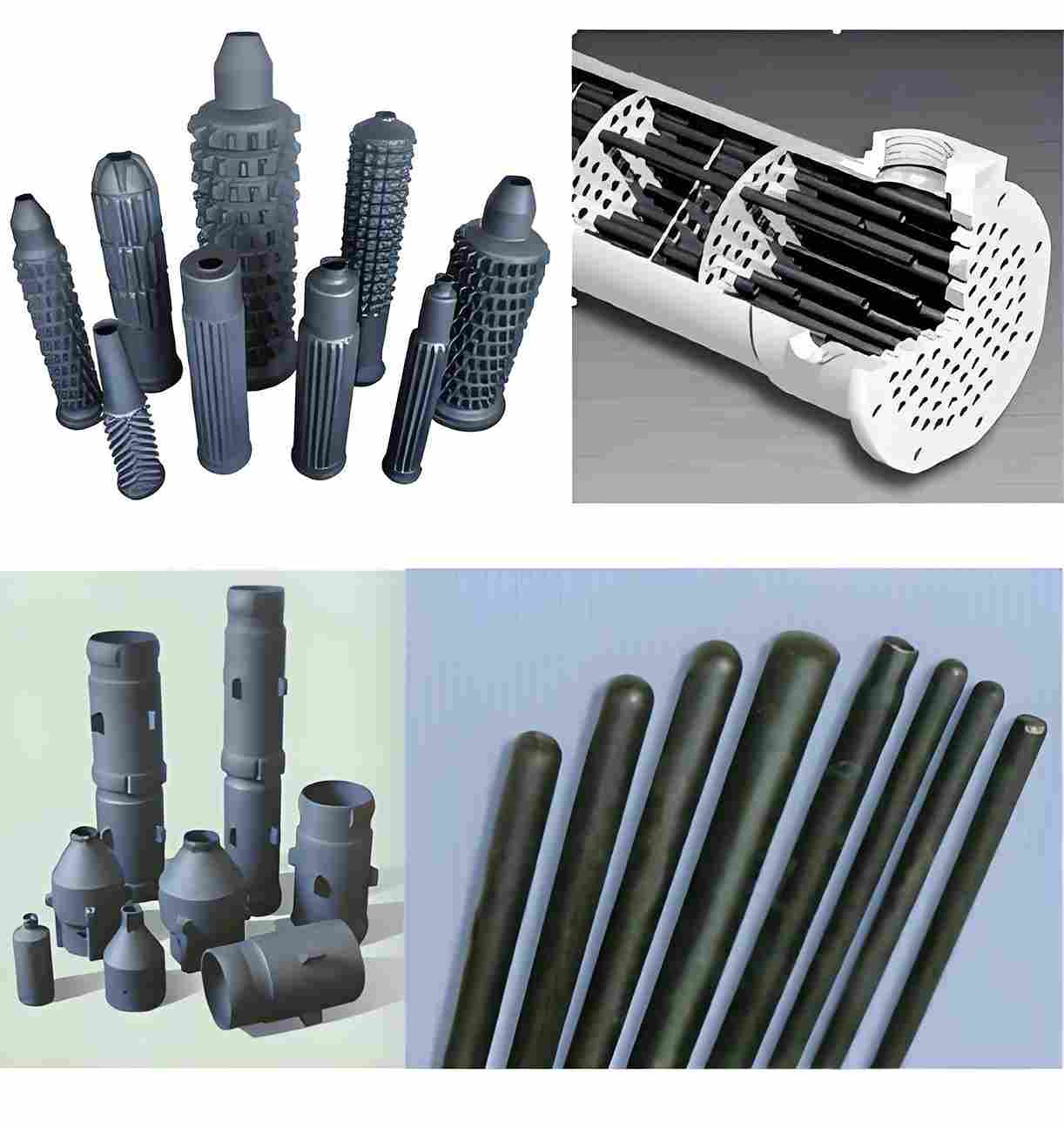
When a furnace or a high‑temperature process line needs reliable thermocouple protection and a radiant heat conduit, the choice of silicon carbide (SiC) tube can determine whether the equipment runs for years or fails after weeks.
Quick Summary (FAQ)
- What makes SiC the preferred material for thermocouple protection? It combines >1500°C continuous service temperature, excellent oxidation resistance, and superior wear resistance compared with Al2O3 or Si3N4.
- Which dimensions should I specify? Standard wall thicknesses (1‑3 mm) cover most K‑type and Type N thermocouples; custom wall thicknesses are required for high‑pressure or high‑flow applications.
- How does ZIRSEC guarantee dimensional accuracy? Our in‑house CNC grinding workstation achieves ±0.2 mm tolerance on OD/ID and surface roughness Ra 0.8‑3.2 µm.
- What is the typical lead time? Stock sizes ship within 24 h; custom drawings are prototyped in 2‑4 weeks, with full‑scale production in 4‑8 weeks.
- Can I get a single‑piece sample? Yes – we provide a 5‑piece trial run for engineering validation.
Why Silicon Carbide Beats Competing Ceramics
In high‑temperature environments the material must survive three simultaneous stresses: thermal load, chemical attack, and mechanical abrasion. Below is a concise comparison:
| Property | SiC | Al2O3 | Si3N4 |
|---|---|---|---|
| Continuous service temp. | ≥1600 °C | ≈1150 °C | ≈1300 °C |
| Thermal shock resistance | Excellent (ΔT > 1000 °C) | Good | Very good |
| Oxidation resistance | Forms protective SiO₂ layer | Limited | Forms SiO₂ but slower |
| Wear rate (mm³/h) | 0.02 | 0.12 | 0.08 |
| Typical compressive strength | ≥1300 MPa | ≈1500 MPa | ≈950 MPa |
For thermocouple sleeves that sit directly in corrosive flue gases, the SiO₂ passivation film is the decisive factor. Even when the temperature swings rapidly, SiC retains its structural integrity, reducing sensor drift and preventing catastrophic breakage.
Key Selection Criteria
1. Operating Temperature Range
Identify the maximum continuous temperature of your process. If the furnace peaks above 1500 °C, select a tube certified for 1600 °C or higher. ZIRSEC’s Grade‑A SiC tubes are tested up to 1800 °C in inert atmosphere, providing a safety margin for occasional spikes.
2. Chemical Environment
Flue gases may contain H₂S, Cl‑bearing compounds, or molten salts. SiC resists most chlorides and sulfides; however, in highly alkaline molten salts (e.g., Na₂CO₃) a thin protective coating (Al₂O₃ or Y₂O₃) is advisable. Our engineering team can suggest a coating based on your MSDS data.
3. Mechanical Loads
Thermocouple sleeves often experience axial tension from compression springs and bending from pipe routing. For pressures >2 MPa, increase wall thickness to 2‑3 mm or adopt a double‑wall design (inner SiC tube with outer metal reinforcement). ZIRSEC manufactures double‑wall SiC‑metal hybrid tubes on demand.
4. Dimensional Tolerances
Standard thermocouple diameters are 6 mm (ID) for Type K and 8 mm for Type N. Our catalog provides ID/OD combos with ±0.2 mm tolerance. When you need sub‑0.1 mm precision for tight‑clearance reactors, we mill the tube after sintering and certify each batch with a COA.
5. Installation Geometry
Radiant tubes are often bent into elbows or fitted into flanged housings. SiC can be machined to 90° bends with a radius of 1.5 × wall thickness without cracking. For tighter radii, we recommend a mandrel‑bending process that preserves micro‑structure.
Designing for Thermocouple Protection
Below is a step‑by‑step workflow we have refined with more than a dozen steel‑making plants:
- Define sensor type and sheath length. A 300 mm long K‑type sensor typically needs a 6 mm ID, 1 mm wall sleeve.
- Map process temperature profile. Record peak, dwell, and cooldown rates. If ΔT > 800 °C per minute, choose a tube with high thermal shock coefficient (≤4 × 10⁻⁶ K⁻¹).
- Select surface finish. For high‑velocity gas streams, Ra ≤ 1 µm reduces fouling; for static zones, Ra ≤ 3 µm is acceptable.
- Validate chemical compatibility. Run a 48 h corrosion test in a simulated gas mixture; ZIRSEC can provide test data on request.
- Confirm mechanical fit. Verify clearance with a go/no‑go gauge. Our tolerance report includes a 3‑σ confidence interval.
- Place the tube. Insert the SiC sleeve, secure with a ceramic‑compatible compression spring, and terminate with a stainless‑steel flange sealed with a high‑temperature ceramic‑based gasket.
Following this workflow eliminates the most common failure modes – cracking due to thermal shock, oxidation‑induced sensor drift, and unwanted metal‑ceramic interaction.
Designing for Radiant Heat Transfer
When SiC tubes act as radiant emitters (e.g., in infrared heaters or furnace wall panels), the geometry and surface emissivity become critical.
Emissivity Management
Pure SiC exhibits an emissivity of 0.85‑0.90 across 800‑1500 °C. If you need higher radiative output, a matte SiC coating (SiC‑SiO₂‑Al₂O₃) can push emissivity to >0.95. Conversely, a polished SiC surface reduces emissivity to ~0.70, useful for selective heating.
Tube Arrangement
Array spacing should be 1‑2 × tube outer diameter to avoid shadowing while maintaining structural rigidity. For a 25 mm OD tube, a 30‑40 mm pitch provides 80 % surface exposure.
Thermal Expansion Compatibility
Mount SiC tubes in a metal frame made from Inconel 718 or a high‑temperature stainless steel (e.g., 310S). The matching coefficient of thermal expansion (≈4.5 × 10⁻⁶ K⁻¹) minimizes stress at the joints.
Case Studies
Case 1 – European Pump‑Valve Manufacturer
Problem: Frequent thermocouple failures in a high‑pressure, chlorine‑rich furnace resulted in $15,000 weekly downtime.
Solution: ZIRSEC supplied 6 mm ID, 2 mm wall SiC sleeves with a Y₂O₃ surface coating. The sleeves were machined to ±0.15 mm tolerance and installed with an Inconel compression spring.
Result: Sensor lifespan increased from 3 weeks to over 12 weeks; downtime reduced by 80 %; ROI realized in 4 months.
Case 2 – North‑American Steel Re‑heat Furnace
Problem: Radiant heating panels made of stainless steel warped after 800 °C cycles, causing uneven temperature distribution.
Solution: Replaced steel panels with a modular SiC tube array (Ø 25 mm, 3 mm wall, polished finish). The array was mounted on a 310S steel frame with isolation gaskets.
Result: Uniform heat flux improved by 22 %; panel life extended beyond 5 years; fuel consumption dropped 5 % due to better emissivity.
Case 3 – Asian Chemical Reactor Upgrade
Problem: Existing Al₂O₃ thermocouple protectors cracked under rapid temperature swings (ΔT ≈ 1100 °C/min).
Solution: ZIRSEC provided custom‑bent SiC tubes with a 1.5 mm wall, engineered to survive rapid ramps. Each tube was validated in‑house with a thermal shock test chamber.
Result: No cracks after 10,000 thermal cycles; process stability improved; the client avoided a costly redesign of the reactor vessel.
How ZIRSEC Supports Your Project
- Instant stock availability. Over 150 standard SiC tube sizes are on hand for same‑day shipment.
- Custom engineering. Our in‑house engineers collaborate on CAD drawings, perform finite‑element stress analysis, and suggest surface treatments.
- Quality assurance. Every batch receives a Certificate of Analysis (COA), X‑ray diffraction pattern, and dimensional inspection report.
- Logistics expertise. We handle export documentation, arrange temperature‑controlled containers, and provide door‑to‑door tracking.
- After‑sales support. A dedicated technical account manager remains on‑call for installation queries and performance monitoring.
Explore our full catalog of SiC tubes here: ZIRSEC silicon carbide tubes.
Action Checklist – Before You Place an Order
- Gather process data: max temperature, gas composition, pressure, flow velocity.
- Define tube dimensions: ID, OD, wall thickness, bend radius.
- Choose surface finish and any protective coating.
- Prepare a CAD drawing or technical sketch and attach material compatibility notes.
- Contact ZIRSEC via info@zirsec.com with the drawing; request a free feasibility report.
- Approve the prototype sample; schedule production run.
- Confirm shipping terms (Incoterms DDP preferred for North America & Europe).
Following this checklist ensures you receive a tube that fits perfectly, lasts longer, and protects your investment.
Conclusion
Choosing the right silicon carbide tube is not a matter of picking the lowest price; it requires matching material performance to temperature, chemistry, mechanical load, and geometry. By applying the selection framework above, you eliminate guesswork, reduce downtime, and unlock the full efficiency of thermocouple protection and radiant heating systems. ZIRSEC’s 20‑year manufacturing pedigree, on‑site engineering support, and rapid‑delivery model make us the ideal partner for any high‑temperature application.
Ready to upgrade your furnace or sensor system? Reach out today, share your specifications, and let our experts deliver a tailored SiC solution that keeps your process running flawlessly.