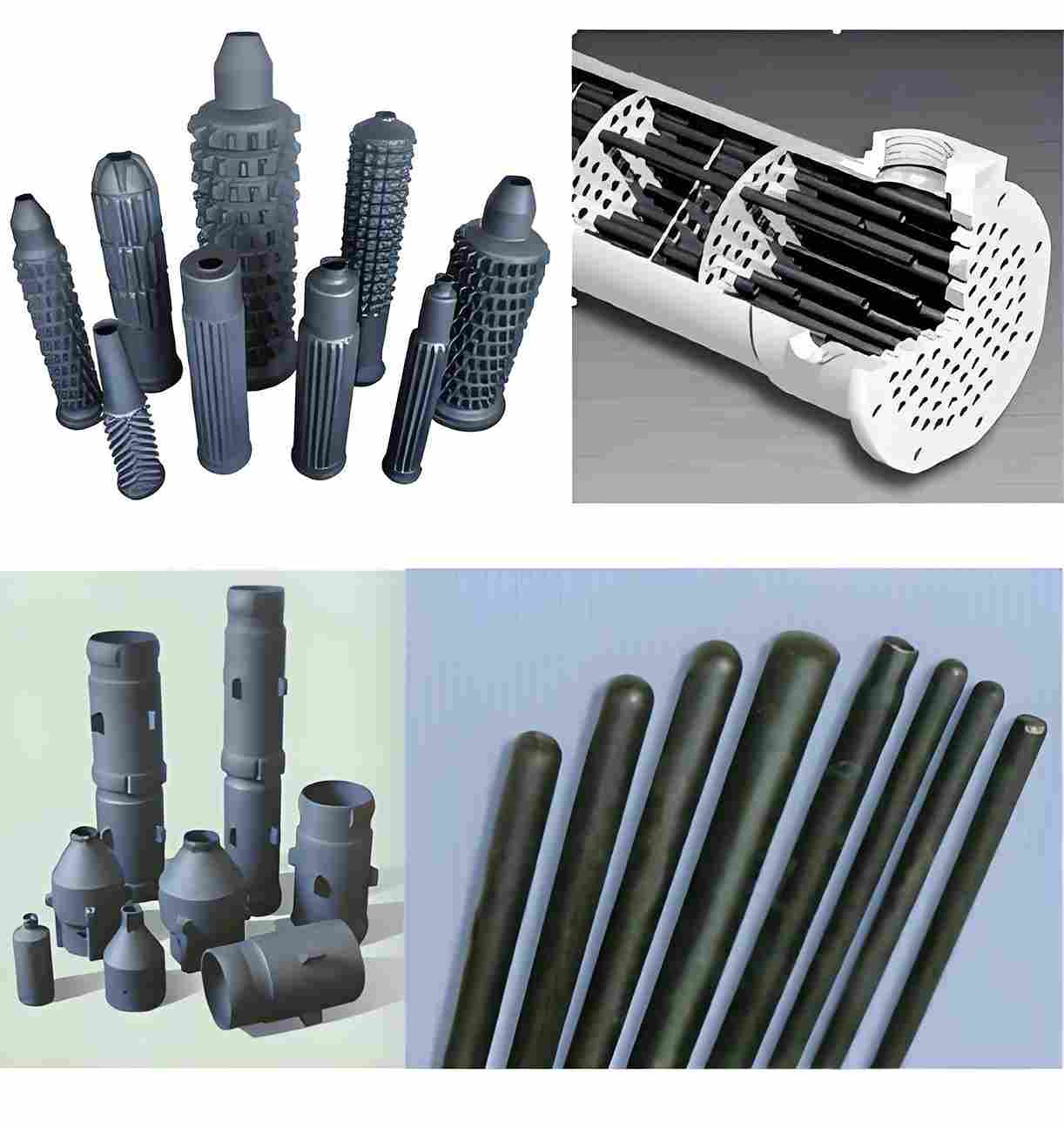
In a flue gas desulfurization (FGD) system, the spray nozzles are the small components that decide whether your SO2 removal targets are hit or missed. They sit in hot, dirty, corrosive gas streams, spraying abrasive limestone slurry for thousands of hours. When nozzles wear, plug or lose their spray pattern, the result is simple: unstable emissions, unplanned maintenance and annoyed operators.
This guide explains how to select silicon carbide nozzles for flue gas desulfurization, why SiC is the material of choice for harsh FGD duty, and how Zirsec supports OEMs and plant engineers with practical, specification-level solutions.
What Are Silicon Carbide Nozzles for FGD?
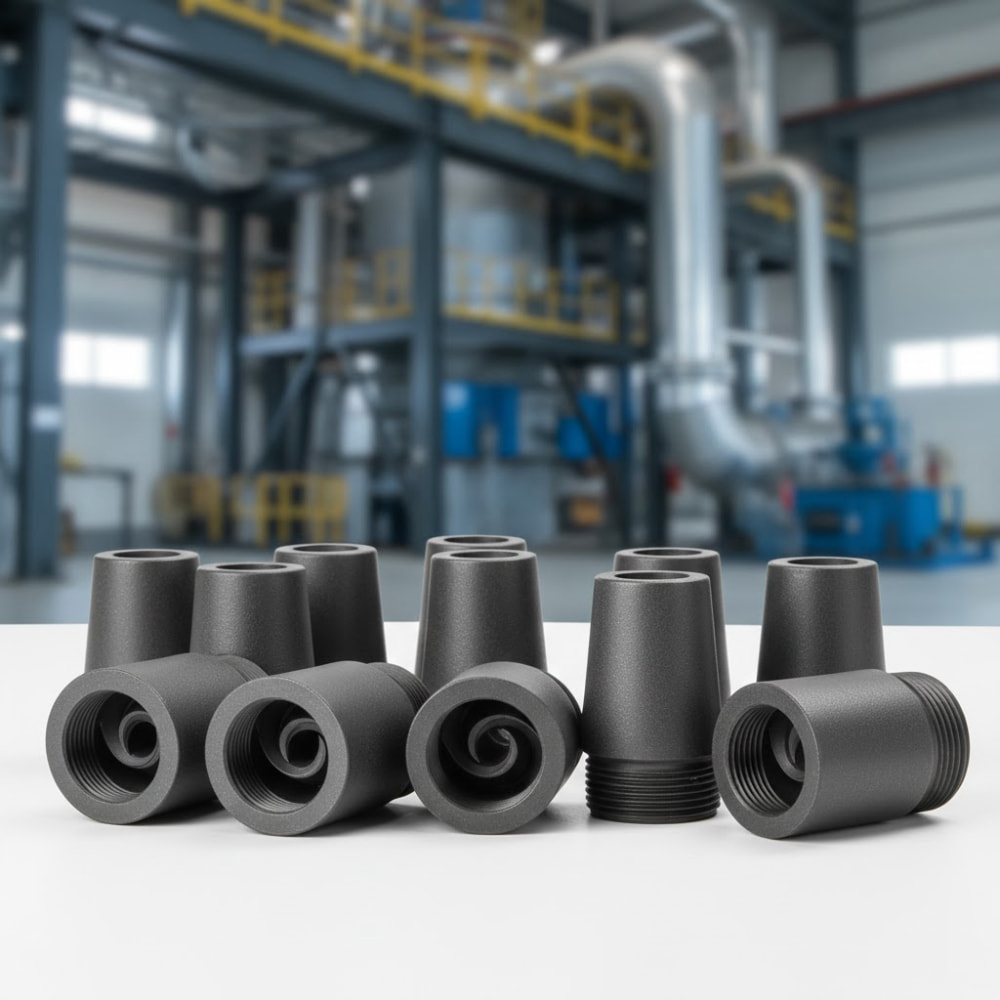
Silicon carbide (SiC) FGD nozzles are ceramic spray nozzles specifically designed for wet flue gas desulfurization systems. They are installed in absorber towers to atomize the scrubbing slurry (usually limestone or lime in water) into fine droplets. These droplets react with SO2 in the flue gas, forming gypsum or other salts that can be removed from the system.
Unlike metal or plastic nozzles, silicon carbide nozzles are made from an advanced ceramic with very high hardness, excellent wear resistance and strong chemical stability. In practice, that means they maintain orifice size, spray angle and pattern far longer under abrasive, acidic conditions, which directly stabilizes FGD performance and reduces nozzle-related downtime.
Common Problems with Conventional FGD Nozzles
If you are still running metal or plastic nozzles in an FGD scrubber, you have probably seen some of these issues:
- Rapid erosive wear: Slurry particles and fly ash enlarge the orifice, which changes the flow rate and droplet size and destroys the design spray pattern.
- Corrosion and pitting: Acidic, chloride-containing environments attack stainless steels and many alloys, leading to surface damage and early failure.
- Frequent plugging: Narrow internal passages fill with solids or scale, causing mis-sprays, dead zones and higher SO2 slip.
- Unpredictable lifetime: Different batches or suppliers lead to inconsistent service life, making outage planning difficult.
- High maintenance demand: Maintenance teams spend valuable time opening the absorber and swapping nozzles instead of improving process stability.
Most of these problems are not “operator errors”; they are a direct consequence of using nozzle materials that cannot survive the real FGD environment. This is exactly where silicon carbide becomes valuable.
Key Selection Criteria for Silicon Carbide FGD Nozzles
Once you have decided to use silicon carbide, the next step is choosing the right nozzle design and specification. Below are the main criteria engineers should work through before ordering.
1. Scrubber Design and Spray Pattern
The absorber tower geometry and gas flow profile determine what spray pattern you need:
- Hollow cone: Common in FGD towers; produces a ring-shaped spray ideal for overlapping coverage and uniform gas–liquid contact.
- Full cone (solid cone): Fills the entire cone volume with droplets; suitable for zones requiring dense spray, such as near inlets or in compact towers.
- Spiral / large free passage designs: Favored when plugging is a major concern or when slurry has large particles.
Clarify: tower diameter, spray level height, nozzle layout (number per header), and required spray angles (e.g. 60°, 90°, 120°). This ensures your silicon carbide nozzle pattern and angle actually match the gas cross-section instead of leaving “dry” regions.
2. Flow Rate, Pressure and Droplet Size
Nozzle hydraulics must match your pump and process requirements:
- Define design flow rate per nozzle (m3/h or L/min) at a specific operating pressure (bar).
- Check your pump curve to ensure the system can maintain the required pressure at that flow.
- Target a droplet size range that balances high surface area (for absorption) with droplet mass (to avoid carryover).
For the same flow rate, higher pressure produces smaller droplets but increases pump energy. Silicon carbide nozzles can handle higher pressures safely, but the sweet spot should be selected based on your absorber design and fan/pump limitations.
3. Slurry Composition and Solids Loading
FGD slurries are not all equal. When selecting nozzle design and internal passage size, consider:
- Solids concentration: Higher solids content increases erosive wear and plugging potential.
- Particle size distribution: Larger particles require larger free passage to avoid clogs.
- Scaling tendency: Some systems are more prone to gypsum or other deposits; internal contours should discourage buildup.
For abrasive, scaling-prone slurries, a silicon carbide spiral or large-passage hollow cone nozzle can significantly reduce plugging while still benefiting from SiC’s wear resistance.
4. Silicon Carbide Grade and Expected Lifetime
Not all silicon carbide is the same. For FGD nozzles, you typically see two main types:
- Reaction-bonded SiC (RBSiC / SiSiC): High density, very good wear and corrosion resistance, cost-effective for mainstream FGD duty.
- Sintered SiC (SSiC): Very low porosity, excellent chemical resistance and strength, used where the environment is extremely aggressive or where maximum lifetime is critical.
For most power plant and industrial FGD scrubbers, RBSiC delivers an excellent lifetime-to-cost ratio. Define your target lifetime (for example, one or two outage intervals), then use that as a benchmark when evaluating different nozzle options and suppliers.
5. Mechanical Interface and Maintenance Concept
The nozzle’s mechanical connection must survive the environment and be maintenance-friendly:
- Threaded, flanged or clamped connections must match your existing headers.
- Adapters may be needed to transition from metal pipework to ceramic nozzles without overstressing the ceramic.
- Consider whether nozzles can be swapped from outside or require full entry; this affects your choice of connection and overall nozzle size.
Involving your mechanical and maintenance teams early will help avoid nozzle designs that are theoretically good but painful to install or replace in real space constraints.
Zirsec Silicon Carbide FGD Nozzles: Product Overview and Specifications
Zirsec manufactures silicon carbide nozzles specifically for flue gas desulfurization applications. Our designs focus on high wear resistance, stable spray performance and easy integration into existing scrubber systems. Below is an example of typical specification ranges for Zirsec SiC FGD nozzles (values can be customized to project requirements):
| Parameter | Typical Range / Example |
|---|---|
| Nominal size | DN 40 / DN 50 / DN 65 / DN 80 |
| Spray pattern | Hollow cone / Full cone / Spiral |
| Spray angle | 60° / 90° / 120° (custom on request) |
| Flow rate (at 2 bar) | 3 – 20 m³/h per nozzle (project-specific) |
| Design pressure | Up to 6–10 bar, depending on model |
| Material grade | RBSiC (SiSiC) as standard; SSiC available for special duty |
| Hardness | ≈ HV0.5 ≥ 2200–2600 (grade-dependent) |
| Max service temperature | Up to 1300–1400 °C in oxidizing atmosphere |
| Chemical resistance | Excellent in acidic and chloride-containing FGD slurries |
| Connection options | Threaded adaptors, flanged seats, custom clamp designs |
For OEM projects and retrofits, Zirsec can match existing nozzle envelopes or develop new geometries according to your absorber drawings. Standard sizes can be stocked for faster delivery, while fully custom designs follow a controlled sampling and validation process.
Suggested next step: if you already know your flow, pressure and tower geometry, you can send those parameters to Zirsec and receive a recommended SiC nozzle configuration and quotation.
Where Zirsec SiC Nozzles Are Typically Used
Zirsec silicon carbide FGD nozzles are used in a wide range of gas-cleaning systems, including:
- Coal-fired and biomass power plant wet FGD absorbers
- Waste-to-energy and municipal solid waste incinerator scrubbers
- Cement and lime kiln exhaust gas scrubbers
- Non-ferrous metal smelter off-gas desulfurization units
- Refinery and petrochemical boiler/exhaust gas scrubbers
In each case, the value is the same: longer nozzle lifetime, more stable spray performance and fewer surprises during outages.
How Zirsec Supports OEMs and Plant Engineers
Choosing the right silicon carbide nozzle is not just picking a catalog part number. Zirsec works with you through the engineering and supply process:
- Engineering consultation: Review of absorber geometry, spray levels, liquid distribution and process data to select suitable nozzle types and SiC grades.
- Drawing and sample support: 2D/3D drawings for approval, small-batch samples for field trials and fast iteration based on test feedback.
- Flexible production: Support for small pilot orders and larger mass production, with stable quality between batches.
- Integrated quality control: Material inspection, dimensional checks and performance validation for each production run.
- Export-ready logistics: Packaging, documentation and shipping support for international projects.
For OEMs, this means a development partner that helps you design a robust FGD system from day one. For end users and retrofit projects, it means a realistic upgrade path from problematic nozzles to a stable SiC solution.
FAQs about Silicon Carbide Nozzles for FGD
1. Are silicon carbide FGD nozzles always better than metal nozzles?
In abrasive, corrosive FGD duty, yes, silicon carbide almost always delivers a longer lifetime and more stable spray performance than typical metal alloys. The unit price is higher, but total cost of ownership is usually lower once you factor in reduced replacement and downtime.
2. How do I know what spray angle and pattern I need?
Start from your absorber drawings: tower diameter, gas inlet position, spray level spacing and header layout. From there, you can calculate the coverage needed and choose hollow or full cone patterns with appropriate angles. Zirsec can assist by reviewing drawings and proposing configurations.
3. Do silicon carbide nozzles plug more easily because they are ceramic?
No. Plugging is primarily a function of passage size and slurry characteristics, not the fact that the material is ceramic. In many cases, SiC spiral or large-passage designs plug less frequently, while still resisting wear much better than metal or plastic designs.
4. Can Zirsec match my existing nozzle’s dimensions for an easy retrofit?
In most cases, yes. Zirsec can measure your existing nozzle or work from drawings to produce a silicon carbide version with the same envelope and connection, so you can upgrade material without reworking pipework.
5. How should I budget for silicon carbide nozzle lifetimes?
Actual lifetime depends on slurry abrasiveness, operating hours and maintenance practice, but many users see service life improve by a factor of 3–4 compared with metal or plastic designs. After the first operating cycle, Zirsec can help you refine lifetime estimates based on inspection results.
Get a Tailored Silicon Carbide Nozzle Recommendation from Zirsec
If your FGD system is struggling with nozzle wear, plugging or unstable SO2 removal, it is probably time to move to silicon carbide. You do not need to guess the right design alone.
Prepare these basic data points:
- Absorber drawings (tower diameter, spray levels, header layout)
- Flow and pressure ranges per spray level
- Slurry composition and solids content
- Known issues with current nozzles (wear, plugging, pattern problems)
Send this information to Zirsec, and our engineering team will propose a silicon carbide nozzle configuration, including recommended patterns, sizes and material grades. From sample to mass production, we help you turn nozzle selection into a controlled engineering decision instead of trial-and-error.
Ready to upgrade your flue gas desulfurization nozzles? Get in touch with Zirsec for a project-specific SiC nozzle solution that is designed to last in real industrial conditions.