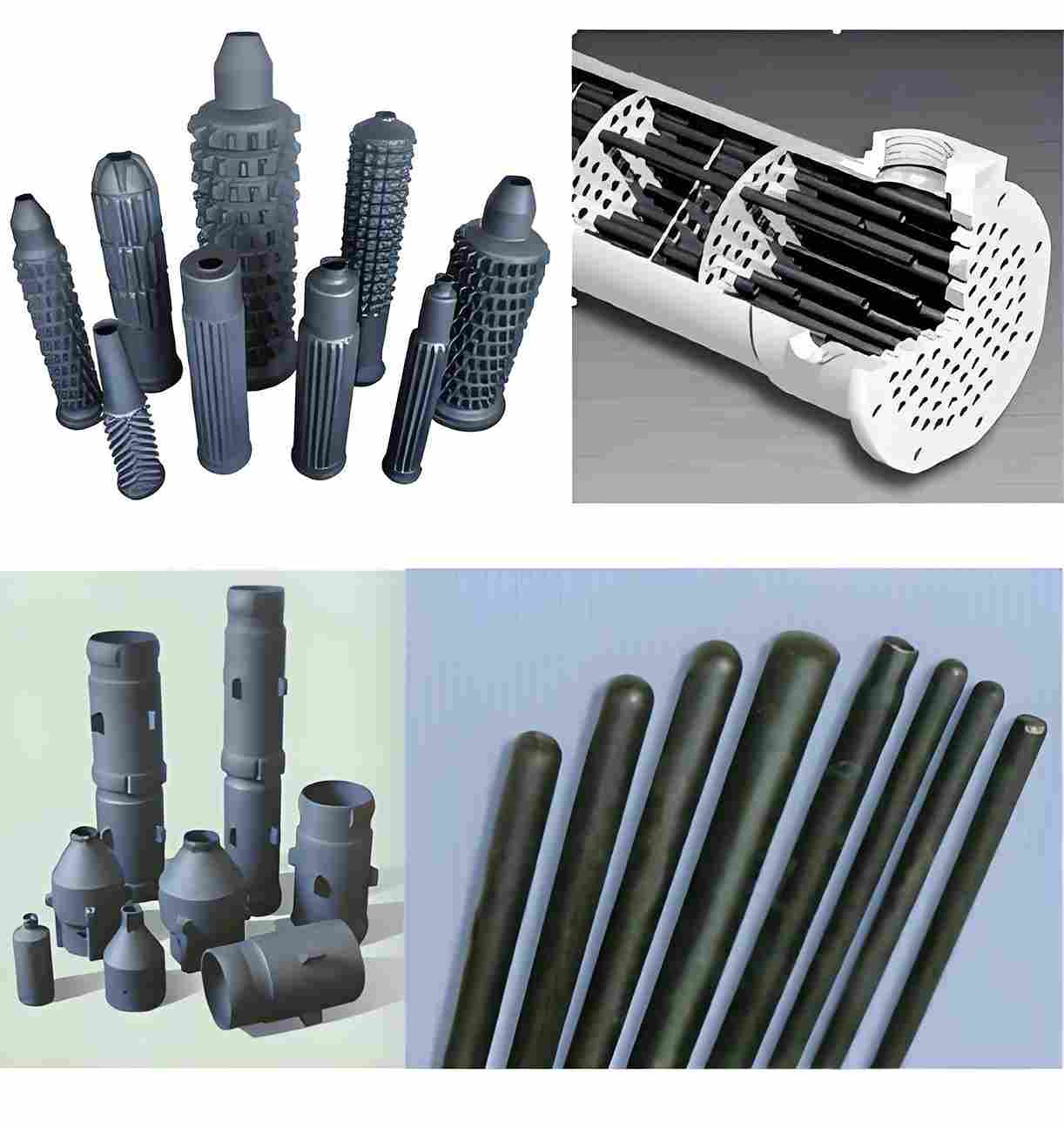
Choosing the right silicon carbide grade is just as important as choosing silicon carbide itself. Two of the most widely used engineering grades are RBSiC (reaction-bonded silicon carbide) and SSiC (sintered silicon carbide). On datasheets they both look like “SiC ceramics”, but in real equipment their behaviour can be very different.
Understanding the trade-offs between RBSiC vs SSiC helps you avoid over-specifying expensive material where it is not needed – or under-specifying and paying for premature failures, downtime and redesigns.
This guide explains what each grade is, compares their key properties and shows where each one works best in industrial applications such as tubes, kiln furniture, plates and mechanical components.
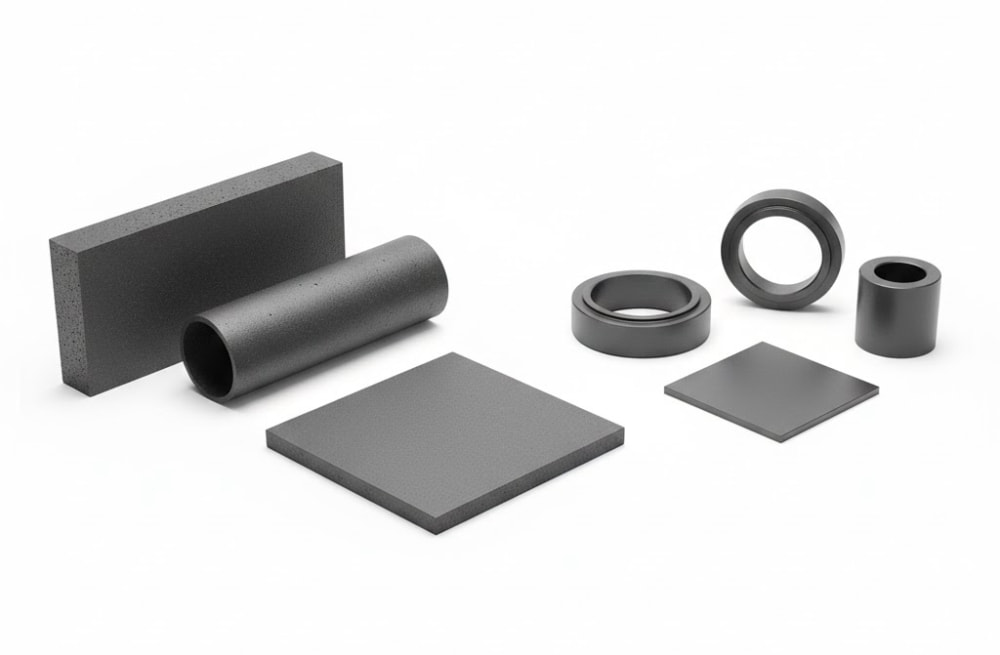
What Is RBSiC (Reaction-Bonded Silicon Carbide)?
RBSiC (reaction-bonded silicon carbide) is produced by infiltrating a porous preform (usually containing SiC and carbon) with molten silicon. During the process, silicon reacts with carbon to form more silicon carbide, filling the pores.
Typical characteristics:
- High strength with good stiffness
- Very good thermal shock resistance
- Good dimensional stability in complex shapes
- Some residual free silicon in the final microstructure
RBSiC is widely used for:
- Beams and supports in kilns and furnaces
- High-temperature SiC tubes and radiant components
- Furnace furniture and structural parts under thermal cycling
What Is SSiC (Sintered Silicon Carbide)?
SSiC (sintered silicon carbide) is produced by pressureless sintering of very fine, high-purity SiC powders, without the need for free silicon infiltration.
Typical characteristics:
- Very high purity and low porosity
- Excellent corrosion resistance in many liquids and gases
- Very high hardness and wear resistance
- High strength, including at elevated temperature
SSiC is often selected for:
- Mechanical seal rings in aggressive chemical service
- High-purity semiconductor and clean-process components
- Precision mechanical parts where leakage and contamination must be minimised
RBSiC vs SSiC – Key Property Comparison
While exact numbers depend on the specific grade and manufacturer, the trends below are typical for engineering design.
| Property | RBSiC (Reaction-Bonded SiC) | SSiC (Sintered SiC) | Design Implication |
|---|---|---|---|
| Microstructure | SiC with residual free silicon in the matrix | Nearly fully dense SiC, very low free phases | SSiC offers higher purity and fewer pathways for corrosion. |
| Density | High, but slightly lower than fully dense SSiC | Very high, near theoretical | Both are dense; SSiC is typically more compact and less porous. |
| Porosity | Low, but higher than high-end SSiC | Very low, near zero open porosity | SSiC resists penetration and leakage better in pressure boundary parts. |
| Flexural strength | High | Very high | SSiC is stronger overall, especially in highly stressed, thin sections. |
| Hardness / wear resistance | Very good | Excellent | SSiC is preferred for critical wear surfaces (seal faces, bearings, nozzles). |
| Thermal shock resistance | Excellent | Very good | RBSiC often wins where thermal cycling is extremely severe. |
| Thermal conductivity | High | High | Both are suitable where fast heat transfer is required. |
| Chemical / corrosion resistance | Very good, but limited by free silicon in some media | Excellent, especially in aggressive acids and alkalis | SSiC is preferred in demanding chemical processing and sealing duties. |
| Manufacturing complexity | Good for larger, complex shapes | More demanding, especially for large components | RBSiC is often cheaper for large structural parts and kiln furniture. |
| Typical relative cost | Lower per kg / per part | Higher per kg / per part | SSiC must be justified by performance or purity requirements. |
In summary: RBSiC is the workhorse for large, thermally cycled structures, while SSiC is the high-end option for precision, high-purity and aggressive environments.
Where RBSiC Is Usually the Better Choice
Structural Components in Hot Zones
For beams, posts and supports inside kilns and furnaces, you often need:
- High strength at elevated temperature
- Excellent thermal shock resistance
- Good dimensional stability in repeated cycles
- Reasonable cost for large cross-sections
RBSiC is widely used for:
- Furnace beams and kiln car structures
- Risers, hangers and supports in high-temperature zones
- Large SiC beams where length and section size are substantial
In these roles, SSiC would be technically excellent but often cost-prohibitive, and its advantages in corrosion behaviour are less critical than thermal shock and mechanical performance.
High-Temperature Tubes and Kiln Furniture
RBSiC grades with good thermal shock resistance are commonly used for:
- SiC tubes in burners and high-temperature gas paths
- Setters, plates and tiles in fast-firing kilns
- Elements of kiln furniture where fast cycling and bending loads are dominant
Here, RBSiC delivers a very good balance of strength, shock resistance and cost, especially in fuel-fired and atmospheric furnaces.
Where SSiC Is Usually the Better Choice
Corrosive Chemical and Sealing Environments
In pumps, valves and mechanical seals, chemistry matters as much as temperature. Residual free silicon in RBSiC can be attacked by certain aggressive media, while high-purity SSiC offers:
- Better resistance in strong acids and alkalis
- Lower corrosion rates in demanding chemical processing streams
- More stable long-term behaviour under combined chemical and mechanical load
That is why SSiC is often chosen for:
- High-end mechanical seal faces in chemical and petrochemical pumps
- Sleeves, bearings and bushings in aggressive liquids
- Critical SiC sealing components where downtime is expensive
High-Purity and Clean-Process Applications
In semiconductor, photovoltaic and ultra-clean process equipment, contamination is unacceptable. SSiC’s high purity and low porosity make it a strong candidate for:
- Wafer boats, carriers and susceptors (when SiC is chosen as the base material)
- Components in corrosive high-purity gas or liquid circuits
- Precision SiC mechanical parts in clean environments
Here the higher material cost is justified by performance, yield and contamination risk reduction.
Design Implications: Choosing the Right Grade
1. Structural vs Functional Role
Ask first: is the component primarily a structural support or a functional surface?
- Structural: beams, shelves, support plates inside a furnace → RBSiC is usually sufficient and cost-effective.
- Functional surfaces: sealing faces, bearing surfaces, precision flow components → SSiC provides better wear and corrosion performance.
2. Environment Severity
Define the actual operating window:
- Very aggressive chemicals or ultra-clean processes: SSiC usually preferred.
- Mainly high temperature + mechanical load + cycling: RBSiC often adequate and cost-effective.
- Mixed gas/liquid service with uncertain chemistry: high-purity SSiC is the safer choice for critical parts.
3. Component Size and Geometry
Very large parts and complex shapes can be easier and more economical to produce in RBSiC. SSiC is superb but more challenging and expensive for large, thick sections. Often the best strategy is:
- Use RBSiC for major structures and supports.
- Use SSiC inserts or functional components where surfaces interact directly with fluids or sensitive processes.
Example: Combining RBSiC and SSiC in a High-Temperature Chemical System
Background
An industrial system combines a high-temperature furnace zone with downstream corrosive gas and liquid handling. Original designs used mixed refractory and metal components with frequent maintenance issues.
Approach
- Replace furnace beams and major kiln furniture elements with RBSiC structures.
- Use SSiC for critical seal faces, sleeves and precise internal components in the corrosive downstream sections.
- Standardise dimensions so that SiC parts can be manufactured efficiently by Zirsec.
Results
- Thermal shock failures in the hot zone were significantly reduced.
- Corrosion-related failures in sealing and flow components dropped.
- Total system uptime improved, with fewer material-related interventions.
FAQ – RBSiC vs SSiC for Industrial Projects
Q1. Is SSiC always “better” than RBSiC?
No. SSiC offers higher purity, lower porosity and superior corrosion resistance, but it is also more expensive and more challenging for large shapes. For many structural high-temperature applications, RBSiC delivers excellent performance at a more practical cost.
Q2. When should I insist on SSiC instead of RBSiC?
Consider SSiC when your component is directly exposed to aggressive chemicals, requires ultra-low leakage and contamination, or needs maximum wear resistance on sealing or sliding surfaces. This includes mechanical seal faces, sleeves in corrosive pumps and high-purity process components.
Q3. Can I mix RBSiC and SSiC components in the same system?
Yes, and this is often the most economical solution. Use RBSiC for large, load-bearing structures and SSiC where high purity, corrosion resistance and wear performance are critical. The key is to design interfaces and joints carefully to accommodate any differences in behaviour.
Q4. How much more expensive is SSiC compared to RBSiC?
Exact ratios depend on geometry, grade and volume, but SSiC is typically noticeably more expensive per kilogram and per part. That is why it is usually reserved for components where its unique advantages directly affect reliability, uptime or product quality.
Q5. What information should I provide when asking Zirsec to recommend RBSiC or SSiC?
Describe the operating temperature, atmosphere (gases or liquids), chemistry, mechanical loads, expected lifetime, existing failure modes and basic geometry or drawings. With this, Zirsec can advise whether RBSiC, SSiC or a combination of both is most appropriate for your project, and propose specific SiC components to match.
Bottom line: treat RBSiC as your robust, cost-effective structural grade for hot and thermally cycled equipment, and SSiC as your precision, high-purity and high-corrosion-resistance grade for the most demanding functional surfaces.