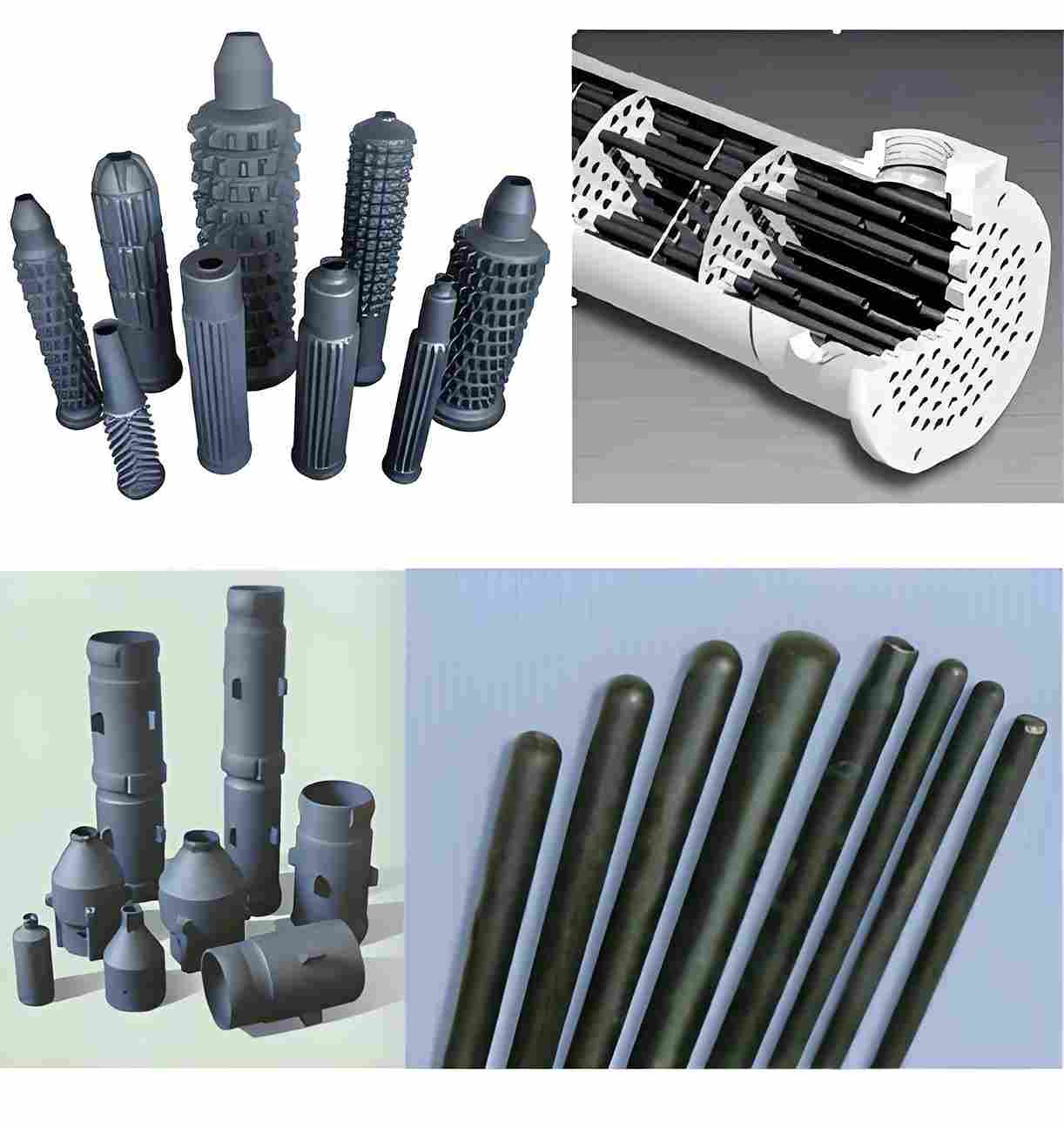
Silicon carbide for metallurgy delivers the high‑temperature strength, wear resistance and chemical stability that modern steel and alloy plants demand, and the right material can eliminate costly downtime caused by furnace component failure.
Why Silicon Carbide Is the Material of Choice in Metallurgical Applications
Core material advantages
SiC’s key properties align perfectly with the harsh environments inside a furnace:
- Thermal tolerance: stable up to 1 600 °C, with minimal creep.
- Mechanical strength: flexural strength often exceeds 300 MPa at room temperature and remains above 150 MPa at 1 200 °C.
- Chemical inertness: resists molten iron, slag, chlorine‑based gases and acidic slags that would quickly degrade Al₂O₃ or metallic alloys.
- Low thermal expansion: coefficient ~4.5 ×10⁻⁶ K⁻¹, reducing thermal shock risk.
- Electrical insulation: retains high resistivity even at elevated temperatures, useful for thermocouple protection.
Economic impact
When a furnace component fails, the loss is two‑fold: the direct cost of replacement and the unplanned production halt. In a typical 200 t steel plant, a single hour of downtime can cost $10 000–$30 000. Selecting SiC components that last 3‑5 times longer than conventional ceramics translates into measurable ROI within the first year.
Key Silicon Carbide Products for Metallurgy
1. SiC Crucibles
Crucibles hold molten metal, slag or high‑temperature alloys. Our SiC crucibles are manufactured from 98 % purity powder, pressed and sintered at 2 200 °C to achieve a dense, low‑porosity body. Typical dimensions range from Ø50 mm×100 mm up to Ø500 mm×1 200 mm, with custom tolerances of ±0.2 mm. Benefits include:
- Longevity in aggressive slags where Al₂O₃ would corrode.
- Uniform heating due to high thermal conductivity (≈120 W/m·K).
- Reduced melt contamination – SiC does not leach trace metals.
Case study: A German alloy‑casting plant replaced its alumina crucibles with SiC (Ø300 mm) and saw a 40 % drop in crucible‑related defects over a 12‑month period.
2. SiC Ceramic Plates & Liners
Plate‑type components line furnace walls, hearths and refractory arches. ZIRSEC offers standard plates (600 mm×600 mm×10 mm) and bespoke sizes up to 2 000 mm×2 000 mm. The plates are machined to a surface roughness of Ra 0.8 µm, ensuring seamless contact with adjacent refractories.
- Thermal shock resistance up to ΔT = 900 °C.
- Wear rates < 0.01 mm/10 000 h in high‑velocity gas flow.
- Easy replacement – plates can be swapped without dismantling the entire furnace.
3. SiC Tubes for Furnace Hot Zones
For gas delivery, thermocouple protection or internal heating elements, SiC tubes are indispensable. Our catalogue includes:
- Standard Ø20‑200 mm, wall thickness 1‑5 mm.
- Specialty inclinations and bends for retrofit projects.
- Optional internal coating (e.g., YSZ) for corrosive environments.
See our silicon carbide tubes page for full specifications.
4. SiC Burner Nozzles & Nozzle Inserts
High‑temperature burners benefit from SiC’s ability to withstand flame temperatures over 2 000 °C. Our nozzles feature precision‑machined orifice diameters (0.1‑5 mm) and are supplied with O‑ring seats for leak‑tight installation. The ceramic body eliminates metal oxidation and extends service life by 300 % compared with stainless steel nozzles.
5. SiC Rollers and Wear‑Resistant Shapes
Rollers used in powder handling or continuous casting lines experience abrasive wear. SiC rollers (Ø150‑500 mm, width 30‑150 mm) provide a hardness of 2 400 HV, outperforming Si₃N₄ and Al₂O₃. Our customers report up to 5 times longer intervals between replacements.
6. SiC Sealing Rings & Custom Parts
Sealing rings protect pumps, valves and rotating shafts from corrosive media. Our standard SiC seal rings are available in diameters 10‑200 mm with a hardness of 2 300 HV. For unique geometries, we accept CAD files and fabricate via CNC grinding, maintaining ±0.1 mm tolerance.
How to Choose the Right SiC Component for Your Process
Step‑by‑step selection guide
- Define operating parameters: temperature range, pressure, media chemistry and mechanical load.
- Match material grade: 98 % SiC for general use; >99 % purity for ultra‑high‑purity melt environments.
- Determine geometry: standard catalog sizes vs. custom dimensions. Consider thermal expansion matching with adjacent steel or refractory.
- Assess tolerances: high‑precision applications (±0.1 mm) may require additional grinding.
- Evaluate supplier support: engineering drawing assistance, rapid prototyping, and post‑sale testing.
Important technical parameters
| Parameter | Typical Value | Impact |
|---|---|---|
| Flexural strength (25 °C) | 300 MPa | Resistance to mechanical shock. |
| Compressive strength (1200 °C) | 150 MPa | Load‑bearing capability in hot zones. |
| Thermal conductivity | 120 W/m·K | Even heat distribution. |
| Coefficient of thermal expansion | 4.5 ×10⁻⁶ K⁻¹ | Low stress during heating/cooling cycles. |
| Porosity | <0.5 % | Minimizes infiltration of slag. |
Cost Considerations and ROI
Although SiC parts have a higher upfront price (typically $30‑$150 per kilogram depending on geometry), the total cost of ownership hinges on lifespan and downtime avoidance. A simple calculation illustrates the benefit:
- Standard alumina crucible replacement cycle: 6 months, cost $2 000.
- SiC crucible replacement cycle: 24 months, cost $3 500.
- Net saving over two years: $1 500 plus avoided production loss.
For large‑scale plants, the cumulative saving can exceed $200 000 annually when multiple components are upgraded.
Quality Assurance & Certification
ZIRSEC follows ISO 9001 and ISO 14001 standards. Every batch undergoes:
- Full chemical analysis (ICP‑MS) confirming SiC ≥ 98 %.
- Mechanical testing – three‑point bend and compressive strength at room temperature and 1 200 °C.
- Dimensional inspection with coordinate‑measuring machines (CMM) to ±0.05 mm.
- Thermal shock testing: rapid quench from 1 400 °C to 200 °C, 30 cycles.
Certificates of Conformity (CoC), Material Safety Data Sheets (MSDS) and 3‑D CAD files are provided on request.
Case Studies – Real‑World Success Stories
Case 1 – High‑Alloy Steel Melting in the United States
Problem: Frequent cracks in Al₂O₃ crucibles after 8 months of service, causing $18 000 unplanned downtime per incident.
Solution: Replace with ZIRSEC SiC crucibles (Ø400 mm). The new crucibles survived 30 months under identical conditions. Downtime reduced from 8 days/year to 1 day/year.
Case 2 – Aluminum Recycling Plant in Germany
Problem: Wear on furnace lining plates caused uneven heating and product quality variance.
Solution: Install custom‑machined SiC plates with Ra 0.8 µm finish. After a year, the plant reported a 22 % reduction in energy consumption and a 15 % improvement in melt uniformity.
Case 3 – Solar‑Thermal Receiver Upgrade in Spain
Problem: Oxidation of Si₃N₄ tubes at temperatures above 1 400 °C limited service life.
Solution: Switch to SiC tubes with an optional YSZ coating. Service life extended from 6 months to over 2 years, saving €120 000 in replacement costs.
Quick FAQ – Your Most Common Questions Answered
Q: How long does a custom SiC component take to manufacture?
A: Typical lead time is 4‑6 weeks for prototyping, 8‑12 weeks for full‑scale production after design approval.
Q: Can SiC be annealed to improve thermal shock resistance?
A: Yes, a post‑sintering anneal at 1 800 °C for 2 hours reduces residual stresses and enhances crack‑propagation resistance.
Q: What documentation do you provide for export?
A: We supply MSDS, CoC, test reports, and if required, a full set of drawings complying with IEC/ISO standards.
Q: Do you offer small‑batch orders?
A: Minimum order quantity is 20 pieces for standard sizes; custom designs start at 10 pieces, with rapid 24‑hour dispatch for stocked items.
Next Steps – How ZIRSEC Can Accelerate Your Metallurgical Projects
Our engineering team will review your furnace drawings, suggest the optimal SiC geometry, and provide a cost‑benefit analysis within 48 hours. Contact us at info@zirsec.com or submit an inquiry through the website to receive a free sample set tailored to your application.
Choosing the right silicon carbide component is not just a materials decision; it’s a strategic move that safeguards production, cuts long‑term expenses, and positions your plant at the forefront of metallurgical efficiency.