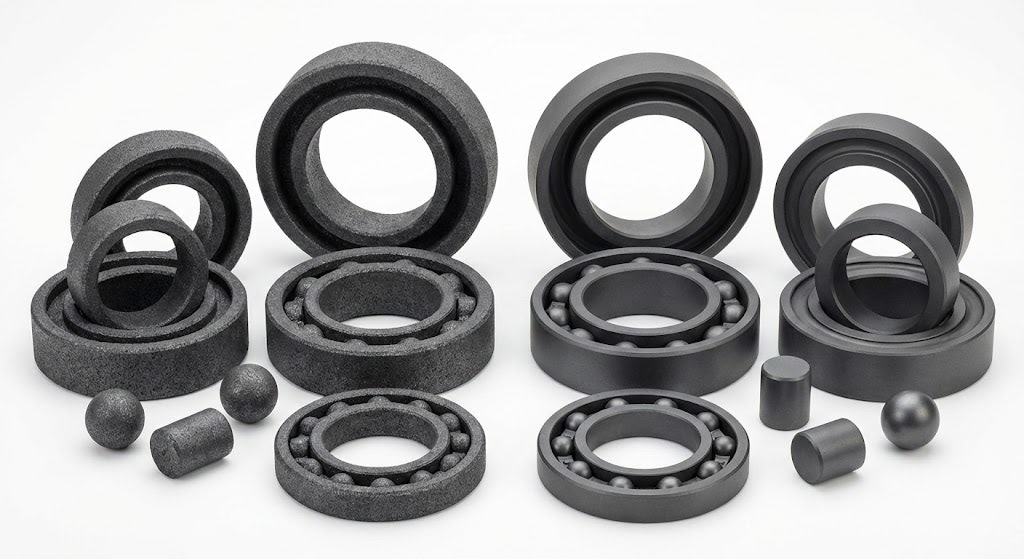
High-speed bearing applications place extreme demands on material performance, especially in environments involving high rotational speed, elevated temperature, poor lubrication or chemical exposure. Silicon carbide (SiC) and silicon nitride (Si₃N₄) are two advanced ceramics commonly specified for ceramic bearing components, yet they serve different engineering priorities. Selecting the wrong material can lead to premature wear, thermal damage or catastrophic bearing failure. This article provides a practical comparison to help engineers specify the correct material for high-speed bearing systems.
Why Bearing Material Selection Is Critical at High Speed
As bearing speed increases, frictional heat, centrifugal forces and lubrication sensitivity rise sharply. Conventional steel bearings often fail due to thermal expansion, corrosion or lubricant breakdown. Ceramic bearings reduce mass, improve heat resistance and extend service life, but ceramic materials themselves vary significantly in hardness, toughness and chemical stability. Understanding these differences is essential for reliable high-speed operation.
Silicon Carbide vs Silicon Nitride: Key Performance Differences
Although both SiC and Si₃N₄ are classified as technical ceramics, their behavior under high-speed bearing conditions differs in several critical aspects.
Density and Rotational Stability
Silicon nitride has lower density than silicon carbide, reducing centrifugal force at very high rotational speeds. This makes Si₃N₄ particularly suitable for ultra-high-speed spindle bearings. Silicon carbide is denser, but its superior stiffness and thermal stability compensate in many industrial bearing applications.
Wear Resistance
Silicon carbide exhibits significantly higher hardness than silicon nitride, providing excellent wear resistance in abrasive or contaminated environments. In applications where particles, poor lubrication or mixed friction conditions are present, SiC bearings maintain surface integrity longer than Si₃N₄.
Thermal Conductivity and Heat Dissipation
Silicon carbide offers much higher thermal conductivity, allowing heat generated at high speed to dissipate rapidly. This reduces local thermal stress and helps maintain bearing dimensional stability. Silicon nitride has lower thermal conductivity, which can lead to localized heat buildup under continuous high-speed operation.
Chemical and Corrosion Resistance
SiC provides outstanding resistance to acids, alkalis and aggressive chemical media. Silicon nitride performs well in neutral environments but is less suitable for corrosive fluids. In chemically aggressive or humid operating conditions, silicon carbide bearings offer greater reliability.
Fracture Toughness and Shock Resistance
Silicon nitride has higher fracture toughness, making it more resistant to impact and vibration. This advantage benefits applications with misalignment or dynamic loading. Silicon carbide is stiffer and harder but less tolerant of sudden mechanical shock, requiring precise installation and alignment.
How Zirsec Helps Engineers Choose the Right Bearing Material
Zirsec assists bearing manufacturers and equipment designers by analyzing rotational speed, operating temperature, lubrication quality and environmental exposure. For high-speed bearings operating in corrosive, high-temperature or contaminated environments, Zirsec typically recommends precision-machined silicon carbide components due to their superior wear resistance and thermal stability. For ultra-high-speed, lightly loaded applications requiring low inertia, silicon nitride may be more suitable. Zirsec provides drawing-based customization, tight dimensional tolerances and rapid sample delivery to support bearing development and validation.
Application Scenarios
Silicon carbide bearings are widely used in chemical pumps, high-temperature blowers, process agitators, slurry handling equipment and corrosive fluid systems. Silicon nitride bearings are commonly applied in machine tool spindles, high-speed motors and aerospace auxiliary systems where low density and shock tolerance are critical. In industrial environments combining speed, heat and chemical exposure, silicon carbide offers a more robust solution.
Case Example: Bearing Upgrade in Chemical Pump Systems
A chemical processing facility experienced repeated bearing failures in high-speed circulation pumps due to abrasive contamination and chemical exposure. Original silicon nitride bearings showed surface wear and thermal degradation. Zirsec supplied custom silicon carbide bearing components designed for improved wear resistance and heat dissipation. After implementation, bearing service life increased by more than three times, and pump reliability improved significantly under continuous operation.
Typical Property Comparison
| Property | Silicon Carbide (SiC) | Silicon Nitride (Si₃N₄) |
|---|---|---|
| Density | Higher | Lower |
| Wear Resistance | Excellent | Good |
| Thermal Conductivity | Very high | Moderate |
| Chemical Resistance | Excellent | Moderate |
| Fracture Toughness | Moderate | High |
| Best Use Case | Harsh industrial environments | Ultra-high-speed applications |
FAQs: SiC vs Si₃N₄ Bearings
Is silicon nitride always better for high-speed bearings?
No. While Si₃N₄ offers low density, SiC performs better in high-temperature, abrasive or chemically aggressive conditions.
Can silicon carbide bearings operate at high speed?
Yes. SiC bearings perform reliably at high speed, especially where thermal stability and wear resistance are required.
Which material lasts longer in contaminated environments?
Silicon carbide typically lasts longer due to superior hardness and chemical resistance.
Does Zirsec offer custom ceramic bearing components?
Yes. Zirsec supplies custom SiC bearing rings and components based on drawings or samples.
Which material should I specify for chemical pump bearings?
Silicon carbide is generally preferred for chemical pumps due to corrosion and wear resistance.
Contact Zirsec for High-Speed Bearing Solutions
If your bearing system operates at high speed under heat, wear or chemical exposure, Zirsec can help evaluate the optimal ceramic material. Contact Zirsec for engineering consultation, drawing review and fast quotation support.