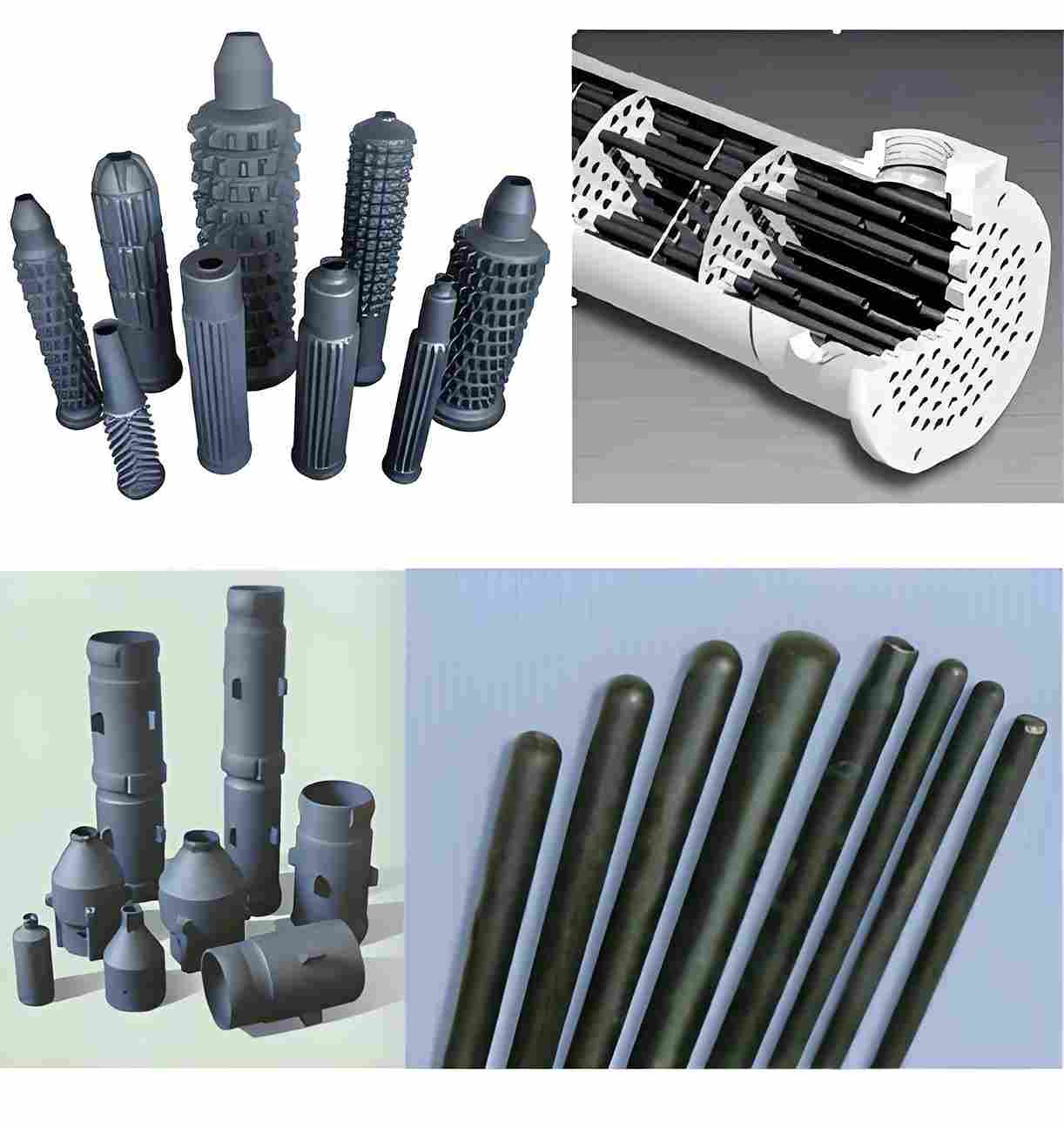
Most silicon carbide datasheets look impressive: many numbers, properties, and test methods on a single page. But when you need to choose SiC components for a real project, those tables can feel more confusing than helpful.
This guide explains how to decode silicon carbide specifications, what the key properties really mean in practice, and how to use data sheets to compare suppliers and select the right SiC components for your application.

1. Why decoding SiC datasheets matters
Silicon carbide is used in applications where failures are expensive: high-temperature furnaces, chemical pumps, heat exchangers, burners, and wear components. A bad choice of material or supplier can lead to:
- Cracked tubes and plates after thermal cycling.
- Seal rings that leak or wear out too fast.
- Crucibles that react with the melt or contaminate the product.
- Unexpected downtime and scrap during high-value production.
Understanding the numbers on a datasheet helps you move from “this looks like silicon carbide” to “this SiC grade is suitable for my temperature, chemistry, and load.”
2. Start with the basics: which SiC grade are you looking at?
Before diving into numbers, identify the type of silicon carbide ceramic on the sheet. The most common families are:
- SSiC (pressureless sintered SiC) – very high density, very low open porosity, excellent chemical resistance; widely used for mechanical seal rings, sleeves, and precision parts.
- RBSiC / SiSiC (reaction-bonded SiC) – a silicon-infiltrated material suitable for larger structural parts such as tubes, beams, burners, and plates.
- RSIC (recrystallized SiC) – used in some extreme-temperature furnace components where thermal shock and gas permeability behaviour are important.
If the datasheet only says “silicon carbide” without clearly stating the type, that is already a warning sign. For critical components like silicon carbide tubes or mechanical seal rings, you should know exactly which family of material you are dealing with.
3. Density and porosity: the foundation of performance
For structural ceramics like SiC, density and porosity are core indicators of quality.
- Bulk density (g/cm³) – tells you how much solid material is present per unit volume.
- Open porosity (%) – indicates the volume fraction of connected pores that can be penetrated by fluids or gases.
In practice:
- Higher density and lower open porosity generally mean better mechanical strength, higher corrosion resistance, and better leak tightness.
- For SSiC, you will usually see densities ≥ 3.10 g/cm³ with very low open porosity (often close to 0%).
- For RBSiC/SiSiC, density is slightly lower, and some residual free silicon and porosity are normal.
When comparing suppliers, be suspicious of datasheets that show “ideal” values but no density and porosity ranges. Real production always has tolerances.
4. Mechanical properties: strength and hardness in real life
Several mechanical properties appear on SiC datasheets. The most common are:
- Flexural strength (MOR) – usually given in MPa; measured via 3- or 4-point bending tests.
- Hardness – often reported as Vickers hardness (HV).
- Elastic modulus (Young’s modulus) – indicates stiffness.
How to interpret them:
- Higher flexural strength suggests better resistance to bending and tensile stresses, but remember that silicon carbide is still a brittle ceramic.
- High hardness supports wear resistance, especially in abrasive flow or sliding contact.
- Elastic modulus matters when calculating deflection under load in beams, plates, and tubes.
For components like silicon carbide seal rings, pay special attention to the combination of flexural strength, hardness, and surface finish, since these directly relate to leakage and wear behaviour.
5. Thermal properties: conduction, expansion, and temperature limits
Because silicon carbide is used in high-temperature applications, thermal properties are just as important as mechanical values. Key ones include:
- Thermal conductivity (W/m·K) – how well the material conducts heat.
- Coefficient of thermal expansion (CTE, 10⁻⁶/K) – how much the material expands as temperature rises.
- Maximum service temperature (°C) – practical limit based on softening, oxidation, and structural stability.
In practice:
- Higher thermal conductivity helps distribute heat and reduce hotspots in tubes, plates, and burners.
- Lower CTE helps with thermal shock resistance, especially when combined with appropriate design and mounting.
- Maximum service temperature should be considered with a safety margin below your highest operating temperature, especially under cycling conditions.
Note that thermal properties can be temperature-dependent. If the datasheet lists values at only one temperature, ask how they change across your operating range.
6. Chemical resistance and microstructure
Many datasheets summarize chemical resistance in general terms (“excellent”, “good”) but offer limited detail. For SiC used in aggressive media, pay attention to:
- SiC content and free silicon content – more free silicon typically means more vulnerability to certain corrosive environments.
- Microstructural notes – grain size and distribution can affect corrosion behaviour and crack propagation.
- Exposure tests – any standardized test data in acids, alkalis, or relevant process environments.
When datasheets are vague, use them as a starting point but rely on real corrosion testing under your conditions for final decisions.
7. Dimensional tolerances, flatness, and surface finish
Datasheets often mention geometric and surface specifications, especially for precision components. Typical items include:
- Dimensional tolerances – e.g. ±0.05 mm or ±0.1 mm for critical dimensions.
- Flatness and parallelism – important for seal faces, plates, and mating surfaces.
- Surface roughness (Ra) – often given in µm for ground, lapped, or polished surfaces.
How this affects your application:
- Tighter tolerances and better flatness are essential for mechanical seals, bearings, and precision fits, but they also add cost.
- For structural parts like furnace plates and beams, it is often enough to control flatness and straightness while keeping other tolerances relaxed.
- Roughness levels determine how a surface interacts with fluids, lubrication, or mating surfaces; extremely smooth finishes are not always necessary.
A good datasheet will distinguish between standard tolerances and optional tighter tolerances available on request.
8. Test methods and conditions: read the fine print
Two datasheets may list similar numbers that were measured under very different conditions. Always look for:
- Test method references – such as standard test methods for flexural strength, hardness, or thermal properties.
- Temperature and environment – especially for mechanical and thermal tests.
- Sample geometry – some properties are sensitive to sample size and shape.
Differing methods make “apples to apples” comparisons difficult. When in doubt, ask suppliers to explain how they measured key values and whether they can provide data using more widely recognized standards.
9. Typical vs guaranteed values – and why ranges matter
Many datasheets split values into categories like “typical” and “guaranteed minimum.” Understanding the difference is crucial:
- Typical values – average results from a set of tests; good for understanding what the material normally delivers.
- Guaranteed values – minimum levels the supplier commits to meeting for production batches.
For engineering decisions, typical values show potential performance, but design safety margins should rely on guaranteed minima. If a datasheet shows only high “typical” numbers with no guaranteed range, probe deeper before using those values in your calculations.
10. Putting it all together: using SiC specs to select components
Once you understand individual properties, use them together to select the right components. For example:
- For furnace tubes and burners, prioritize thermal conductivity, maximum service temperature, density, and thermal shock behaviour, along with straightness and wall thickness control.
- For kiln plates and structural parts, focus on density, flexural strength, CTE, flatness, and long-term stability at temperature.
- For seal rings and pump components, look closely at density, porosity, flexural strength, hardness, surface finish, and tight dimensional tolerances.
Datasheets for standard products such as silicon carbide plates and tubes are a good starting point, but custom parts often require additional discussion of geometry, tolerances, and inspection plans on top of basic material properties.
11. Practical checklist for reading a silicon carbide datasheet
When you open a new SiC specification sheet, use this checklist:
- Identify the material family: SSiC, RBSiC/SiSiC, RSIC, or other. If it is not clear, ask.
- Check density and porosity: confirm they match your expectations for strength and tightness.
- Review mechanical properties: flexural strength, hardness, and modulus relative to your loading and safety factors.
- Review thermal properties: thermal conductivity, CTE, and maximum service temperature vs your real operating conditions.
- Look at chemical resistance: composition, microstructure notes, and any corrosion or exposure data relevant to your media.
- Examine tolerances and finishes: ensure the standard dimensional and surface specifications fit your design, or note where you need tighter control.
- Verify test methods and conditions: confirm how and at what temperature key values were measured.
- Distinguish typical vs guaranteed values: design to the guarantees, not only to the marketing numbers.
FAQ – Understanding silicon carbide specifications
Q1: Why do different suppliers list different values for “the same” SiC grade?
A: Even within the same family (SSiC, RBSiC, etc.), powder sources, processing routes, and firing conditions differ. That leads to variations in density, porosity, strength, and thermal behaviour. Always compare datasheets in detail instead of assuming all “SSiC” is identical.
Q2: The datasheet lists very high strength. Does that guarantee no breakage in my application?
A: No. Strength tests are done on standardized samples. Real parts can fail due to geometry, mounting, stress concentrations, and thermal shock. Use datasheet values to guide design, but always consider safety factors, realistic loading, and proper support of the ceramic.
Q3: How much can I trust typical values without guaranteed minimums?
A: Typical values are useful for comparison, but they do not define what you will always receive. For critical applications, you should request guaranteed ranges or minimum values for key properties and include them in your specifications or purchase documents.
Q4: The datasheet doesn’t mention thermal shock resistance. What should I do?
A: Use CTE, thermal conductivity, and strength as indirect guides, but ultimately you may need application-specific testing or references from similar installations. Ask the supplier for real-world experience in conditions close to yours.
Q5: Can I rely purely on datasheets to choose a silicon carbide component?
A: Datasheets are a starting point, not the final answer. Combine them with your own operating conditions, design analysis, and – if possible – trial installations. When in doubt, discuss your requirements directly with a supplier experienced in silicon carbide ceramics.
Conclusion
Silicon carbide datasheets can be powerful tools instead of confusing tables if you know what to look for. By focusing on material family, density and porosity, mechanical and thermal properties, tolerances, and test methods, you can quickly see whether a given SiC grade is appropriate for your application.
Once you decode the specifications, you are in a better position to compare suppliers, write meaningful technical requirements, and select silicon carbide components that not only look good on paper, but also perform reliably in real industrial conditions.