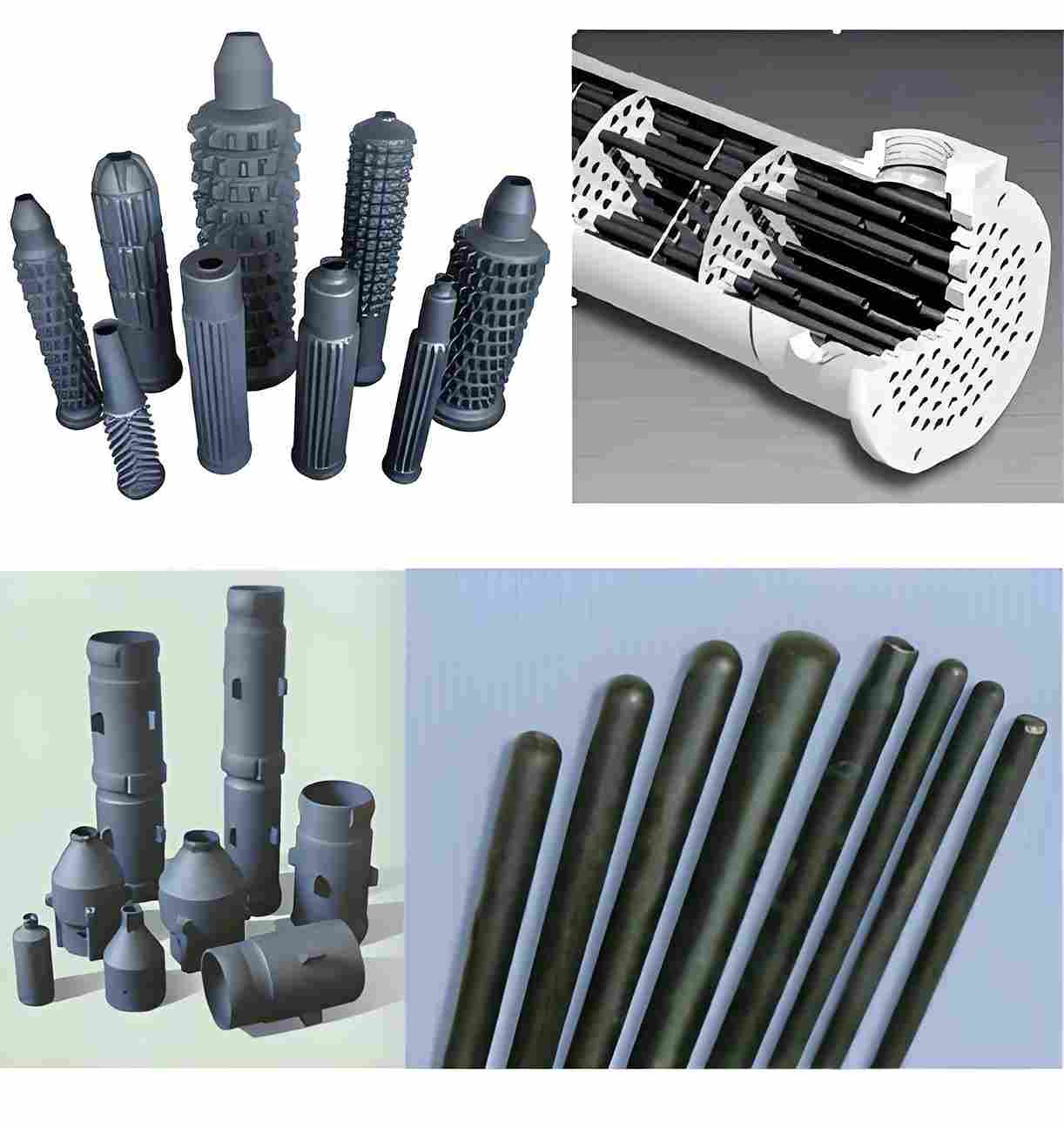
Silicon carbide has been around for more than a century, but it is not standing still. As industries push for higher temperatures, tighter emission rules, and better energy efficiency, SiC ceramics are quietly evolving in both materials and manufacturing.
This overview looks at what’s new in silicon carbide ceramics by 2025 and what engineers, buyers, and maintenance teams should actually care about when specifying tubes, plates, seals, and custom SiC parts.
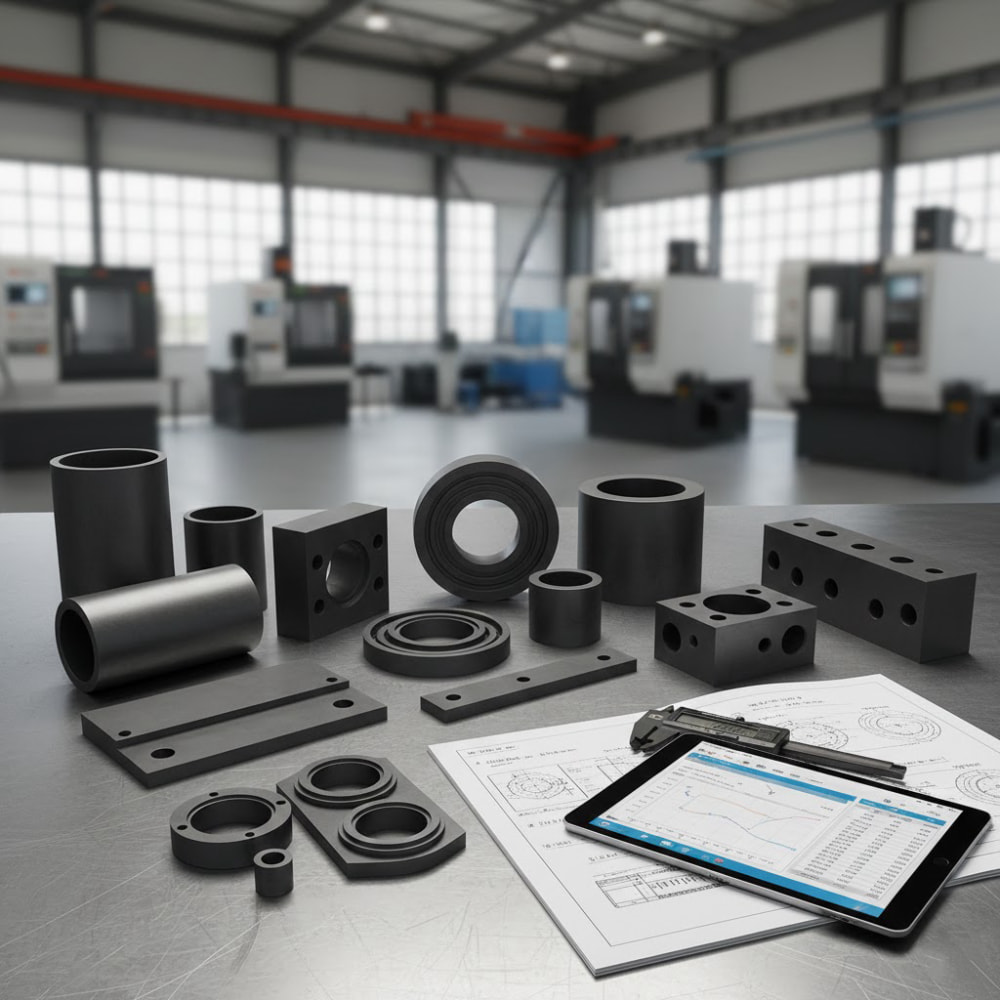
1. Smarter SiC grades: beyond “just SSiC and RBSiC”
In the past, many specifications stopped at “SSiC” or “RBSiC/SiSiC” as if those labels were enough. In 2025, serious users are looking deeper into:
- Tighter control of density and porosity for better corrosion resistance and gas tightness.
- Optimized grain size to balance wear resistance, thermal shock behaviour, and machinability.
- Application-specific variants for seal rings, burner parts, kiln furniture, and heat exchanger tubes.
For example, pressureless sintered SiC grades are being tuned for mechanical seals and sleeves, while reaction-bonded SiC grades are optimized for tubes, beams, and structural plates where shape stability and cost must be balanced.
2. SiC for power and electronics: wafers, substrates, and support parts
Silicon carbide is a core material in modern wide-bandgap semiconductors, especially in EV inverters, power supplies, and renewable energy systems. By 2025, several trends are clear:
- More demand for high-purity SiC wafers and substrates with low defect density.
- Greater focus on thermal management around power devices, where SiC ceramics help conduct heat away from sensitive components.
- More use of SiC support parts in high-temperature process equipment around semiconductor and battery production.
For industrial users, this means better access to SiC components with consistent purity and tighter process control, even for “non-electronic” parts such as silicon carbide tubes and silicon carbide plates used in high-temperature lines and kilns.
3. Near-net-shape and advanced forming: less grinding, more function
Grinding silicon carbide is slow and expensive. Newer forming and shaping techniques aim to put material only where it is needed, so less has to be removed later. Key directions include:
- Near-net-shape forming of complex geometries, reducing machining time and internal stresses.
- Improved isostatic pressing for long tubes and large plates with more uniform density.
- Additive and hybrid processes in early-stage adoption for selected complex SiC shapes, especially where internal channels or unusual flow paths are needed.
For buyers, the practical effect is that some geometries that used to be “too expensive in SiC” are becoming more realistic, especially when lifetime gains justify the initial tooling and development effort.
4. Better surface engineering and interfaces
Another area of innovation is how silicon carbide parts interact with their surroundings. This shows up in:
- Improved lapping and polishing techniques for mechanical seal rings, giving better sealing behaviour and lower leakage.
- Engineered surface roughness where a slightly textured surface improves wetting, lubrication, or coating adhesion.
- Hybrid assemblies that combine SiC with metals or other ceramics via brazing or mechanical interfaces, sharing load and simplifying installation.
The goal is not just a stronger ceramic, but a smarter interface between SiC and metal housings, flanges, or other components, reducing stress concentrations and failure risk.
5. Digital quality control and traceability
Quality expectations for silicon carbide have grown sharply. Instead of a simple “OK” stamp, customers increasingly expect:
- Digital inspection reports tied to each batch or even each part for critical components.
- More automated dimensional inspection using CMMs and optical systems.
- Better batch traceability from SiC powder through sintering, machining, and final inspection.
These changes make it easier to link field failures back to root causes and to prove consistency when qualifying new applications or equipment types.
6. Greener production and longer life cycles
Environmental pressure is pushing ceramic manufacturers to clean up their own house. In silicon carbide, “greener” does not just mean marketing language; it shows up in:
- More efficient kilns and firing schedules to reduce energy consumption per kilogram of SiC produced.
- Better scrap management and internal recycling of off-spec parts and machining waste where possible.
- Design-for-longevity – more effort put into geometries and grades that extend real service life instead of chasing only initial price.
When a well-designed SiC component replaces multiple short-lived metal or low-grade ceramic parts, the net result is usually lower overall resource use and fewer maintenance interventions. That is where “green” starts being visible in the maintenance budget, not just in presentations.
7. What engineers and buyers should ask in 2025
With so many buzzwords floating around, it is easy to get lost. A practical way to benefit from these innovations is to ask suppliers very specific questions, such as:
- Which SiC grade are you proposing (SSiC, RBSiC/SiSiC, RSIC), and what density/porosity range do you guarantee?
- How do you control and document dimensions, flatness, and surface finish for critical parts?
- Do you offer any near-net-shape options for my geometry to reduce cost and internal stress?
- What lifetime or thermal cycling experience do you have in applications similar to mine?
- Which inspection reports and certificates will I receive by default with each shipment?
The suppliers who can answer these concisely – with real data, not just adjectives – are usually the ones implementing the more meaningful innovations in their daily production.
8. How these innovations translate to real benefits
In practical terms, the recent developments in silicon carbide ceramics mostly show up in four areas:
- Longer service life under high-temperature, corrosive, or abrasive conditions.
- Higher reliability when scaling up production or pushing equipment closer to its design limits.
- Lower lifetime cost through fewer shutdowns and less frequent part replacements.
- Better documentation and traceability for audits, certifications, and internal quality control.
For many plants, these benefits matter more than the specific details of powders, furnaces, or test machines – but they are made possible by exactly those behind-the-scenes innovations.
FAQ – Innovations in Silicon Carbide Ceramics
Q1: Are the new SiC grades in 2025 completely different materials?
A: No. Most innovations are refinements of existing sintered and reaction-bonded SiC systems – tighter control of density, porosity, grain size, and impurities – rather than entirely new chemistries. The changes are small on paper but important for lifetime and reliability.
Q2: Do I need to change my equipment design to benefit from these innovations?
A: Not always. In many cases, you can replace existing components with improved SiC versions using the same geometry. For more aggressive upgrades (higher temperature, longer spans, new flow paths), it is worth reviewing the design with your SiC supplier to adjust thicknesses, radii, and mounts.
Q3: How can I tell if a supplier is actually using advanced processes or just rebranding old materials?
A: Ask for hard data: density and porosity ranges, mechanical test results, inspection samples, and real application references. Suppliers who have genuinely improved their processes are usually happy to share structured information instead of generic claims.
Conclusion
Silicon carbide ceramics in 2025 are not a revolution, but they are noticeably better and smarter than they were a decade ago. With more advanced SiC grades, improved forming and finishing, stronger quality systems, and greener production, modern SiC components offer:
- Higher reliability in extreme environments.
- More design freedom for complex parts.
- Better long-term economics for high-duty applications.
For engineers and buyers, the main opportunity is to connect these innovations to specific problems: furnace failures, seal leaks, warped plates, or high maintenance costs. Once the real pain points are clear, the newer generation of SiC ceramics can be applied where they have the most impact, instead of being just another line in a specification.