Kiln linings fail in slow, expensive ways: shelves warp, plates crack, energy consumption creeps up, and usable loading area shrinks with every campaign. If you are responsible for firing performance, uptime, and cost per cycle, silicon carbide plates for kiln linings and kiln furniture are one of the few levers that can improve mechanical stability, thermal efficiency, and lifetime at the same time.
This guide explains what silicon carbide plates are, where they fit into kiln linings, the benefits and limits of using them, and practical best practices for designers, process engineers, and maintenance teams. The focus is on continuous and intermittent kiln furniture applications where plates act as structural elements in the hot zone.
What Are Silicon Carbide Plates for Kiln Linings?
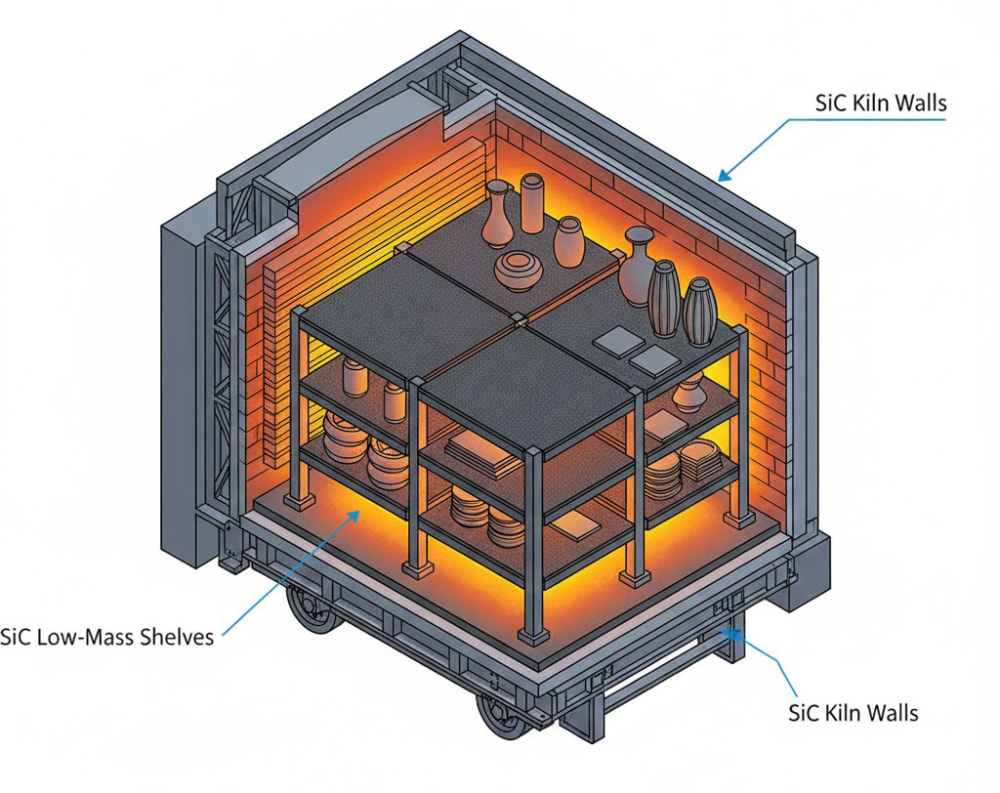
In high-temperature industrial kilns and furnaces, silicon carbide (SiC) plates are flat or shaped refractory components used as:
- kiln shelves and decks on kiln cars,
- lining elements in roofs, sidewalls, and zones with high thermal or mechanical load,
- setters and support plates for tiles, technical ceramics, sanitaryware, and other products,
- interface layers between insulation and product, where stiffness and low mass are both needed.
Silicon carbide combines:
high strength at temperature, high thermal conductivity, excellent thermal shock resistance, and good chemical resistance. Compared with traditional cordierite or basic oxide plates, SiC kiln plates can be made thinner and lighter while still carrying higher loads and surviving more cycles at elevated temperatures.
Key Benefits of Silicon Carbide Plates in Kiln Linings
When correctly specified, SiC plates provide a set of advantages that show up directly in energy consumption, throughput, and maintenance KPIs.
- Higher load capacity with lower mass: Low-mass SiC plates allow more product and less “dead weight” kiln furniture, improving loading efficiency and reducing energy needed to heat the furniture itself.
- Improved thermal efficiency: High thermal conductivity helps equalize temperature across shelves and loading surfaces, enabling faster heating and cooling ramps and shorter firing cycles.
- Better thermal shock resistance: SiC plates tolerate rapid temperature changes and opening/closing events much better than many oxide refractories, reducing crack formation during cycling.
- Dimensional stability and flatness: Properly designed SiC plates retain flatness under load and temperature, maintaining consistent product support and minimizing distortion.
- Longer service life: High wear resistance and chemical stability in many firing atmospheres translate into more cycles per plate and fewer unplanned replacements.
- Reduced contamination risk: Dense, smooth SiC surfaces shed less dust and spalled material into the load, which is critical for technical ceramics and high-value products.
These benefits make silicon carbide plates particularly attractive wherever kiln furniture accounts for a large fraction of total charge mass and where product flatness or surface quality is highly sensitive to furniture deformation.
Limits: When Silicon Carbide Plates Are Not a Silver Bullet
Silicon carbide plates are powerful tools, but they are not magic or universally optimal. Recognizing their limits is part of using them well.
- Cost sensitivity: SiC plates have a higher purchase price than basic cordierite or simple refractory slabs. They must be justified in terms of cost per firing or cost per ton, not piece price.
- Atmosphere and chemistry constraints: Certain highly reducing, strongly alkali-rich, or vapor-phase corrosive environments can still attack SiC over long campaigns. Matching SiC grade to atmosphere matters.
- Impact and handling: While strong, SiC remains a ceramic. Sharp mechanical impact, poor stacking, or forklift damage will break plates that could otherwise last many campaigns.
- Design dependencies: If plates are supported poorly (large spans, point loads, no allowance for expansion), even SiC will warp or crack prematurely.
- Temperature window: SiC covers a wide high-temperature range, but below certain temperatures cordierite or other materials may still be more economical, especially for low-duty electric kilns.
The right mindset is: use SiC plates where they unlock measurable improvements in energy, throughput, flatness, or lifetime, rather than assuming that “SiC is always better.”
Selection Criteria for Silicon Carbide Plates in Kiln Linings
Good selection starts from the kiln and the product, not from the catalogue. The following criteria can be treated as a checklist when specifying silicon carbide plates for kiln linings or kiln furniture.
1. Kiln Type and Firing Mode
- Continuous vs. batch: tunnel kilns and roller kilns have different loading patterns and thermal gradients compared with shuttle or periodic kilns.
- Fuel source: gas, oil, or electric heating influences atmosphere, local hot spots, and cycling behavior.
- Car-based vs. fixed hearth: kiln cars introduce mechanical vibration and thermal lag that affect plate design.
The more dynamic the firing cycle and the more frequent the loading/unloading, the more a low-mass, high-strength SiC plate system can support higher throughput and stable product quality.
2. Firing Temperature and Cycle Profile
- Maximum firing temperature: e.g., 1,200–1,450 °C for many ceramic products, or higher for technical ceramics.
- Dwell time at peak: long holds place more emphasis on creep resistance and long-term dimensional stability.
- Ramp rates and cooling: aggressive heating and cooling cycles increase thermal shock demands on plates.
In general, as temperature and ramp rates rise, silicon carbide plates become more advantageous compared with low-tech kiln shelves, provided they are sized and supported correctly.
3. Product Type, Load Pattern, and Contact Conditions
- Product category: tiles, tableware, sanitaryware, refractories, technical ceramics, battery materials, or metal components all load differently.
- Load density: heavy loadings demand higher bending strength and carefully designed support geometries.
- Contact area and footprint: narrow feet or small supports create local stress peaks that must be considered in plate thickness and span.
When you know typical load per plate and how the load is distributed, it becomes possible to choose plate thickness, span, and grade that keep deflection and stress within safe limits throughout the firing campaign.
4. Atmosphere, Vapors, and Deposits
- Atmosphere: oxidizing, neutral, mildly reducing, or special atmospheres for technical ceramics.
- Vapors and condensables: glazes, fluxes, volatiles, and condensates that may land on plate surfaces.
- Glaze and flux interaction: risk of sticking, wettability of plate surfaces, and need for kiln wash or protective coatings.
Dense, smooth silicon carbide plates are often chosen to reduce sticking and glaze pickup, but in some cases a specific surface finish or coating is required to fine-tune interaction between plate and product.
5. Material Grade and Bonding Type
- Reaction-bonded SiC (RBSiC / SiSiC): dense, strong material widely used for kiln furniture, combining high thermal shock resistance with good mechanical strength.
- Nitride-bonded SiC: strong, thermally shock-resistant material often used where cyclic loading is severe and mechanical strength is a priority.
- Recrystallized or high-purity SiC: used for the most demanding high-temperature or clean applications where purity and low porosity are critical.
Each bonding type offers a different balance between maximum temperature, shock resistance, cost, and chemical resistance. Plate selection should always consider actual load, cycle, and atmosphere rather than relying on generic “SiC” labels.
6. KPI and Cost Metrics
Finally, plate selection should link back to measurable outcomes:
- energy consumption per firing or per ton of product,
- usable setting area per kiln car or per shelf,
- average campaigns per plate before replacement,
- scrap and rework rate due to distortion or contamination.
Well-designed silicon carbide plate systems can reduce energy per ton and increase campaign life. Both effects must be quantified to build a credible business case against more basic kiln furniture options.
Product Overview and Specifications: Zirsec Silicon Carbide Plates
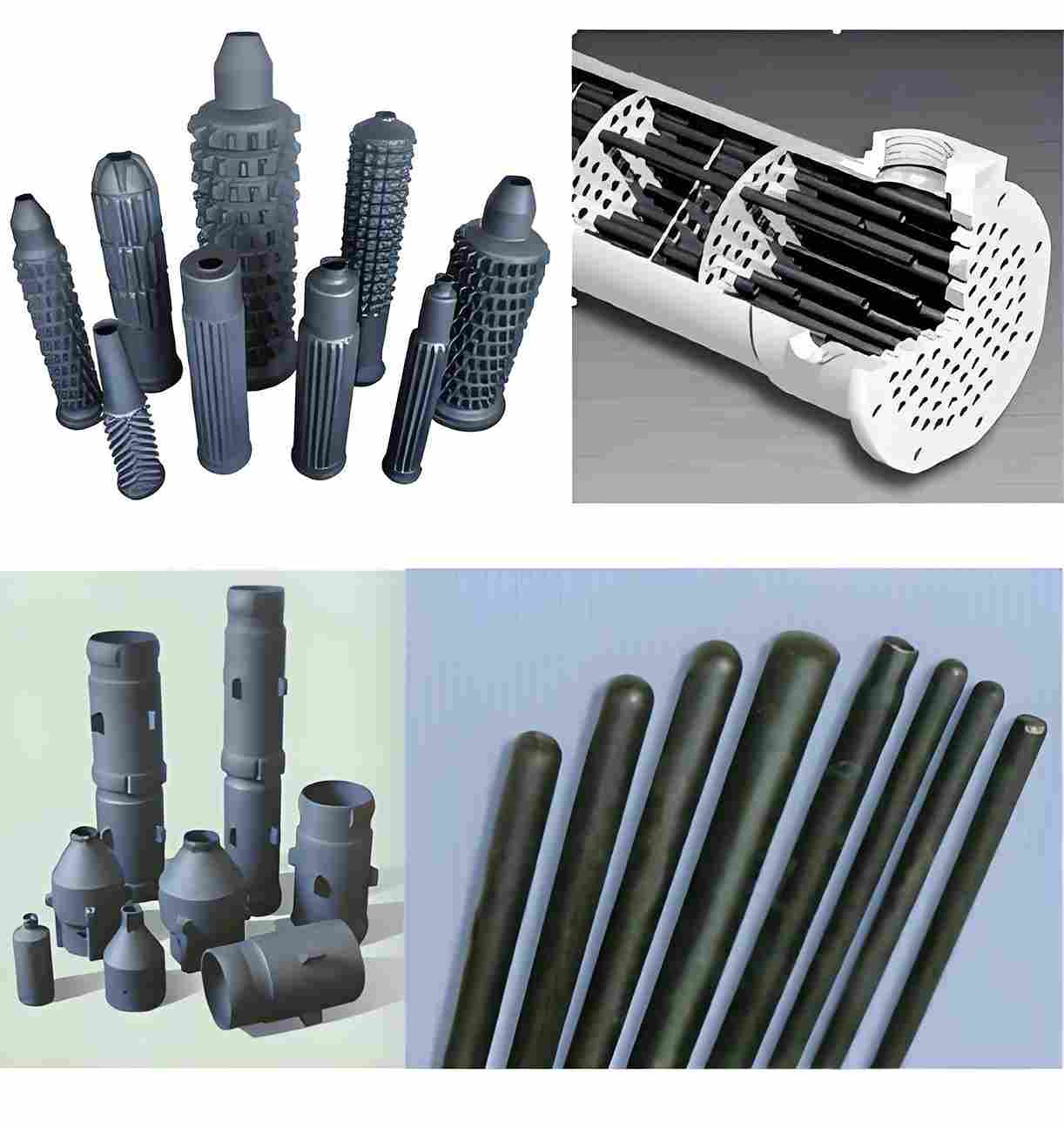
Zirsec supplies silicon carbide plates and kiln furniture components as part of its SiC product families for high-temperature furnaces, grouped under:
https://zirsec.com/types/.
Typical applications are detailed on the
High-Temperature Furnace Applications pages, where plates, beams, posts, and other items are combined into complete kiln car and lining systems.
Typical Feature Set
- High operating temperature capability: suitable for industrial kiln temperatures commonly in the 1,300–1,500 °C range (grade and atmosphere dependent).
- Low mass designs: thin, high-strength plates that reduce the share of kiln furniture in the total charge mass.
- High bending strength and stiffness: controlled deflection under load at temperature, maintaining flatness across the setting area.
- Thermal shock resistance: engineered to withstand repeated heating and cooling cycles typical of industrial practice.
- Low porosity and smooth surfaces: reduced glaze sticking and easier cleaning between campaigns.
Indicative Comparison: SiC Plates vs. Traditional Kiln Shelves
| Parameter | SiC Plate (typical) | Traditional Cordierite / Basic Shelves (typical) |
|---|---|---|
| Max. service temperature | up to ~1,400–1,500 °C | ~1,200–1,300 °C |
| Strength at temperature | high, good flatness retention | lower, more warping and creep |
| Thermal conductivity | high, supports faster ramps | lower, slower heating and cooling |
| Weight for same load capacity | lower (thin, low-mass design) | higher (thick, heavy shelves) |
| Typical campaign life | long, multi-campaign with correct handling | shorter, more frequent replacement |
Exact values and recommended plate sizes are specified in individual Zirsec data sheets and project proposals, aligned with specific kiln layouts and load patterns.
Applications and Use Cases
Silicon carbide plates from Zirsec are suitable for a wide range of kiln linings and kiln furniture systems across industries:
- Ceramic tiles and slabs: low-mass SiC plates as shelves and decks on kiln cars, minimizing warpage and improving flatness control.
- Sanitaryware and tableware: SiC plates as part of lightweight kiln furniture systems that reduce energy consumption and increase stacking density.
- Technical ceramics and components: plates used as setters and support surfaces, where cleanliness, dimensional stability, and low contamination are critical.
- Refractories and high-duty bricks: heavy loads at high temperature on SiC plate decks, combined with beams and posts for efficient kiln car layouts.
- Battery materials and powders: thin SiC plates acting as supports and separator decks in high-temperature processing of powders and substrates.
In many kilns, plates are used together with SiC beams, posts, and other furniture elements in a complete layout engineered to minimize dead weight and maximize usable setting space.
Best Practices for Using Silicon Carbide Plates in Kiln Linings
Even the best plates will fail early if they are used carelessly. The following best practices are simple and highly effective.
- Design for even loading: avoid concentrated loads on small contact patches; use setters or props to distribute weight evenly across plates.
- Respect maximum span: follow recommended support spacing and avoid unsupported spans that exceed design limits.
- Control start-up and cooling: adopt defined heat-up and cool-down curves to avoid extreme thermal gradients through plate thickness.
- Use proper kiln wash where needed: in glaze or flux-heavy applications, apply compatible kiln wash or coatings to reduce sticking and facilitate cleaning.
- Handle with care: train operators and forklift drivers; avoid dropping, point impacts, or stacking plates on uneven surfaces.
- Monitor and record life: track firing cycles or operating hours per plate and correlate with failure modes to refine design and operating practice.
A combination of good design, controlled firing practice, and disciplined handling is usually enough to unlock the full life and performance that silicon carbide plates can deliver.
Zirsec Support for OEMs and Kiln Operators
Zirsec supports both kiln OEMs and end users who want to adopt SiC plates in kiln linings and kiln furniture systems.
- Concept and layout support: assistance in designing kiln car decks, shelves, and lining concepts based on SiC plates and companion components.
- Material and grade selection: recommendations on SiC grade and bonding type linked to temperature, atmosphere, and duty cycle.
- Finite life and deflection assessment: evaluation of plate thickness, span, and load to keep deflection and stress within safe limits at temperature.
- Prototype and trial campaigns: pilot sets of plates for one or more kiln cars, combined with simple monitoring plans for deformation and damage.
- Standardization: helping users rationalize plate sizes and types to reduce SKU count and simplify inventory.
- Supply and logistics: coordinated supply aligned with shutdown windows and new line commissioning.
FAQs: Silicon Carbide Plates for Kiln Linings
1. How much energy can be saved by switching to low-mass SiC plates?
Exact savings depend on kiln design and furniture mass ratio, but low-mass silicon carbide plates reduce the amount of “dead weight” that must be heated and cooled every cycle. In practice, users often see both lower energy per firing and shorter cycles, as higher thermal conductivity and lower mass allow faster ramps without sacrificing product quality.
2. Do silicon carbide plates always last longer than traditional shelves?
Not automatically. When correctly matched to load, span, temperature, and atmosphere, SiC plates generally deliver significantly longer life than many traditional shelves. However, poor support design, overloading, impact damage, or extreme atmospheres can still cause early failures. Life is a combination of material, design, and operating practice.
3. Can SiC plates replace existing cordierite shelves one-for-one?
Sometimes yes, especially in smaller electric or gas kilns. In larger industrial kilns with high loads and long spans, plate thickness and support layout often need optimization. Zirsec typically reviews current shelf dimensions, load patterns, and firing curves before recommending either a direct replacement or a refined SiC-based layout.
4. How do I choose plate thickness and support spacing?
Plate thickness and support spacing are chosen based on load per plate, maximum temperature, and acceptable deflection. As a rule, heavier loads and higher temperatures require either thicker plates, shorter spans, or both. Zirsec can help calculate safe combinations and translate them into practical kiln car or shelf designs.
5. Are silicon carbide plates suitable for all kiln atmospheres?
Silicon carbide plates are widely used in oxidizing and many controlled atmospheres. For very strong reducing, alkali-rich, or chemically aggressive environments, material grade and surface condition must be chosen with care. For borderline cases, it is often advisable to start with a trial campaign and detailed inspection before full conversion.
6. How should SiC plates be handled and stored?
Plates should be stored on flat, stable surfaces with adequate support, not on point contacts or sharp edges. Use mechanical handling equipment with suitable forks and protection, avoid impacts, and keep surfaces clean. Good handling is low-cost insurance for extending plate life.
7. Can SiC plates be combined with other kiln furniture materials?
Yes. In many systems, silicon carbide plates are combined with SiC beams, posts, and sometimes cordierite or alumina components in lower-temperature or lower-stress areas. The goal is to use each material where it provides the best balance of performance and cost, rather than applying a single material everywhere.
Get a Silicon Carbide Kiln Lining Concept from Zirsec
If you are considering silicon carbide plates for new kilns or for upgrading existing kiln linings, the most efficient path is to combine your actual process data with Zirsec’s SiC plate and kiln furniture portfolio under Zirsec Types
and the related High-Temperature Furnace Applications.
Summarize kiln type, firing temperature, cycle, atmosphere, current furniture layout, and pain points (warpage, breakage, energy use, or product quality issues). With this information, Zirsec’s engineering team can develop a concrete silicon carbide plate concept for your kiln lining or kiln furniture system, focused on improving energy efficiency, stability, and total cost per firing instead of just swapping out individual shelves.