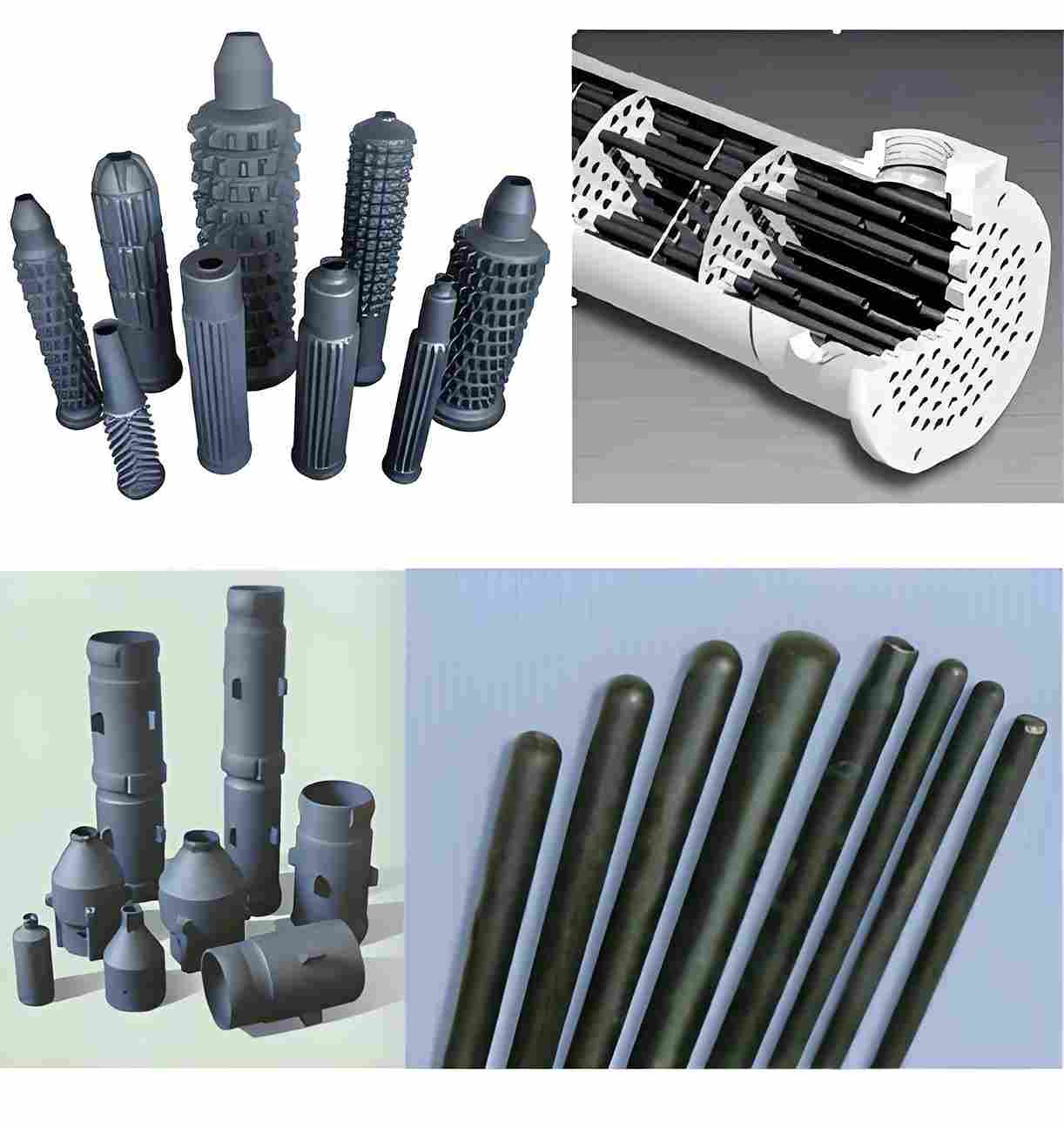
Silicon carbide (SiC) has a reputation in industry: when metals, traditional refractories, and basic ceramics all fail, engineers start looking at SiC. To use it properly, you need more than marketing claims – you need a clear view of its properties and what they mean for real designs.
This guide walks through the key mechanical, thermal, chemical, and electrical properties of silicon carbide ceramics, and explains how they translate into design rules for pumps, furnaces, wear parts, and other industrial equipment.
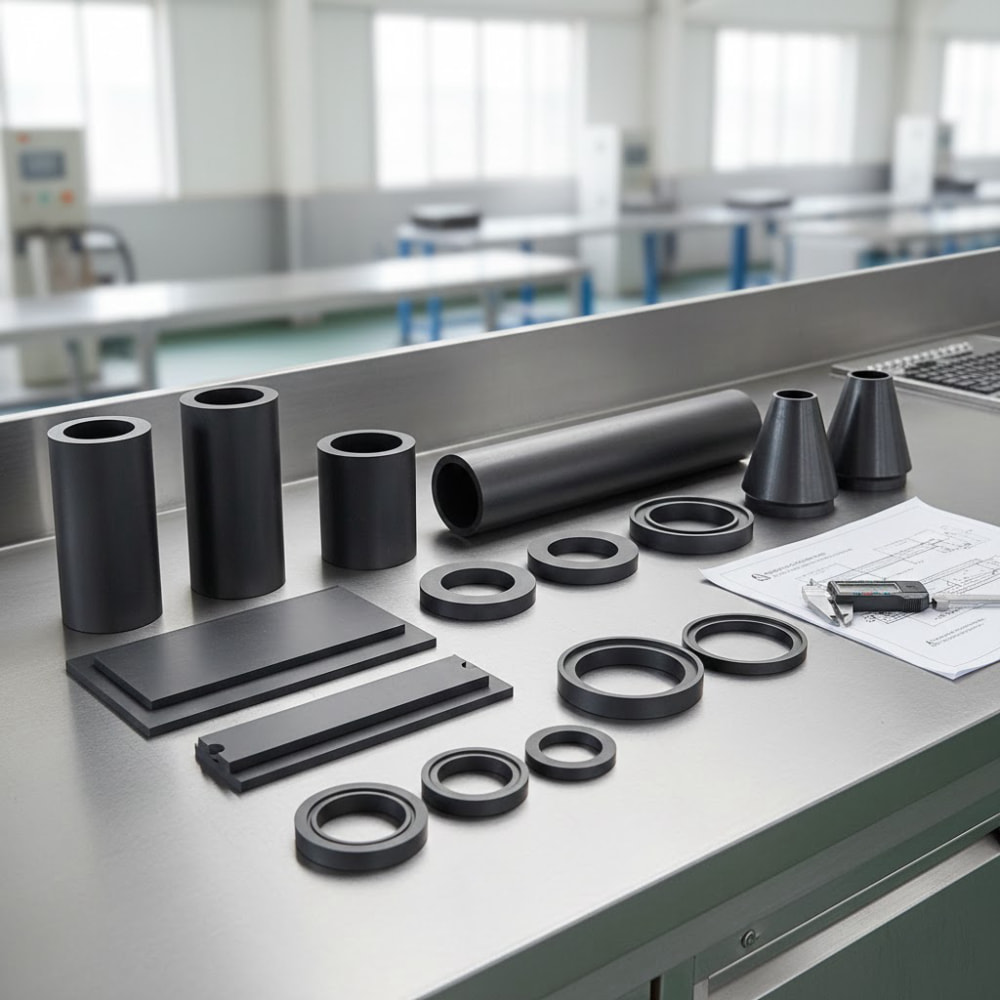
1. What exactly is silicon carbide?
Silicon carbide is a covalently bonded ceramic made from silicon and carbon. At the crystal level it has a very strong lattice, which gives it:
- Very high hardness
- High elastic modulus (stiffness)
- Good stability at elevated temperatures
Industrial SiC ceramics are not loose grains – they are sintered, reaction-bonded, or recrystallized bodies, engineered to have specific density, porosity, and microstructure depending on the application.
2. Mechanical properties: hardness, strength, and wear
Most engineers meet silicon carbide first as a wear part or a seal face. That is not an accident.
Hardness
On the Mohs hardness scale, silicon carbide sits close to the top, below diamond and a few superhard materials. Practically, this means:
- SiC will cut and wear metals, not the other way round.
- Abrasive slurries that destroy steel or bronze often cause only slow, uniform wear on SiC.
Strength and brittleness
Silicon carbide ceramics have high compressive strength and high stiffness, but like most ceramics they are brittle in tension. For design, this implies:
- SiC components handle compressive loads very well when properly supported.
- They are sensitive to tensile stress, bending, and impact, especially at stress concentrations.
- Sharp corners, thin unsupported sections, and misalignment are common root causes of cracking.
Wear resistance
In sliding and erosive wear, SiC is one of the best-performing structural materials available:
- Outstanding resistance to abrasion from hard particles.
- Stable surfaces for mechanical seal faces and seats.
- Long life as wear liners, nozzles, and plates in mining, cement, and slurry handling.
This is why you see SiC in products like silicon carbide nozzles and wear plates used to protect chutes, hoppers, and pipe bends.
3. Thermal properties: high temperature and thermal shock
Silicon carbide is not just a hard material – it also behaves very differently from metals under heat.
High-temperature capability
- SiC maintains strength and stiffness at temperatures where many steels creep or soften.
- It is routinely used in furnace and kiln components operating above 1200°C, depending on grade.
That is why SiC is widely used for tubes, beams, plates, and crucibles in high-temperature equipment, such as silicon carbide tubes and kiln hardware.
Thermal conductivity
Unlike many ceramics, silicon carbide has relatively high thermal conductivity:
- Heat is conducted through the body more efficiently than in typical oxide ceramics.
- This helps reduce thermal gradients and local hot spots, which supports thermal shock resistance.
Thermal expansion and thermal shock
- SiC has a low coefficient of thermal expansion compared with many metals.
- Combined with good thermal conductivity, this gives strong thermal shock resistance when the part is correctly designed and supported.
In practice, high-quality SiC tubes, plates, and beams can handle aggressive heating and cooling cycles – provided you avoid sharp temperature spikes, severe mechanical restraint, and sudden quenching beyond design limits.
4. Chemical properties: corrosion and oxidation resistance
Another major reason to choose silicon carbide ceramics is their behaviour in aggressive media.
Corrosion resistance
- High-purity pressureless sintered SiC (SSiC) shows excellent resistance across a wide pH range, including many acids and alkalis.
- In combined wear–corrosion environments (slurries, chemical pumps), SiC generally outperforms metals and many polymers.
This makes SiC an attractive material for mechanical seal rings, sleeves, and bearings in chemical processing, seawater systems, and other harsh services.
Oxidation behaviour
- At elevated temperatures in air or oxidizing atmospheres, SiC forms a thin silica-based layer.
- In many furnace and kiln applications, this oxide layer is stable and protective.
However, at very high temperatures or in specific gas chemistries, you must still review long-term oxidation and possible reactions with slags or atmospheres when designing components such as burner tubes, beams, and plates.
5. Electrical properties
Electrically, silicon carbide is a semiconductor. For structural ceramics in industrial equipment, the relevant points are:
- SiC ceramics often behave as electrically insulating at room temperature in many configurations.
- At high temperatures and in certain doped grades, SiC can be used as heating elements and resistive parts.
For most mechanical components – tubes, plates, seals – you simply treat SiC as a high-temperature, wear-resistant structural material. For specialized roles like SiC heating elements, you need grade-specific electrical data and design rules.
6. Differences between SSiC, RBSiC, and RSIC
“Silicon carbide ceramic” is not one single material. The most common industrial grades are:
Pressureless sintered SiC (SSiC)
- High density, low porosity, and high purity.
- Excellent mechanical strength and corrosion resistance.
- Typical uses: mechanical seal rings, pump components, precision sleeves, high-purity parts.
Reaction-bonded SiC (RBSiC / SiSiC)
- Made by infiltrating silicon into a porous SiC preform.
- Good strength and shape capability, suitable for large and complex geometries.
- Typical uses: beams, rollers, burner tubes, kiln furniture, structural furnace parts.
Recrystallized SiC (RSIC)
- Produced by recrystallizing SiC grains at very high temperatures without sintering aids.
- Excellent high-temperature behaviour and thermal shock resistance; usually more porous than SSiC.
- Typical uses: certain extreme-temperature furnace and kiln components.
Choosing the right grade is about matching temperature, environment, dimension, and required precision to the strengths of each material type.
7. What these properties mean for design
Translating lab properties into real-world design rules is where many projects succeed or fail. A few practical guidelines:
Avoid tension and stress concentrations
- Design parts so they work mainly in compression or gentle bending, not high tension.
- Use generous radii at corners and transitions – avoid sharp internal corners in loaded regions.
- Provide proper support to reduce bending loads on tubes, plates, and long beams.
Control section thickness and geometry
- Very thin, long, unsupported sections are high risk.
- In large structural parts (e.g. beams, rollers), geometry should balance stiffness and weight while respecting safe stress levels.
Respect thermal gradients
- Rapid temperature ramp rates, cold air jets, or localized flame impingement can create high thermal stress.
- Use appropriate preheat, warm-up, and cool-down procedures in furnaces and kilns.
Specify surface and tolerance correctly
- Seal faces, bearing surfaces, and mating fits may need defined flatness, run-out, and Ra values.
- Tighter tolerances and finer finishes are possible, but they increase cost because they require more diamond grinding.
8. How properties drive application choices
The property set of SiC directly explains where it is most valuable:
- Pumps and seals: Hardness + corrosion resistance + dimensional stability => mechanical seal rings, sleeves, and bearings with much longer life in difficult fluids.
- Furnace and kiln components: High-temperature strength + thermal shock resistance => tubes, beams, plates, and burners that maintain geometry and support over time.
- Wear protection: Extreme hardness + abrasion resistance => liners, plates, and nozzles that convert chronic repair points into planned maintenance items.
- Metal processing: Thermal conductivity + high-temperature stability => crucibles and kiln furniture with efficient, repeatable heating behaviour.
For example, a designer working on a high-temperature tube assembly might evaluate silicon carbide tubes, while someone dealing with floor-level impact and wear in a heat-treatment line may look at silicon carbide plates for kiln furniture or wear surfaces.
9. Practical selection checklist for engineers
When you are deciding whether to use silicon carbide ceramic in a project, a simple checklist helps:
- Define the failure mode of your current material: wear, corrosion, thermal distortion, cracking, or a mix.
- List key conditions: temperature (normal + peak), pressure, medium (fluid/gas/solids), and mechanical loads.
- Identify component function: seal face, tube, crucible, plate, liner, nozzle, structural support, etc.
- Estimate lifetime target: how many hours/cycles between replacements would make the business case work?
- Choose a SiC grade family: SSiC for precision / severe chemical duty, RBSiC for structural / kiln / burner parts, RSIC for very high-temperature thermal shock cases.
- Work with a supplier to design geometry, tolerances, and mounting details around SiC’s strengths and limitations.
- Run a pilot and measure actual performance versus the existing solution.
Summary
Silicon carbide ceramics combine:
- Extreme hardness and wear resistance
- High strength and stiffness at elevated temperatures
- Good thermal conductivity and thermal shock behaviour
- Strong corrosion and oxidation resistance in many industrial environments
For engineers, the value of SiC is straightforward: when an application suffers from combined wear, heat, and corrosion, silicon carbide is often one of the few materials capable of delivering stable, long-term performance. Understanding its properties – and designing with them in mind – is the difference between an expensive ceramic experiment and a reliable, high-value solution.