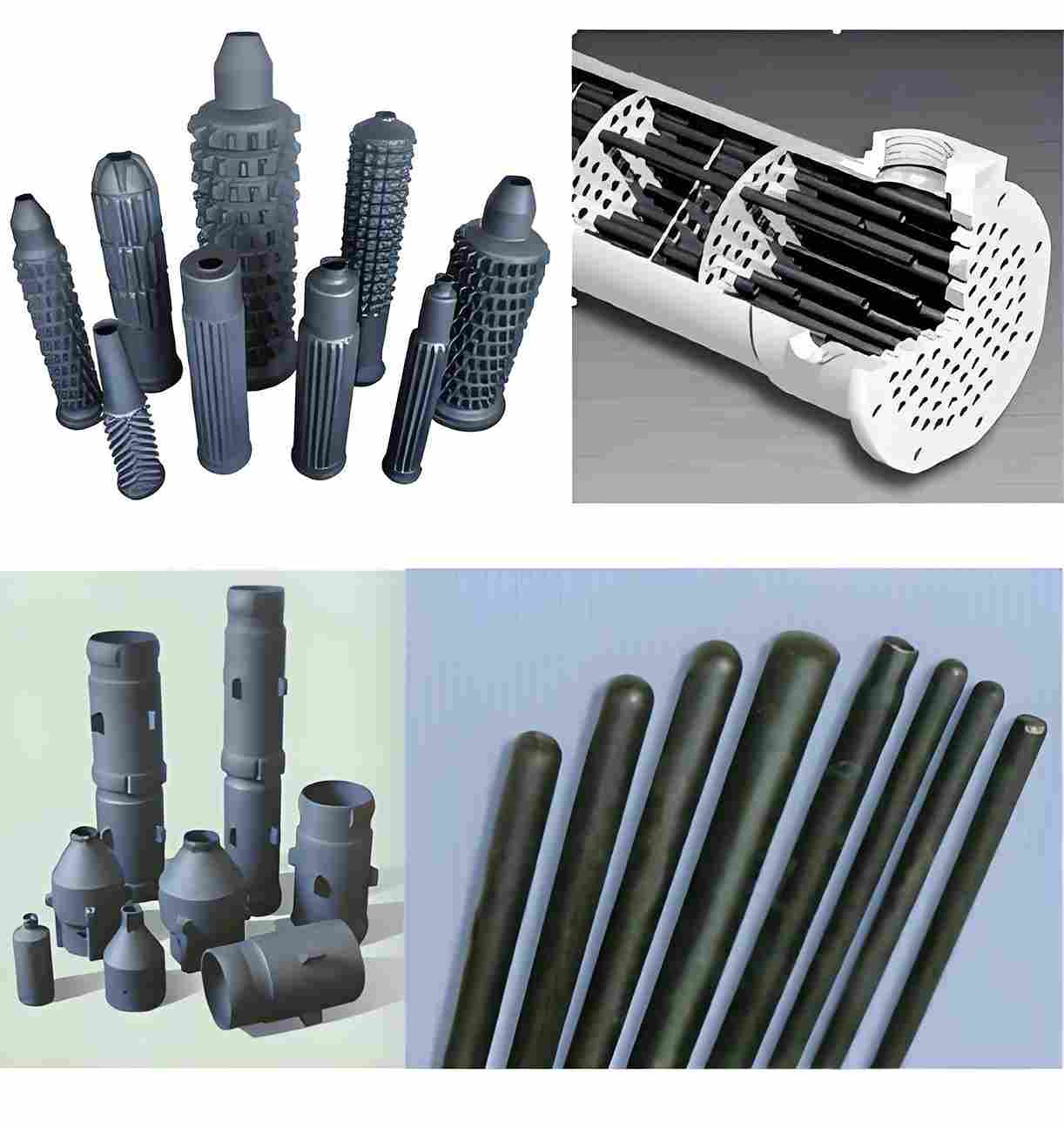
When you order a silicon carbide ceramic part, you only see the drawing, the quotation, and the finished component. Behind that simple outcome is a long chain of process decisions that directly affect quality, tolerances, cost, and delivery time.
This guide walks through how silicon carbide ceramics are made – from powder to finished product – so engineers and buyers can understand what is possible, what is risky, and why “just changing the drawing” is never as simple as it sounds.
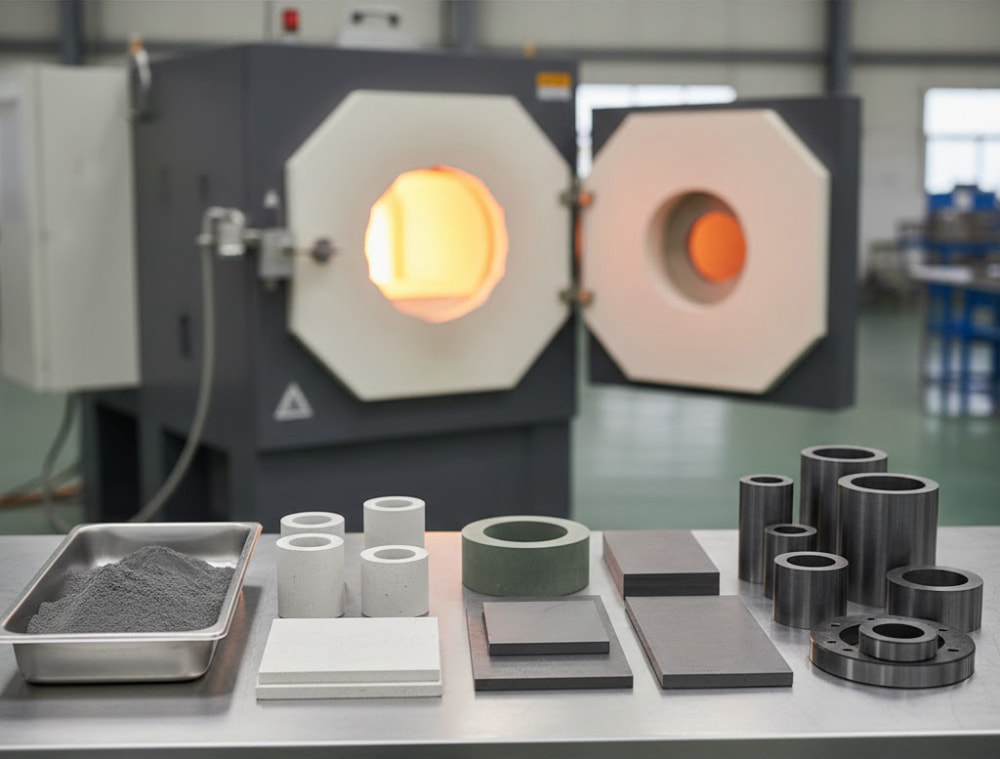
1. Raw materials: the starting point is powder
Every silicon carbide ceramic part starts as powder. The quality of this powder sets the ceiling for the performance you can get out of the final component.
- Base material: high-purity silicon carbide powder, often with controlled particle size distribution.
- Additives: small amounts of sintering aids, binders, plasticizers, and sometimes pore formers, depending on the target grade (SSiC, RBSiC, RSIC) and process route.
- Powder control: particle size, shape, and impurity content strongly influence density, strength, corrosion resistance, and consistency across batches.
For high-performance industrial parts – such as silicon carbide tubes or precision seal rings – suppliers use tighter powder specifications than for basic refractories.
2. Powder preparation: mixing, milling, and granulation
Before forming, the powder has to be conditioned so it flows, packs, and sinters correctly.
- Mixing: SiC powder is blended with binders, lubricants, and other additives to achieve uniform composition.
- Wet or dry milling: ball mills or attrition mills break down agglomerates and tune the particle size distribution.
- Granulation: for pressing and isostatic forming, the powder may be spray-dried into granules for better flow and filling.
Good powder preparation means consistent “green” density (the density before sintering), which is critical for predictable shrinkage and final dimensional accuracy.
3. Forming: giving the part its basic shape
Next, the prepared powder is formed into a “green body.” The forming route depends on shape, size, and volume:
Uniaxial pressing
- Powder-filled steel dies compact the material under high pressure.
- Best for simple, relatively flat shapes like discs, plates, and basic rings.
- Tooling cost is moderate; good for medium to high volumes of standard sizes.
Cold isostatic pressing (CIP)
- Powder is filled into a flexible mold, then compressed uniformly in a pressure vessel with fluid.
- Provides very uniform green density, useful for thick sections or larger parts.
- Often used for blocks or billets that are later machined to near-net shape.
Extrusion
- A plasticized SiC mix is pushed through a die to create continuous profiles.
- Ideal for tubes, rods, and long, constant-cross-section parts.
- Common for products such as SiC tubes, protection tubes, and membrane supports.
Injection molding and slip casting
- Used for complex shapes with internal features that are difficult to press or machine.
- Higher tooling and process complexity, more suited to specialized high-volume parts.
At this point, the parts are still relatively weak “green bodies” held together by binders. They can chip or crack if handled incorrectly.
4. Green machining: shaping before sintering
To avoid expensive post-sintering machining, many features are added while the part is still in the green or pre-sintered state:
- Drilling holes, turning OD/ID, or shaping grooves while the ceramic is still soft enough to be cut with conventional tools.
- Adjusting critical dimensions to reduce how much grinding is needed after sintering.
- Adding chamfers, radii, and relief features that help reduce stress concentrations.
Designing parts for efficient green machining is one of the easiest ways to control cost without sacrificing performance.
5. Debinding: removing organic additives
Before a part can be sintered, the binders and plasticizers used for forming must be removed carefully.
- Controlled heating: green parts are heated at low rates to gradually burn off or decompose organics.
- Atmosphere control: air, inert gas, or specific gas mixtures may be used depending on the formulation.
- Slow ramp rates: too aggressive debinding can cause cracks, blisters, or internal defects.
Debinding is a classic hidden risk in ceramic manufacturing: if it is rushed, parts may look fine at the surface but fail later during sintering or in service.
6. Sintering: turning powder into a dense ceramic
Sintering is where silicon carbide ceramics gain their strength, density, and final microstructure. Different SiC grades use different sintering routes.
Pressureless sintered SiC (SSiC)
- Debound parts are heated to very high temperatures in a controlled atmosphere.
- Powder particles bond and densify without external pressure.
- Produces high-density, low-porosity ceramics with excellent mechanical and chemical properties.
- Used for precision parts such as mechanical seal rings, pump sleeves, and high-purity components.
Reaction-bonded SiC (RBSiC / SiSiC)
- A porous SiC preform is infiltrated with molten silicon.
- The silicon reacts with residual carbon to form additional SiC, bonding the structure.
- Allows good control of large or complex shapes with strong, relatively dense structures.
- Common for kiln furniture, beams, rollers, burner tubes, and structural furnace parts.
Recrystallized SiC (RSIC)
- SiC grains are sintered at very high temperature so they grow together (recrystallize) without sintering aids.
- Resulting material is typically more porous than SSiC but has excellent high-temperature and thermal shock behaviour.
- Used where extreme temperature stability matters more than maximum mechanical strength.
During sintering, parts shrink – sometimes by 15–20% or more, depending on the route. This shrinkage must be predictable and uniform; otherwise, dimensions and flatness will be out of tolerance.
7. Post-sinter machining: precision where it matters
After sintering, silicon carbide is extremely hard. At this stage, only diamond tools can machine it efficiently.
- Grinding and lapping: used to achieve tight tolerances on diameters, faces, and sealing surfaces.
- Surface finish control: critical for mechanical seal faces, bearing surfaces, and high-precision fits.
- Flatness and run-out: adjusted so components assemble correctly and run smoothly in rotating equipment.
Every micron of material removed at this step costs time and money, which is why good forming and green machining are so important. Typical examples include finishing silicon carbide plates for kiln furniture, or grinding the sealing faces of SiC rings for pumps.
8. Inspection, testing, and quality control
To make silicon carbide ceramics reliable in critical equipment, manufacturers layer multiple checks into the production process:
- Dimensional inspection: calipers, CMMs, and gauges verify that key dimensions and tolerances are met.
- Visual and microscopic checks: look for cracks, chips, pores, and surface defects.
- Density and porosity measurements: confirm that sintering achieved the target microstructure.
- Mechanical and corrosion testing: on representative samples to validate strength and resistance to target media.
For demanding industries, this may be documented with certificates of conformity, test reports, and traceability back to powder batches and furnace runs.
9. Cleaning, packaging, and logistics
The final steps are often ignored in theory but matter in practice:
- Cleaning: removal of grinding residues, dust, and loose chips, especially important for seal faces and high-purity components.
- Protection: each part is separated with foam, film, or trays to prevent contact damage during shipping.
- Labeling: part numbers, batch codes, and orientation marks to make installation and traceability easier for the end user.
Good packaging is not “nice to have” for SiC parts; a poorly packed shipment can undo a perfectly controlled production process.
10. What this means for engineers and buyers
Understanding how silicon carbide ceramics are made helps you make better decisions when specifying parts and choosing suppliers.
- Drawings and tolerances: extremely tight tolerances or unnecessary complex features will increase grinding time and cost; discuss critical vs non-critical surfaces.
- Material and grade choice: match SSiC, RBSiC, or RSIC to your real operating conditions instead of asking vaguely for “SiC.”
- Lead time expectations: forming tools, debinding, sintering, and post-machining all take time; realistic schedules avoid expensive rush jobs.
- Design for manufacturability: simple geometry changes (chamfers, radii, wall thickness) can dramatically improve yield and reliability.
If you know where your SiC component sits in the manufacturing chain, you can have much more productive discussions about cost, risk, and performance.
Summary
Silicon carbide ceramics are not commodity castings; they are the result of carefully controlled steps:
- Raw material selection and powder preparation
- Forming (pressing, isostatic pressing, extrusion, casting, or molding)
- Green machining and debinding
- Sintering (SSiC, RBSiC, or RSIC, depending on the application)
- Post-sinter grinding and finishing
- Inspection, testing, and packaging
For engineers and buyers, the key takeaway is simple: good silicon carbide components come from good process control. When you select a supplier, you are not just buying a part number – you are buying a complete, repeatable process from powder to finished product.