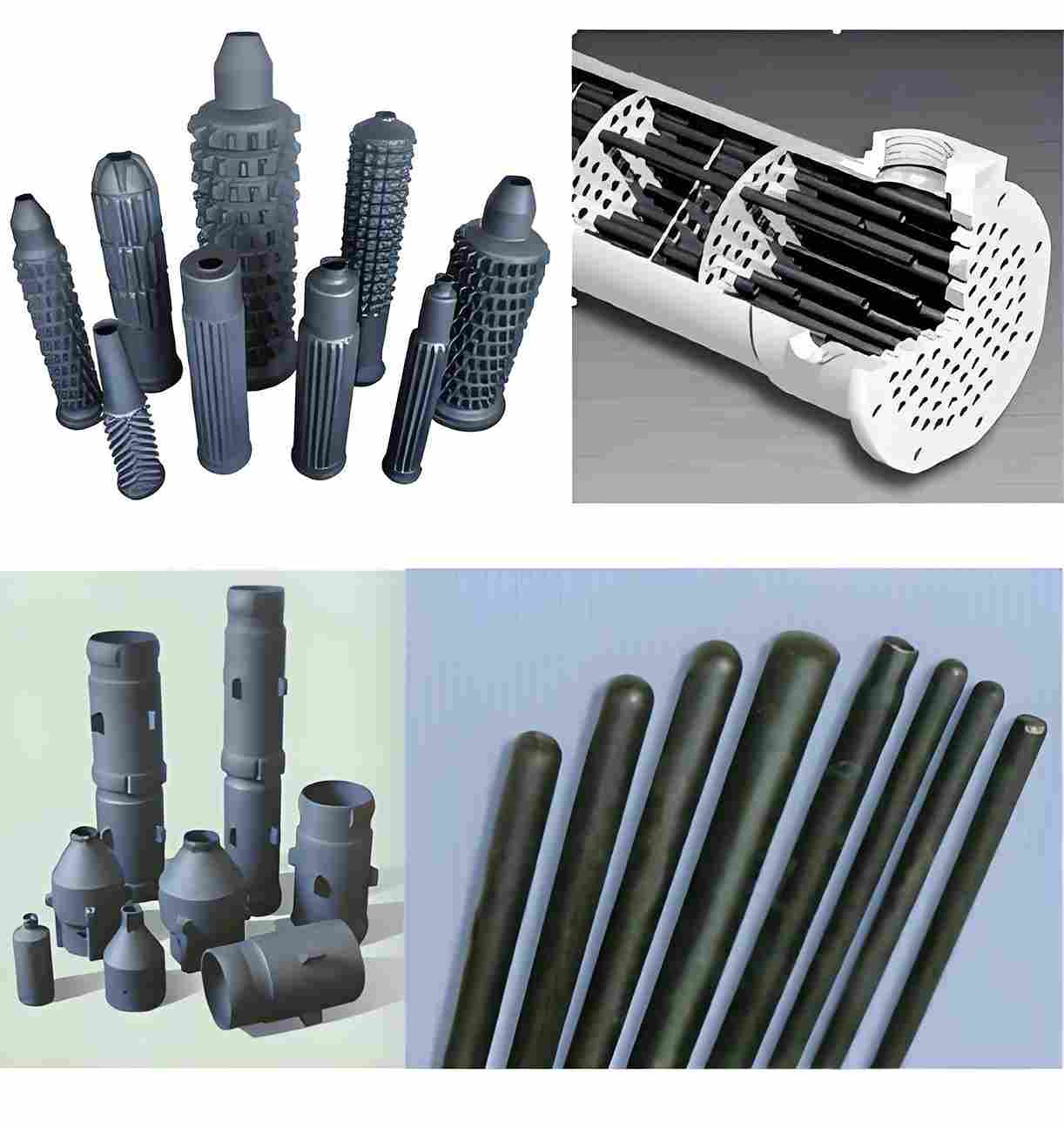
Corrosion is the quiet killer in industrial plants. You rarely see it coming until a tube leaks, a seal fails, or a liner disappears faster than the budget. When temperature, chemistry, and flow all get aggressive, a lot of “corrosion-resistant” materials tap out. Silicon carbide is one of the few that can stay in the game.
This guide explains why silicon carbide excels in corrosive environments, how it compares with metals and other ceramics, and how to use it effectively in real equipment instead of just hoping a better alloy will fix everything.
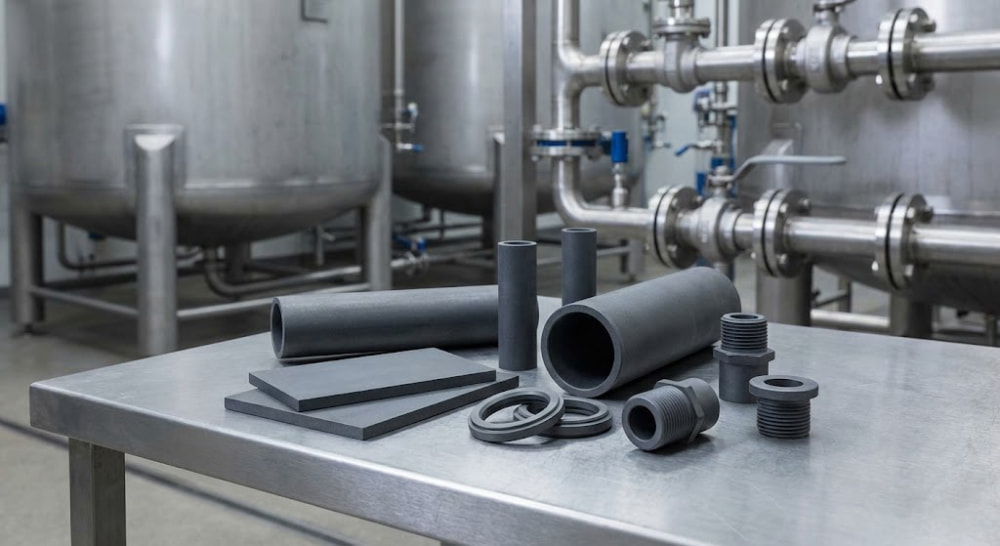
Corrosion in real industrial environments
Industrial corrosion is rarely a simple textbook case. In practice, you usually have a mix of:
- Acidic or alkaline media (liquids and vapours).
- Elevated temperatures that accelerate every reaction.
- Dissolved gases such as oxygen, CO₂, H₂S, or halogens.
- Suspended solids that add erosion on top of corrosion.
- Flow-induced effects like turbulence, cavitation, and impingement.
Metals respond by corroding, pitting, or eroding, especially when protective films are stripped away by flow. Standard refractories may resist bulk chemical attack but can spall, crack, or erode when combined with thermal cycling and abrasion.
Silicon carbide takes a different approach: it relies on a combination of strong covalent bonding, dense microstructure, and stable surface films to survive where many materials don’t.
What makes silicon carbide so corrosion resistant?
Silicon carbide has several built-in advantages for corrosive service:
- Covalent bonding and strong crystal structure – makes the lattice itself inherently stable against many chemical attacks.
- High density and low open porosity (for quality SSiC grades) – fewer pathways for corrosive media to penetrate into the bulk material.
- Protective surface layer – in oxidizing and many acidic environments, SiC forms a thin silica-based film that slows further attack.
- Chemical inertness over wide pH range – especially valuable in process equipment that sees changing media or cleaning cycles.
In dense, pressureless sintered SiC (SSiC), corrosion often progresses very slowly even in challenging environments, which is why it’s widely used for:
- Pump seal rings, sleeves, and bearings in chemical processing.
- Nozzles and liners in flue gas desulfurization and slurry systems.
- Silicon carbide tubes and plates in high-temperature, corrosive gas zones.
SiC vs metals: why alloys often lose in severe corrosion
Metals fight corrosion with passive films (oxides, chromia layers, etc.) and alloying elements. This works up to a point, but in harsh conditions you see:
- Pitting and crevice corrosion – local breakdown of passive films that leads to rapid penetration.
- Uniform thinning – steady wall loss that eventually reaches critical thickness.
- Stress corrosion cracking – cracks driven by the combination of tensile stress and chemistry.
In hot acids, oxidizing slurries, or mixed environments, even expensive nickel alloys can suffer. Silicon carbide’s advantages here include:
- No metallic microstructure to pit or selectively attack.
- Very high hardness, so erosive flows struggle to strip protective surface layers.
- Stability at temperatures where many alloys creep, soften, or oxidize aggressively.
That’s why many plants switch to SiC for internal components – seal faces, sleeves, nozzles, liners – even when they keep metals for pressure shells and structural frames.
SiC vs other ceramics and refractories
Compared with conventional refractories and some oxide ceramics, silicon carbide usually offers:
- Better combination of corrosion and erosion resistance – crucial in flowing or particle-laden media.
- Higher thermal conductivity – reduces thermal gradients that can drive spalling and cracking.
- Good thermal shock behaviour – especially important in systems with cyclic operation.
Alumina and other oxides can work well in many situations, but they tend to reach their limits in:
- Hot acidic environments.
- Combined corrosion + erosion + thermal cycling zones.
- Applications where both mechanical load and chemistry are severe.
In those cases, switching critical components to silicon carbide often extends life significantly, even if bulk linings and low-stress areas remain alumina or other refractories.
Where silicon carbide really excels in corrosion service
Silicon carbide’s strengths show up most clearly in equipment zones that are both chemically aggressive and operationally important, such as:
- Chemical pumps and agitators – SiC mechanical seal rings, sleeves, and bearings in hot, corrosive liquids.
- Flue gas and wet scrubbing systems – SiC nozzles and inserts where acids, chlorides, and solid particles are present.
- High-temperature furnace and kiln zones with corrosive atmospheres (e.g. sulphur- or chlorine-bearing gases).
- Metal processing – SiC crucibles and tiles in non-ferrous melting where fluxes and slags attack conventional materials.
- Environmental and waste treatment – components exposed to aggressive leachates, vapours, and process streams.
In many of these cases, plant engineers report that silicon carbide components outlast previous materials by a factor of several times, even though conditions are unchanged or slightly more demanding.
How media and SiC grade influence corrosion behaviour
Not all silicon carbide is identical. Corrosion resistance depends strongly on:
- SiC grade and processing route – dense pressureless sintered SiC (SSiC) usually offers the best corrosion resistance.
- Free silicon content – in reaction-bonded SiC (RBSiC/SiSiC), residual silicon is more vulnerable to some acids.
- Porosity and microstructure – lower open porosity means fewer pathways for media to penetrate.
- Surface condition – ground and polished surfaces are less prone to localized attack than rough, defected surfaces.
On the media side, key parameters include:
- Chemical composition (acids, alkalis, oxidizers, chlorides, etc.).
- Temperature and pressure.
- Presence of solids and gas bubbles.
- Flow velocity and turbulence.
For aggressive chemistries, dense SSiC is usually the safest choice for seal rings, sleeves, and critical wetted parts, while RBSiC is often suitable for larger structural elements like beams and some tube designs.
Design strategies to take advantage of SiC’s corrosion resistance
The material alone doesn’t save you if the design is bad. To use silicon carbide effectively in corrosive environments:
- Use metals for pressure, SiC for exposure: let steel or alloys carry pressure and structure; use SiC where media is most aggressive.
- Avoid stagnant pockets: dead zones trap aggressive media and can lead to localized attack; design for smooth flow and drainage.
- Minimize stress concentrators: rounded transitions and adequate wall thickness reduce crack risk when corrosion and mechanical loads interact.
- Control joints and interfaces: ensure seals, gaskets, and adhesives are compatible with both SiC and the process media.
- Match grade to zone: use the highest-grade SiC where failure cost is highest (e.g. seal faces and primary wetted parts).
Done right, silicon carbide becomes the “armor” in the most hostile sections of your plant while the rest of the system can stay with more conventional materials.
FAQ – Corrosion and silicon carbide
Q1: Is silicon carbide resistant to all acids?
A: No material is invincible, but dense SiC generally has excellent resistance to many mineral acids and aggressive media, especially in oxidizing conditions. Performance depends on grade, temperature, concentration, and flow. Critical applications should be validated with test data or reference cases, not assumptions.
Q2: How does SiC behave in combined corrosion and erosion?
A: This is one of SiC’s strongest areas. High hardness and wear resistance help protect against particle erosion, while the ceramic’s chemical stability slows corrosion. That combination often makes SiC the best option in high-velocity, particle-laden, corrosive flows.
Q3: Is silicon carbide always better than high-alloy metals for corrosion?
A: Not always, but in many severe environments it is. High-alloy metals can perform well until conditions become too hot, too acidic, or too erosive. At that point, SiC frequently offers longer life and more stable performance, especially for internal components like seals, nozzles, and liners.
Q4: Do I need special cleaning procedures for SiC parts in corrosive service?
A: Cleaning is usually less about protecting SiC and more about avoiding thermal shock and mechanical damage. Avoid rapid temperature shocks and aggressive mechanical impacts. Most chemical cleaning agents that attack metals will not harm dense SiC, but always confirm compatibility with your specific media.
Q5: What information should I provide when evaluating SiC for corrosion problems?
A: At minimum: full media composition (including impurities), temperature and pressure, flow conditions, current material and failure modes, and target lifetime. With that, a SiC supplier can propose suitable grades and component designs instead of copying an old metal part and hoping it survives.