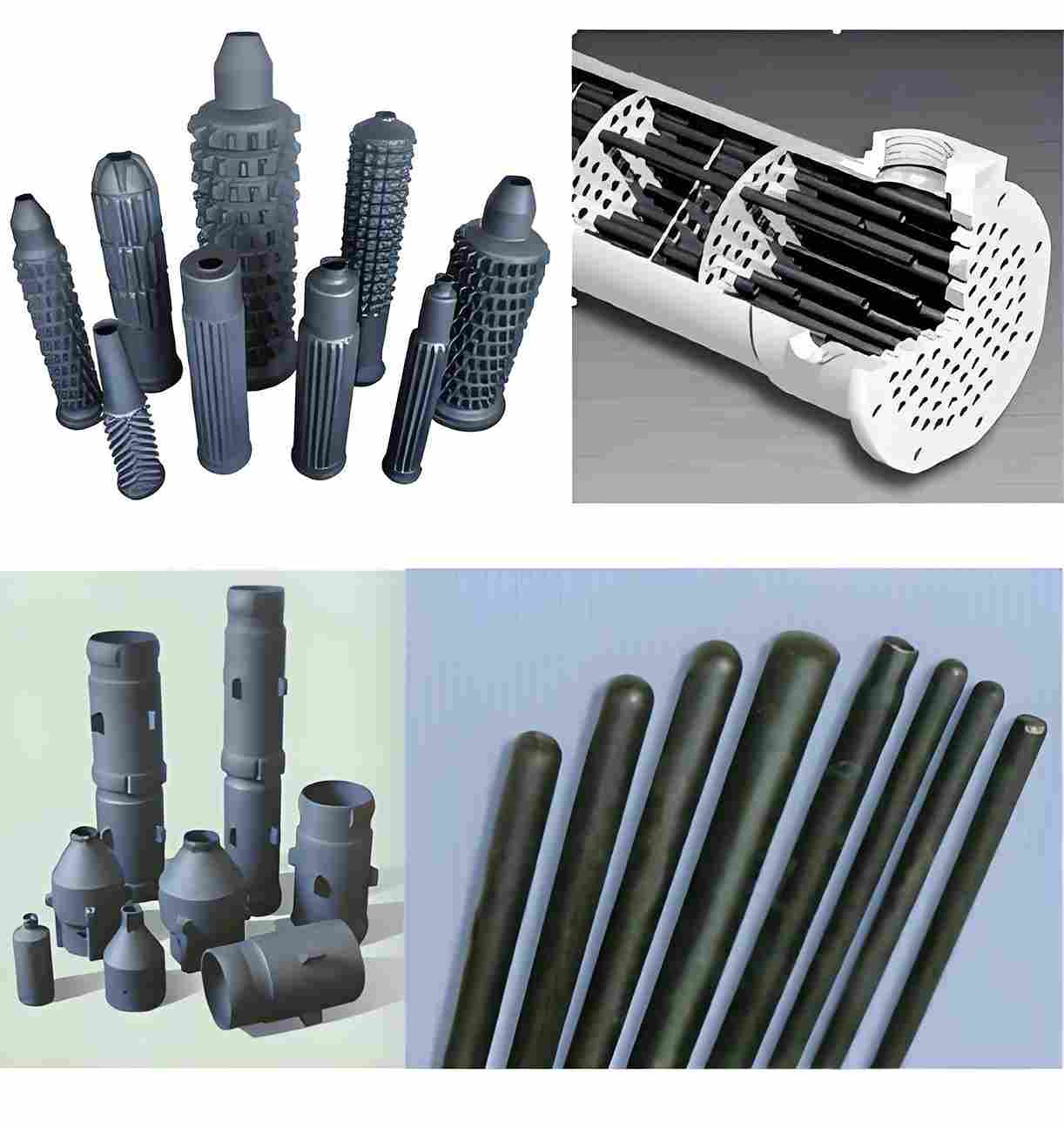
Extreme heat doesn’t care about your maintenance budget. If thermal management is bad, tubes crack, plates warp, seals fail, and you get the usual combo of downtime + blame game. Silicon carbide won’t magically fix bad design, but it gives you a much better set of tools to control heat instead of being controlled by it.
This guide explains how silicon carbide helps manage extreme heat in real industrial systems: what its thermal properties actually do for you, where it outperforms other materials, and how to use SiC components intelligently instead of just throwing “high-temperature material” at the problem.
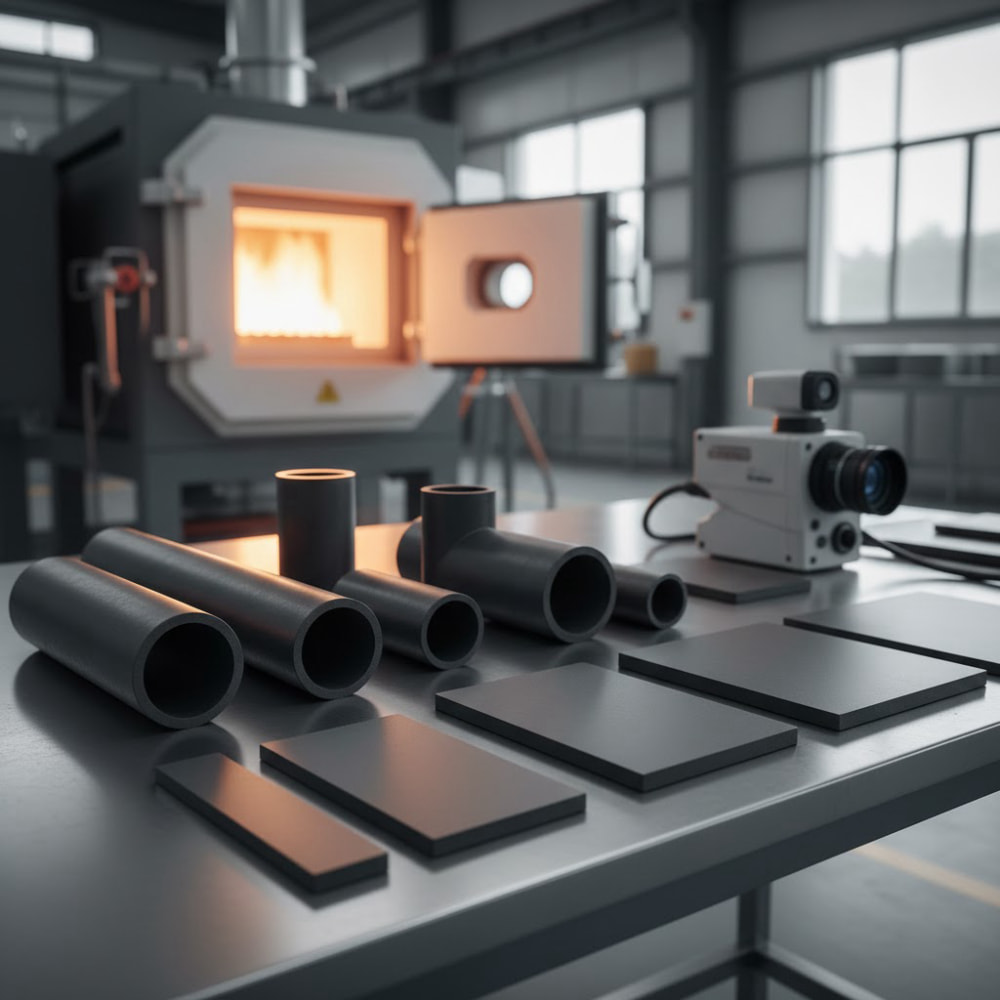
The thermal properties that matter in SiC
For thermal management, the key material properties are:
- Thermal conductivity – how fast heat moves through the material.
- Coefficient of thermal expansion (CTE) – how much the material expands when heated.
- Specific heat capacity – how much energy it stores per degree of temperature rise.
- High-temperature strength – whether the part can still carry load at real operating temperatures.
Compared with many traditional refractories and even with alumina, silicon carbide generally offers:
- Higher thermal conductivity – it spreads heat instead of trapping it in local hotspots.
- Lower CTE – less expansion, less internal stress for a given temperature change.
- Good strength at temperature – so parts don’t sag or deform as soon as things run hot.
In plain language: SiC lets you move heat where you want it and survive the temperature you actually run, not just the one in the brochure.
How SiC helps control hotspots and gradients
Hotspots kill components. They create thermal gradients, which create thermal stress, which cracks ceramics and fatigues metals. Silicon carbide’s relatively high thermal conductivity is useful because it:
- Spreads heat along tubes, plates, and beams, reducing peak temperature in local areas.
- Helps keep surface temperature more uniform, which is critical for product quality in kilns and furnaces.
- Reduces extreme temperature differences between hot and cold sections of the same part.
For example, using silicon carbide tubes in burners or radiant sections can distribute heat more evenly along the length of the tube, instead of building extreme hotspots near the flame front.
Thermal shock: surviving fast temperature changes
Most real furnaces and process lines do not live in a perfect steady state. You get:
- Start-ups and shutdowns.
- Batch cycles and recipe changes.
- Fuel or flow disturbances that swing temperature faster than anyone would like.
Silicon carbide handles this better than many ceramics because of the combination of:
- Low thermal expansion – less strain per degree of temperature change.
- Good thermal conductivity – so temperature differences inside the part equalize faster.
- Decent fracture toughness for a ceramic (especially in some grades).
It is still a brittle material, not rubber, but if you design the geometry and support correctly, SiC components are noticeably more forgiving under thermal cycling than many traditional refractories and basic ceramics.
Where silicon carbide is used as a “thermal management tool”
Furnace and kiln tubes
In high-temperature furnaces, SiC tubes serve as burners, radiant tubes, or protective elements. Their thermal properties help to:
- Transfer heat efficiently from combustion or electric elements into the process zone.
- Reduce temperature gradients along the tube length.
- Maintain dimensional stability at elevated temperature over long campaigns.
Plates, tiles, and kiln furniture
Silicon carbide plates and kiln furniture elements need to carry load while managing heat flow. With SiC you get:
- Better resistance to warping under hot load.
- More uniform heating of products on shelves and setters.
- Improved cycling behaviour when kilns ramp up and down.
Using high-quality silicon carbide plates as supports or wear surfaces often reduces both deformation and crack frequency in high-temperature zones.
Crucibles and thermal processing vessels
In metal melting and thermal processing, silicon carbide crucibles are used because they:
- Support rapid heat-up and controlled cooling.
- Offer good thermal shock resistance when operated correctly.
- Deliver predictable heat transfer to the charge, aiding process control.
Properly selected and operated SiC crucibles can significantly extend campaign life compared with lower-grade refractories.
Design tips: using SiC to manage heat instead of just resist it
If you treat SiC only as “something that doesn’t melt,” you waste a lot of its value. For thermal management, think in terms of:
- Heat paths: design component shapes and thicknesses so heat flows where it is useful, not into dead zones.
- Uniformity: avoid very thick-and-thin combinations in the same part that create local thermal gradients.
- Support and mounting: allow for expansion without clamping the SiC so tightly it cracks under differential movement.
- Contact with other materials: be aware of how metals and refractories expand differently when bolted or cast to SiC.
For example, when mounting a SiC tube in a metal header, you need to consider the different thermal expansion rates so the joint does not become a stress concentrator as temperature rises.
Comparing SiC with other materials in thermal management
Some typical reference points:
- Versus common refractories: SiC often has much higher thermal conductivity, so it is better where you want efficient heat transfer, not just insulation.
- Versus alumina: SiC usually wins on thermal shock resistance and high-temperature strength, especially under cyclic conditions.
- Versus metals: metals can conduct heat well but soften, creep, or oxidize at high temperature; SiC maintains stiffness and integrity where metals are at their structural limit.
The result: silicon carbide is often used in combination with other materials – metals for structural frames and pressure shells, refractories for bulk linings, and SiC components for critical heat-transfer and wear interfaces.
FAQ – Thermal management with silicon carbide
Q1: Does higher thermal conductivity in SiC always mean better performance?
A: Not automatically. High thermal conductivity is useful when you want to move heat quickly or avoid hotspots. But you still need overall system design: insulation, burner setup, and flow patterns. SiC helps, but it does not fix bad furnace tuning.
Q2: Is silicon carbide more resistant to thermal shock than other ceramics?
A: In many cases, yes. The combination of lower thermal expansion and higher thermal conductivity gives SiC better thermal shock resistance than many traditional ceramics. But if you push it with brutal temperature jumps and bad geometry, it will still crack.
Q3: Can switching to SiC reduce energy consumption?
A: It can help indirectly. Better thermal management means more uniform heating, fewer overfired zones, and more effective transfer of heat into the product instead of into wasteful hotspots or damaged components. You still need good process control, but SiC gives you a more efficient “thermal hardware” foundation.
Q4: Where is SiC overkill for thermal management?
A: In low- or moderate-temperature areas where failure is rare and heat flow is not critical, cheaper materials are often fine. Silicon carbide is most valuable where temperature is high, cycling is real, and the cost of failure or poor heat control is significant.
Q5: What information should I provide when selecting SiC for a thermal application?
A: At minimum: temperature profile (normal and peak), heating/cooling rates, atmosphere (oxidizing, reducing, corrosive), mechanical load, and current failure modes (cracks, warping, erosion, etc.). With that, a supplier can recommend appropriate SiC grades and geometries instead of guessing.