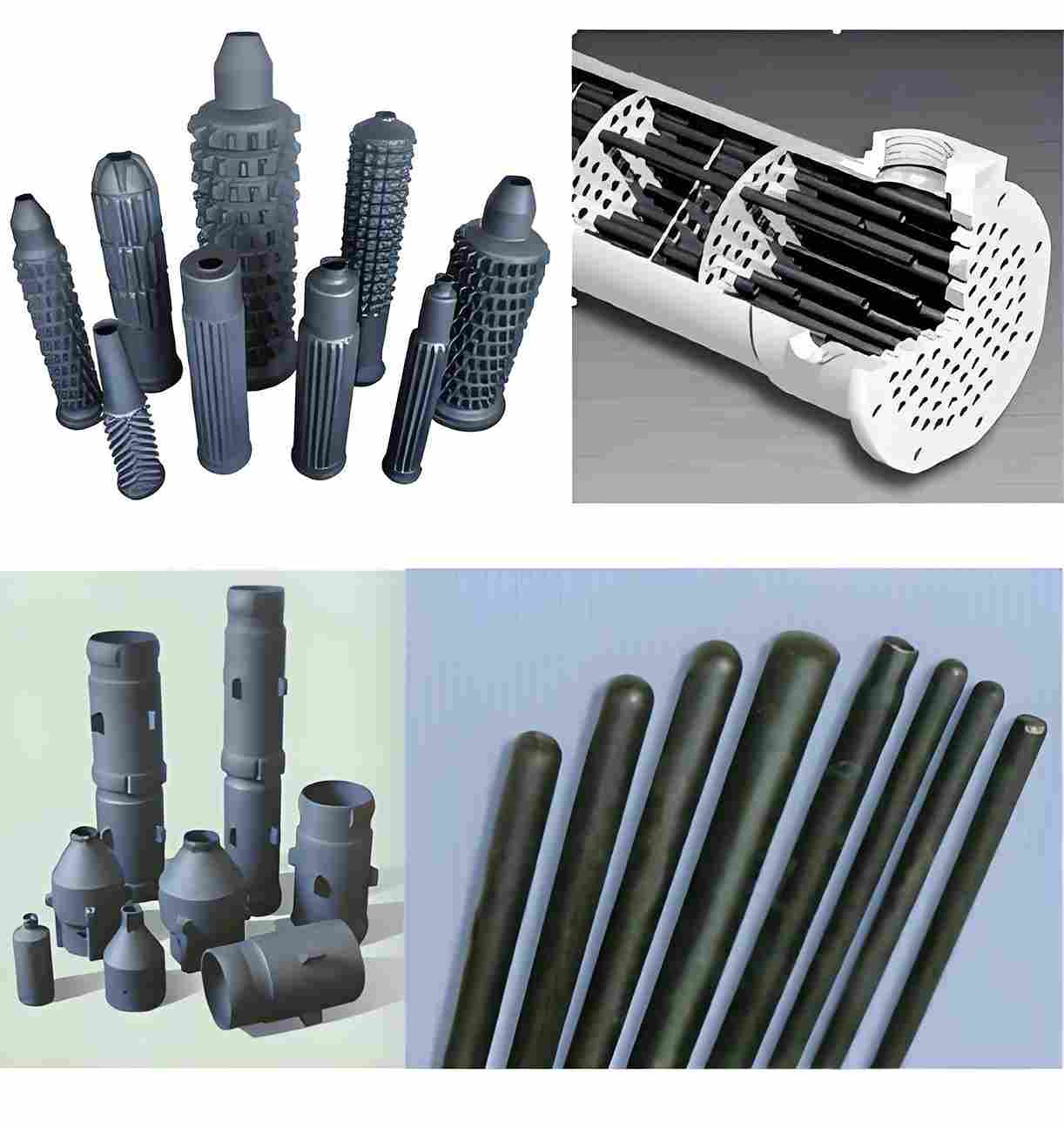
When you need a silicon carbide component that can survive 1500 °C, resist corrosion, and keep a tight dimensional tolerance, the first question is whether to specify reaction‑bonded SiC or sintered SiC – the answer depends on your performance priorities, budget, and delivery schedule.
Quick Decision Matrix
- Initial cost must be low
- Complex shapes are required (e.g., internal channels)
- Thermal shock resistance outweighs highest‑temperature strength
- Lead time under 4 weeks is critical
Choose Sintered SiC if:
- Maximum flexural strength (>200 MPa) is non‑negotiable
- Operating temperature regularly exceeds 1500 °C
- Dimensional stability after prolonged exposure is required
- Budget allows a premium for superior performance
Understanding Reaction‑Bonded SiC
Manufacturing Basics
Reaction‑bonded SiC (often called RB‑SiC) starts with a porous carbon‑containing SiC preform. The preform is infiltrated with liquid silicon at 1500 °C; silicon reacts with the carbon to form additional SiC, filling the pores and binding the structure. The process yields a material that is about 75–80 % SiC by volume, the remainder being silicon metal.
Typical Properties
- Density: 2.9–3.2 g/cm³ (lower than fully sintered SiC)
- Flexural strength: 120–180 MPa (room temperature)
- Thermal conductivity: 80–120 W/m·K
- Thermal expansion: ~4.2×10⁻⁶ /K
- High resistance to thermal shock because of the silicon phase
Strengths and Weaknesses
Because the silicon fills the pores, RB‑SiC can be machined with conventional CNC tools, and complex internal geometries (e.g., lattice structures for burner nozzles) are achievable without expensive hot‑pressing steps. The downside is that the silicon phase melts around 1414 °C, limiting the maximum service temperature and reducing high‑temperature corrosion resistance in oxidizing environments.
Understanding Sintered SiC
Manufacturing Basics
Sintered SiC (SS‑SiC) is produced by hot‑pressing or pressureless sintering of ultra‑high‑purity SiC powder (typically >98 % SiC) together with sintering aids such as B₂O₃, Al₂O₃, or Y₂O₃. The process creates a fully dense, nearly pure SiC lattice with grain sizes that can be engineered from sub‑micron to several microns, directly influencing mechanical strength and creep resistance.
Typical Properties
- Density: 3.15–3.22 g/cm³ (near theoretical density)
- Flexural strength: 200–350 MPa (room temperature)
- Thermal conductivity: 120–200 W/m·K
- Thermal expansion: ~4.0×10⁻⁶ /K
- Maximum service temperature: 1600–1700 °C in inert or reducing atmospheres
Strengths and Weaknesses
SS‑SiC offers the highest strength, stiffness, and oxidation resistance of any SiC grade, making it the material of choice for furnace tubes, high‑temperature valves, and aerospace hot‑section components. However, the sintering cycle can take 12–24 hours at 2100 °C, driving up cost and lead time. Machining SS‑SiC requires diamond tools and tight process controls, which adds to overall expense.
Performance Comparison at a Glance
| Attribute | Reaction‑Bonded SiC | Sintered SiC |
|---|---|---|
| Cost (€/kg) | $30‑$55 | $70‑$130 |
| Typical Flexural Strength | 120‑180 MPa | 200‑350 MPa |
| Max Service Temp. | ≤ 1400 °C (oxidizing) | ≤ 1700 °C (inert/reducing) |
| Thermal Shock Resistance | Very good (silicon phase) | Good, but lower than RB‑SiC |
| Machinability | CNC steel tools OK | Diamond tooling required |
| Typical Lead Time | 2‑4 weeks (stock & simple custom) | 4‑8 weeks (custom sintered) |
Cost & Lead‑Time Implications for Your Project
From our experience serving chemical‑process and metallurgical customers, a 100‑mm‑diameter furnace tube made from RB‑SiC typically costs $45 per unit and can be shipped within three weeks. The same tube, sintered to achieve 250 MPa strength, runs $95 per unit and often requires a six‑week schedule because of the high‑temperature hot‑press cycle.
For OEMs that run multiple production lines, the inventory advantage of reaction‑bonded stock (we keep >200 SKUs in warehouse) can translate into a 30 % reduction in plant downtime. Conversely, high‑performance gas‑turbine manufacturers accept the longer lead time for sintered parts because the cost of a failure at 1600 °C outweighs the price differential.
Application Guidance – Which Grade Fits Which Environment?
1. High‑Temperature Oxidizing Atmospheres (e.g., glass‑melting furnaces)
Sintered SiC is the safe bet. Its negligible silicon content prevents oxidation‑induced melt‑out. We have supplied over 10,000 m of sintered tubes to a European glass plant, and the units have logged >2000 hours of continuous operation at 1550 °C without degradation.
2. Rapid Thermal Cycling (e.g., semiconductor annealing chambers)
Reaction‑bonded SiC shines here. The silicon matrix absorbs sudden temperature gradients, reducing fracture risk. A Chinese semiconductor fab reported a 45 % decrease in nozzle replacement frequency after switching to RB‑SiC burner nozzles.
3. Complex Internal Geometry (e.g., porous burners, filter tubes)
The infiltrated silicon can faithfully replicate intricate CAD features. Our engineering team recently 3‑D‑printed a lattice‑style SiC filter core, infiltrated it, and delivered the part in 18 days – something impossible with fully sintered powder.
4. Extreme Mechanical Load (e.g., high‑pressure reactors)
Sintered SiC’s superior compressive and flexural strength makes it the only choice for pressures above 10 MPa at 1500 °C. In a recent project for a steel‑making furnace, sintered SiC liner plates endured 12 MPa cycles for 800 hours without micro‑cracking.
Why Choose ZIRSEC for Your SiC Needs?
We have been producing SiC ceramics for two decades, and our factory in China operates both a reaction‑bonded line and a state‑of‑the‑art hot‑press sintering line. That dual capability lets us recommend the exact grade you need and deliver it from the same trusted supply chain.
- Inventory Flexibility: Over 150 standard sizes are stocked 24 / 7, guaranteeing a 24‑hour shipment for most RB‑SiC items.
- Custom Engineering Support: Our in‑house engineers work with your CAD files, run finite‑element simulations, and produce a rapid prototype before full‑scale production.
- Quality Assurance: Every batch receives a full material certification (COA), dimensional inspection (±0.2 mm typical), and high‑temperature oxidation testing.
- End‑to‑End Logistics: From order confirmation to customs documentation, we handle freight forwarding, insurance, and on‑door delivery to North America, Europe, and Asia.
Explore our full catalog of Silicon Carbide Tubes or contact our sales engineers at info@zirsec.com for a free feasibility study.
Final Recommendation
If your design prioritizes the lowest purchase price, rapid delivery, or complex internal channels, go with reaction‑bonded SiC. If you need the absolute maximum strength, temperature tolerance, and long‑term oxidation resistance, invest in sintered SiC. In most mixed‑environment projects, we advise a hybrid approach: use reaction‑bonded components for the high‑thermal‑shock sections and sintered parts for the zones that see the highest steady‑state temperature.
By partnering with ZIRSEC, you gain a single source that can supply both grades, provide engineering validation, and keep your supply chain lean. That’s the real competitive edge when you’re racing against downtime and cost pressures.