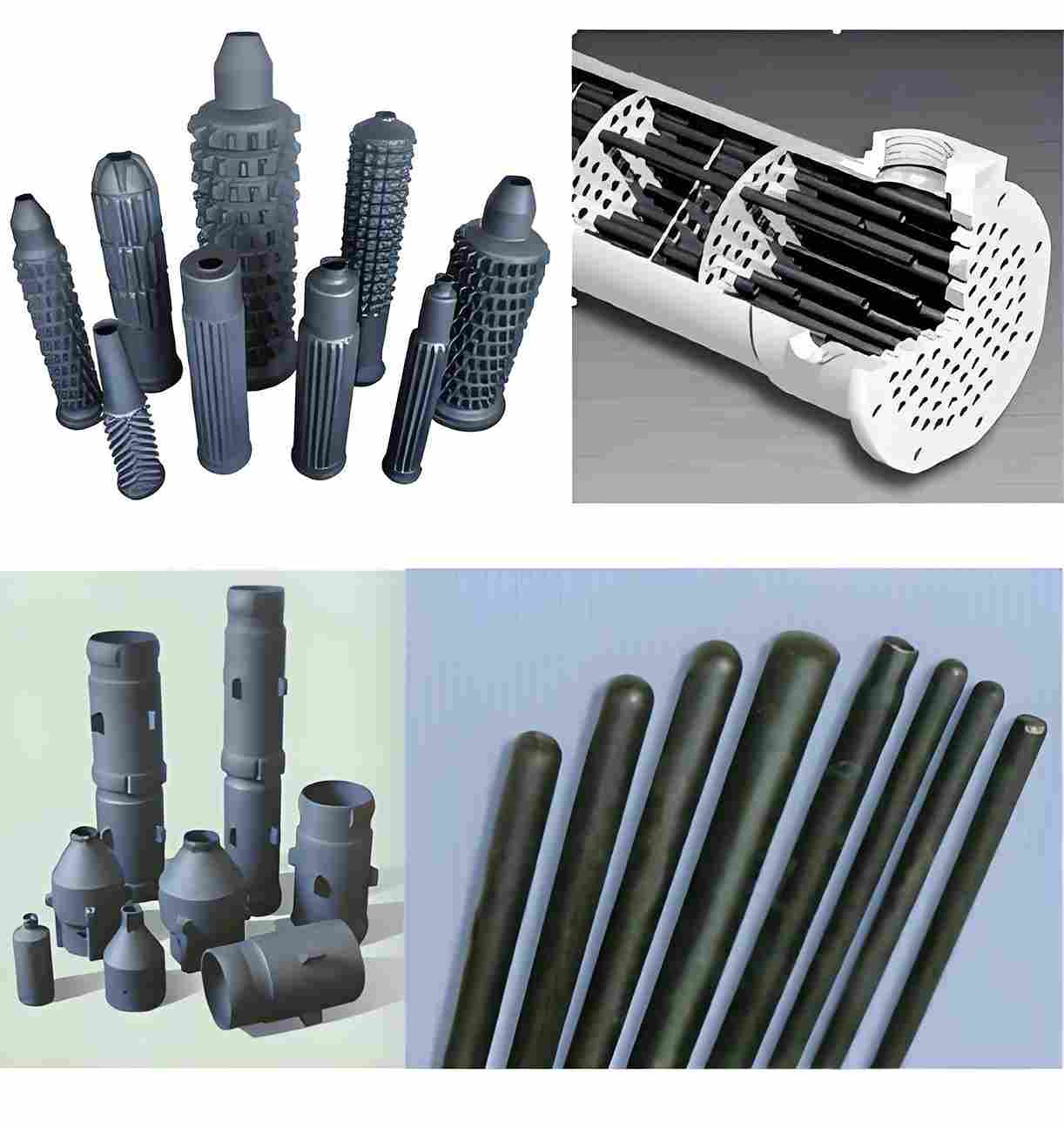
In high-temperature heat exchangers, thermal conductivity is not a “nice to have” – it decides whether your system runs efficiently or spends its life fighting hot spots, cracking and fouling. Silicon carbide (SiC) ceramics stand out for their ability to move heat quickly while surviving extreme temperatures, pressure and corrosion.
This article compares the thermal conductivity of silicon carbide with other common engineering ceramics used in heat exchangers and hot process equipment. It also gives practical guidance on when to choose SiC and how to match the material to your heat exchanger design.
Why Thermal Conductivity Matters in Ceramic Heat Exchangers
Thermal conductivity (k) describes how efficiently a material conducts heat. Higher k means faster heat transfer through the tube or plate wall, so you can achieve the same duty with less surface area or lower temperature differences between fluids. In heat exchangers, that translates directly into:
- Higher thermal efficiency and tighter approach temperatures
- Smaller and lighter exchanger designs
- Lower fuel or energy consumption
- Reduced thermal gradients and lower thermal stress in components
Ceramics are chosen when metals fail: very high temperature, aggressive media, or when you want electrical insulation and low contamination. Among these, silicon carbide is known for combining high thermal conductivity with strong mechanical and chemical performance.
Thermal Conductivity: Silicon Carbide vs Other Ceramics
The numbers below are typical room-temperature values for engineering-grade ceramics used in heat-exchange and hot process components:
| Material | Typical Thermal Conductivity (W/m·K) | Key Notes |
|---|---|---|
| Silicon carbide (SiC) | ≈ 120 W/m·K (typical engineering grade) | High thermal conductivity, low thermal expansion, excellent high-temperature strength. |
| Alumina (Al₂O₃) | ≈ 20–35 W/m·K (depends on purity) | Robust, widely used, but significantly lower thermal conductivity than SiC. |
| Zirconia (ZrO₂) | ≈ 2–3 W/m·K | Very low k; ideal where you want to contain heat, not move it. |
| Aluminum nitride (AlN) | ≈ 140–180 W/m·K | Extremely high k and good electrical insulation, but more expensive and less chemically robust in many wet-process environments. |
In simple terms:
- SiC ≈ 4–5× higher k than alumina, with better high-temperature strength.
- SiC ≫ zirconia for moving heat; zirconia is more like a thermal insulator.
- AlN > SiC in k, but SiC wins in many real-world chemical and mechanical environments.
Where Silicon Carbide Heat Exchanger Components Fit Best
Silicon carbide heat exchanger tubes and plates are particularly attractive in processes where you need both high heat flux and long-term stability in aggressive media:
- Hot acids and alkalis in chemical processing
- Flue gas and waste heat recovery at >1000 °C
- High-temperature gas coolers in metallurgical and combustion systems
- Corrosive, particle-loaded flows where erosion is a problem
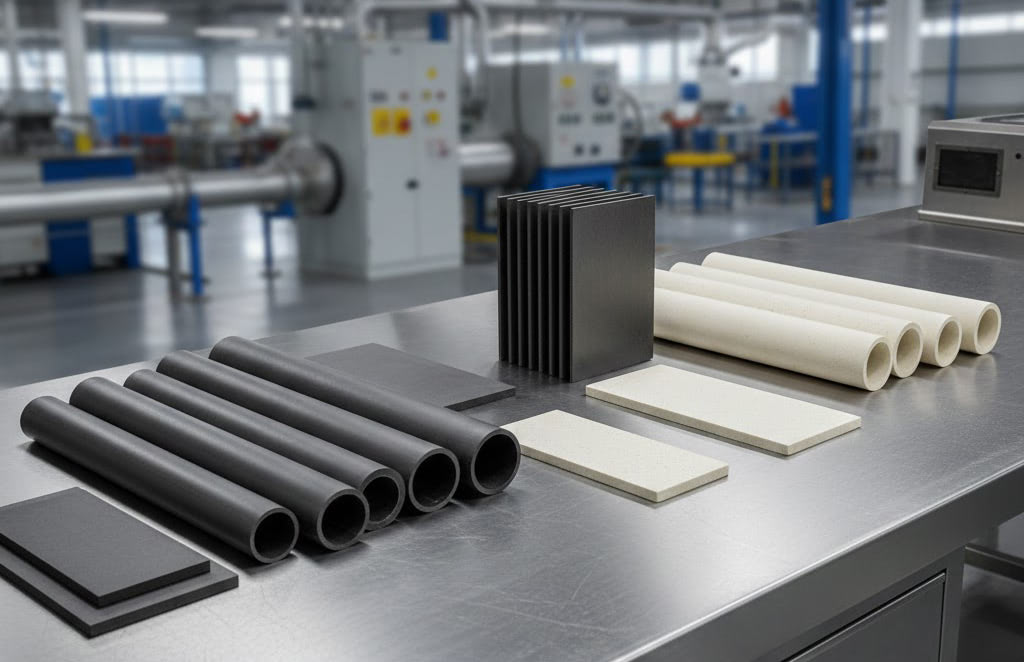
For example, Zirsec silicon carbide tubes combine high thermal conductivity with excellent thermal shock performance, allowing compact designs and fast start–stop cycles in industrial heat exchangers. For plate-type or panel-style designs, silicon carbide plates transfer heat efficiently while resisting wear and chemical attack on the hot face.
When Alumina Still Makes Sense
Alumina is the classic workhorse ceramic. It has lower thermal conductivity (~25 W/m·K) compared with SiC but offers:
- Good high-temperature capability (up to ~1700 °C in air)
- Stable electrical insulation
- Generally lower raw-material cost
In heat exchanger applications, alumina may be acceptable when:
- Heat duty is modest and surface area is not a constraint
- Operating temperatures are high but corrosion is moderate
- You care more about insulation and electrical properties than maximizing heat flux
For compact, high-performance heat exchangers handling aggressive flows, alumina often struggles to match SiC on efficiency and lifetime.
Where Zirconia Fits (And Where It Doesn’t)
Zirconia ceramics are known for toughness and very low thermal conductivity (around 2 W/m·K). This makes them useful where you want to contain heat inside a component or protect surrounding structures.
In heat exchangers or high-flux panels, that low thermal conductivity is usually a disadvantage:
- Thicker walls or larger surface area needed for the same duty
- Higher thermal gradients and internal stresses under rapid cycles
- Lower overall efficiency compared with SiC or AlN
Zirconia is better reserved for localized wear parts, valves or insulating interfaces within the system, not as the main heat-transfer surface where you want fast, efficient heat flow.
What About Aluminum Nitride?
Aluminum nitride (AlN) is a high-performance ceramic with very high thermal conductivity (≈140–180 W/m·K), similar to or higher than SiC in some grades. It is widely used in electronic substrates and power modules where you need both strong heat spreading and electrical insulation.
For large industrial heat exchangers, however, AlN faces some challenges:
- Higher material cost compared with SiC and alumina
- More sensitive to certain moisture and chemical conditions
- Less mature supply chain for big structural components like long tubes
For heavy-duty process applications, silicon carbide tends to be a more robust and economical option for heat-transfer surfaces, especially in corrosive or dirty gas/liquid service.
Practical Design Considerations Beyond Conductivity
Thermal conductivity is critical, but not enough on its own. When you select a ceramic for heat exchangers, you also need to consider:
- Maximum operating temperature: SiC maintains strength and k at very high temperatures (often >1500 °C in suitable atmospheres).
- Chemical resistance: SiC forms a protective silica layer in many oxidizing atmospheres and resists most acids and alkalis (except HF), making it ideal for hot corrosive media.
- Thermal shock resistance: High k and low thermal expansion in SiC help it survive rapid start–stop cycles better than many other ceramics.
- Mechanical strength: Bending and internal pressure loads demand high flexural strength; dense SiC grades typically provide this.
- Manufacturability: Long, thin-wall tubes, complex manifolds and sealed joints are more mature in SiC than in most alternative ceramics for process equipment.
- Lifecycle cost: A higher initial material cost may be justified if the ceramic runs 2–3× longer or allows a smaller exchanger footprint.
Example Scenario: Replacing Metal Tubes with SiC
Imagine an existing metal-tube heat exchanger suffering from rapid corrosion and scaling in hot acidic gas or liquid service. Engineers often look at ceramics to solve the problem, but worry about heat-transfer performance.
By switching to silicon carbide tubes with thermal conductivity roughly five times that of alumina and far above common metals used under these conditions, you can:
- Maintain or improve heat duty with fewer tubes or shorter length
- Reduce wall thickness while preserving mechanical integrity
- Run at more moderate temperature differences, lowering thermal stress
- Greatly improve corrosion and wear resistance, increasing uptime
A practical implementation is to use SiC tubes in the hottest, most severe section of the exchanger while retaining metals or lower-cost ceramics in cooler zones. This hybrid approach balances budget and reliability.
How Zirsec Supports SiC Heat Exchanger Projects
Zirsec provides a full range of silicon carbide components for high-efficiency heat transfer:
- Silicon carbide tubes for shell-and-tube and gas-to-liquid exchangers
- Silicon carbide plates and panels for radiant walls and plate-type exchangers
- Custom SiC blocks, baffles and structural parts designed around your drawings and process data
With support for small-batch prototyping and tight dimensional tolerances, it’s straightforward to migrate from metal or low-k ceramics into SiC step by step.
FAQ: Thermal Conductivity & Material Selection
1. How much more efficient is SiC than alumina in heat exchangers?
Silicon carbide’s thermal conductivity is typically around 120 W/m·K, compared with about 20–35 W/m·K for common alumina grades. In practical terms, that can mean significantly thinner walls or smaller surface area for the same duty, especially in compact gas or liquid heat exchangers.
2. Does higher thermal conductivity always mean better performance?
Higher k helps, but only when the rest of the design is sound. You still need the right flow regime, surface area, fouling management and mechanical design. A poorly designed SiC exchanger can underperform a well-designed metal unit. Think of thermal conductivity as an enabler, not a magic fix.
3. When would I choose alumina or zirconia instead of silicon carbide?
Alumina can be chosen for lower-duty applications where cost is tight and corrosion is moderate. Zirconia is useful as a thermal barrier or structural material where you want to keep heat in, not transfer it. For the main heat-transfer surfaces in aggressive, high-temperature service, SiC is usually the preferred option.
4. Is aluminum nitride a realistic alternative to SiC in process heat exchangers?
In theory, yes: AlN has excellent thermal conductivity and electrical insulation. In practice, its cost, chemical sensitivity in some wet environments, and manufacturing constraints for large components limit its use in heavy-duty process heat exchangers. SiC is generally more robust for large tubes and plates.
5. How does thermal conductivity change with temperature?
For ceramics, thermal conductivity can decrease as temperature increases, but the trend depends on the material and microstructure. For SiC, values remain high over a broad temperature range, which is one of the reasons it performs so well in hot service. For detailed design, use temperature-dependent data from material datasheets or standards.
6. What information should I prepare before asking for a SiC heat exchanger quote?
Useful data includes: process fluids, inlet/outlet temperatures, pressures, allowable pressure drop, required duty, target approach temperature, preferred geometry (tubes, plates, blocks), expected fouling tendencies, and any space or connection limits. The more complete your parameters, the faster the design loop.
7. Can SiC tubes be combined with metal tube sheets or headers?
Yes. Many designs use SiC tubes mechanically sealed or gasketed into metal tube sheets or manifolds. Proper joint design and allowance for differential thermal expansion are key. A supplier with experience in hybrid designs can help avoid stress concentrations at the interfaces.
8. How do I clean fouled silicon carbide heat exchanger surfaces?
SiC’s chemical resistance allows more aggressive cleaning than metals in many cases, including certain acids or alkalis, depending on the process. Mechanical cleaning (e.g. brushing or soft blasting) is also possible, but must be engineered to avoid impact damage. Cleaning procedures should be validated against the specific chemistry and temperature history.
9. Are there size limits for SiC tubes or plates?
There are practical limits based on sintering furnaces, handling, and machining, but modern facilities can supply long tubes and large plates. For example, some SiC producers manufacture large structural components up to around 1 m diameter or significant lengths for tubes. Check with your supplier based on your exact dimensions and tolerances.
10. How can I evaluate if SiC is worth the extra cost vs metals?
Look beyond the unit price of the tube or plate. Consider lifetime, downtime costs, energy savings from better heat transfer, and the ability to reduce exchanger size or weight. For harsh, high-temperature operations, silicon carbide often pays for itself through longer service intervals and higher process efficiency.
If you want to evaluate silicon carbide for your heat exchanger or hot process system, you can start with a small prototype using SiC tubes in the most critical service zone and expand from there based on actual performance.