Industrial furnaces run in a brutal environment: extreme temperatures, corrosive atmospheres, rapid cycling, and constant mechanical stress. When the tube material is wrong, the result is always the same: cracking, leaks, unplanned shutdowns, and very expensive downtime.
Silicon carbide (SiC) tubes are one of the most reliable solutions for high-temperature and corrosive furnace applications. But not all SiC tubes are the same, and choosing the wrong grade or design can eliminate most of the benefits.
This guide walks you step by step through how to choose the right silicon carbide tube for your industrial furnace, so you can balance lifetime, performance, and cost.
Problem: Why Tube Selection Matters More Than You Think
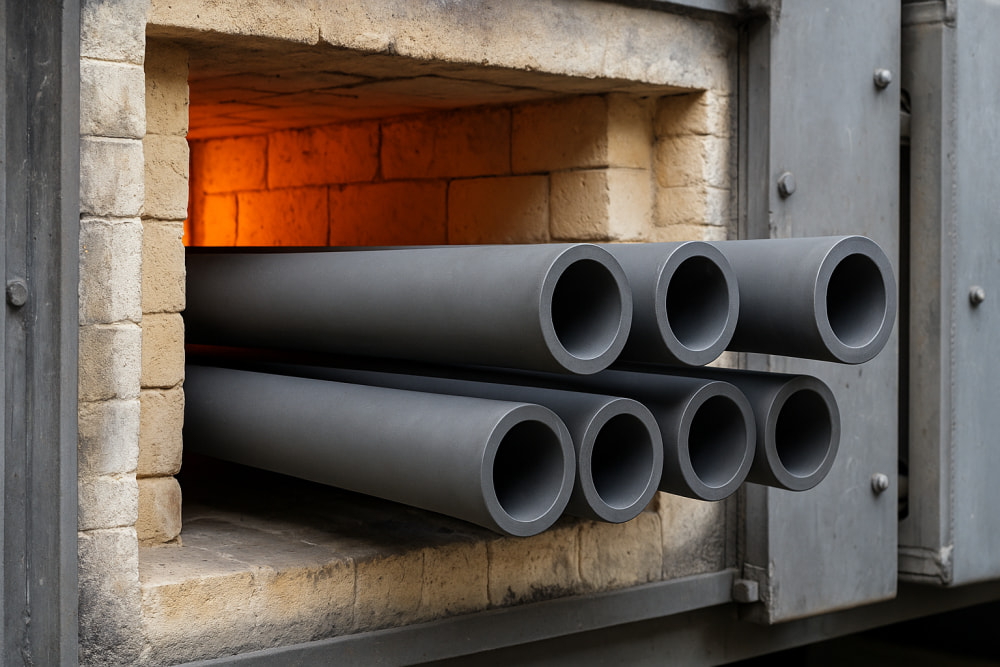
If you are seeing any of the issues below, you do not have a “bad batch problem” – you have a selection and design problem:
- Frequent tube cracking or fracture during heat-up, cool-down or thermal cycling
- Oxidation, scaling or corrosion in aggressive furnace atmospheres
- Deformation or bending of tubes at high temperature under load
- Leaks, contamination or unstable temperature control in process zones
- Short service life and unpredictable failures that disrupt production
Most of these failures trace back to one or more mistakes:
- The tube material cannot handle the maximum service temperature or atmosphere
- The design does not match the thermal cycling profile (start/stop frequency, ramp rates)
- The tube wall thickness or diameter is wrong for the mechanical load
- The supplier did not get full information about the furnace design and process media
Before choosing a tube, you need to understand both your furnace conditions and the main SiC material options.
Step 1 – Clarify Your Furnace Conditions
When you talk to a silicon carbide tube supplier, these are the minimum parameters you should have ready. Without them, nobody can seriously help you with selection.
1. Operating temperature
- Maximum set temperature (°C)
- Normal working range (°C)
- Safety margin (often 100–150°C below the material’s limit)
For example, if your furnace runs at 1450 °C in air, you should not choose a material whose maximum service temperature is only 1380 °C in that atmosphere.
2. Furnace atmosphere
Different atmospheres attack materials in different ways:
- Oxidizing: air, oxygen-rich combustion gases
- Reducing / carburizing: CO, H2, CH4, furnace gases
- Inert / protective: N2, Ar
- Vacuum
- Corrosive species: chlorides, fluorides, sulfur compounds, alkali vapors, molten salts
Some SiC grades are optimized for oxidizing atmospheres, others perform better in corrosive or thermal-shock-heavy conditions.
3. Thermal profile
- Heating rate (°C/min)
- Cooling rate and how often you cycle per day/week
- Is the tube continuously hot, or does it see frequent start/stop?
Recrystallized SiC (RSiC) often performs better in very high thermal cycling, while dense SSiC is ideal when you need maximum strength and gas-tightness.
4. Mechanical and process loads
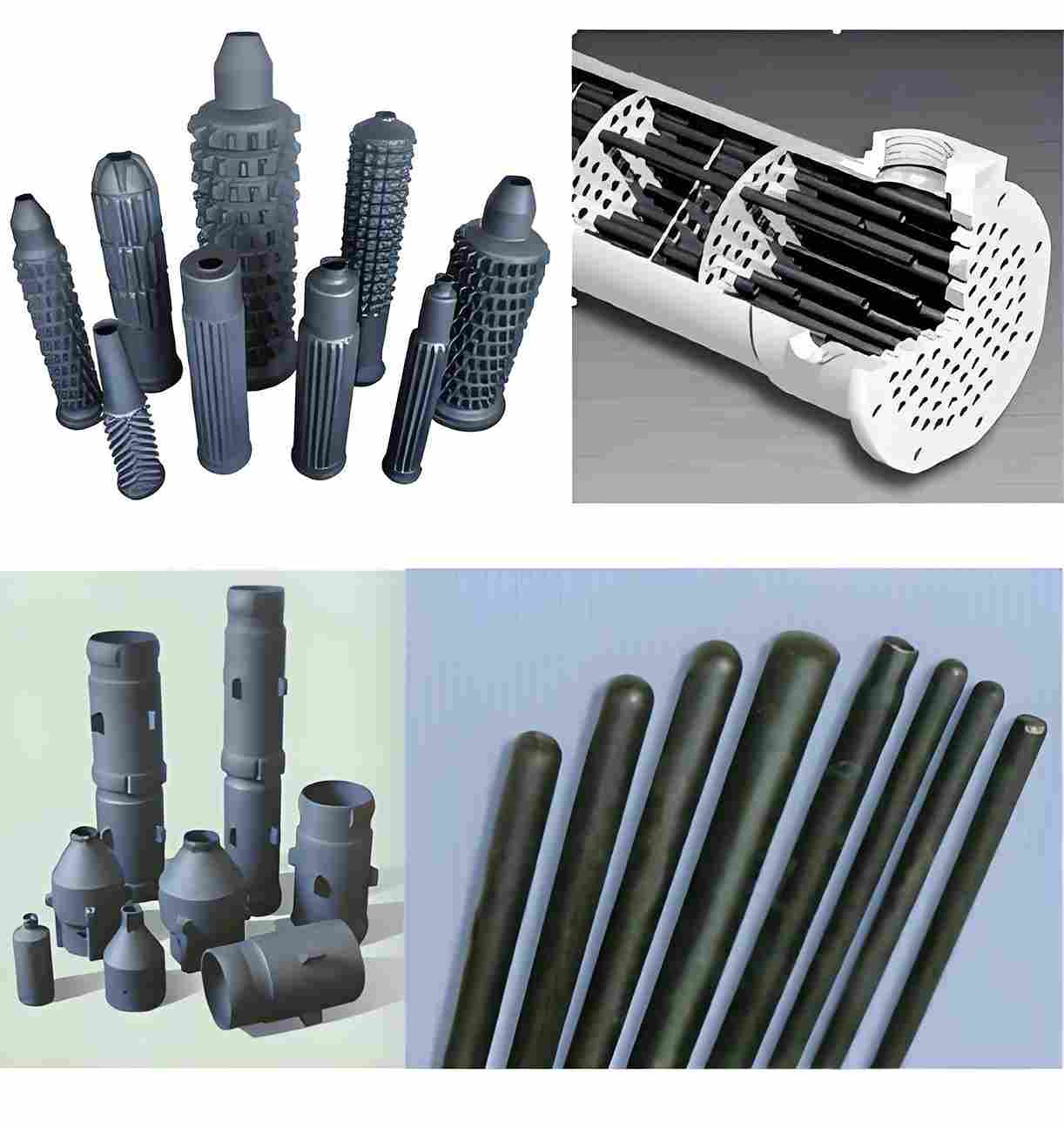
- Tube type: radiant tube, thermocouple protection tube, process tube, burner tube, heat exchanger tube
- Mounting method: simply supported, fixed at both ends, cantilevered
- Internal pressure or flow (gas, liquid, or two-phase)
- External loads: charge weight, roof/brick support, mechanical impacts
For long tubes under load, you must consider deflection and creep at temperature.
5. Corrosion and process media
- What are you contacting? Flue gas, molten metal, acid/alkali vapors, salts, slags?
- Gas composition (if known) and partial pressures
- Dust loading / particle size (abrasion)
This often pushes you toward dense SSiC in highly corrosive/oxidizing media or RSiC where thermal shock and permeability are more important.
Step 2 – Know Your Main Silicon Carbide Tube Materials
For industrial furnace tubes, three SiC families are most common:
- SSiC – Pressureless Sintered Silicon Carbide
- RBSiC / SiSiC – Reaction Bonded Silicon Carbide
- RSiC – Recrystallized Silicon Carbide
The table below gives a practical comparison to help you narrow down your choices.
Silicon Carbide Tube Material Comparison
| Property / Aspect | SSiC (Sintered SiC) | RBSiC / SiSiC (Reaction-Bonded) | RSiC (Recrystallized SiC) |
|---|---|---|---|
| Typical density (g/cm³) | Approx. 3.10–3.20 | Approx. 3.02–3.10 | Approx. 2.7–3.05 (higher open porosity) |
| Max service temperature in air (°C) | Approx. 1600–1700 | Approx. 1350–1380 | Approx. 1600–1650 (depending on atmosphere) |
| Gas-tightness | Excellent (impervious) | Excellent (very low porosity) | Generally porous but controlled |
| Thermal shock resistance | Very good | Very good | Excellent in many kiln / cycling applications |
| Thermal conductivity (W/m·K) | Approx. 90–120 | Approx. 40–60 | Medium to high (good for furnace/kiln duty) |
| Strength at high temperature | Highest | High | High, especially under cycling |
| Typical applications | Thermocouple tubes, seals, critical tubes, highly corrosive zones | Structural parts, beams, kiln furniture, cost/performance balance | Kiln tubes, beams, plates in strongly cycled furnaces |
| Relative cost | Highest | Medium | Medium to high |
Quick rule of thumb:
- Need highest temperature, gas-tightness and chemical resistance (e.g. thermocouple protection, harsh chemical zones) → choose SSiC
- Need large or structural tubes with cost-performance balance (rollers, beams, some radiant tubes) → choose RBSiC / SiSiC
- Need excellent thermal shock performance in heavily cycled kilns → choose RSiC
Step 3 – Match Tube Type to Your Furnace Application
Now let’s connect tube types with typical SiC materials and furnace uses.
1. Thermocouple protection tubes
- Role: Protect thermocouple wires from hot, corrosive, and abrasive furnace gases
- Typical requirements:
- Temperature up to approx. 1600–1650 °C in oxidizing atmosphere
- High thermal shock resistance (frequent insertion/removal or rapid cycling)
- Gas-tight to avoid contamination of the sensor
- Recommended SiC grades:
- SSiC for high-end, gas-tight tubes in harsh chemical atmospheres
- Nitride-bonded SiC (for some lower-temperature cases around 1450 °C where cost is more sensitive)
2. Radiant tubes / burner tubes
- Role: Transfer heat from combustion or electric heating to the furnace chamber
- Typical requirements:
- High temperature (typically 1000–1400 °C)
- Resistance to burner flames, combustion products and thermal gradients
- Good sag resistance for long horizontal tubes
- Recommended SiC grades:
- RBSiC / SiSiC for many standard radiant tubes
- SSiC or RSiC for more extreme temperature and corrosive conditions, or where very long lifetime is required
3. Process tubes / reaction tubes
- Role: Convey or contain process gas, liquid or product inside the furnace
- Typical requirements:
- High temperature and specific atmosphere (oxidizing, reducing, inert, vacuum)
- Gas-tightness and chemical compatibility
- In some cases, high purity requirements
- Recommended SiC grades:
- SSiC where purity and gas-tightness are crucial
- RSiC in very harsh thermal cycling / kiln-like processes
4. Heat-exchanger tubes
- Role: Recover heat from corrosive or high-temperature flue gases or process streams
- Typical requirements:
- High thermal conductivity for efficient heat transfer
- Corrosion resistance to flue gas, process gas and condensates
- Recommended SiC grades:
- SSiC or high-thermal-conductivity RBSiC for tube bundles in heat exchangers
Step 4 – Key Design Parameters You Must Define
When you send a drawing or RFQ for SiC tubes, you should define at least the following parameters:
1. Dimensions
- Outer diameter (OD)
- Inner diameter (ID) / wall thickness
- Length
- Straightness tolerance
- End design: open or closed, flange, threaded interface, special shapes
2. Tolerances
- OD / ID tolerance (for example, ±0.5 mm / ±0.2 mm depending on precision requirements)
- Straightness over full length
- Concentricity (important for double tubes or coaxial designs)
3. Support and mounting
- How the tube is supported in the furnace (one end fixed, both ends fixed, supports along the length)
- Distance between supports
- Any mechanical load from charge, tiles, brackets or other components
4. Thermal conditions
- Maximum temperature
- Ramping rate (°C/min)
- Number of cycles per day/week
- Hot and cold spots along the tube length
5. Atmosphere and media
- Gas composition (if known)
- Presence of dust, slag, molten metal, droplets
- Oxygen level or protective gas used
6. Lifetime expectations
- Target lifetime per tube (hours, months or cycles)
- Acceptable downtime cost if a tube fails
Step 5 – Practical Selection Checklist
You can use this simple checklist as an internal tool before sending drawings to a supplier.
Application type
- Thermocouple protection
- Radiant / burner tube
- Process / reaction tube
- Heat exchanger tube
- Other: ____________
Furnace data
- Maximum operating temperature: ______ °C
- Atmosphere: oxidizing / reducing / inert / vacuum / other: ______
- Heating rate: ______ °C/min
- Typical cycles per day/week: ______
Mechanical and geometric data
- Tube outer diameter: ______ mm
- Tube inner diameter: ______ mm
- Tube length: ______ mm
- Mounting and supports: sketch or description prepared
- Special ends: closed end, flanged, machined features
Process media
- Contact with: flue gas / molten metal / acid or alkali vapors / others: ______
- Dust or particle loading: low / medium / high
Requirements and constraints
- Target lifetime: ______ (hours / cycles / months)
- Critical failure modes to avoid: cracking / oxidation / sagging / leakage
- Budget range per tube: ______
Product Application: Where Zirsec Silicon Carbide Tubes Fit
As an industrial silicon carbide manufacturer with over 20 years of experience, Zirsec typically matches furnace tubes to these application segments:
- High-temperature furnaces (1000–1600 °C)
SSiC or RSiC tubes for thermocouple protection, high-end burner tubes and process tubes. - Metallurgy and non-ferrous metal melting
SiC tubes in contact with molten aluminum, copper and alloys, designed to minimize wetting and thermal shock. - Chemical processing and flue gas handling
Corrosion-resistant SSiC tubes for acidic and aggressive exhaust or heat-recovery heat exchangers. - Kiln and thermal processing lines
RSiC and RBSiC tubes for kiln furniture, roller kilns and strongly cycled firing processes.
Zirsec’s small-batch flexibility (supporting 1-piece MOQ, samples in 3–7 days) and precision machining capability (complex structures with tight tolerances) make it suitable for equipment manufacturers and end users who face harsh operating conditions, complex drawings and moderate batch sizes.
Case Example: Extending Tube Life in a 1450 °C Furnace
Background
A European furnace manufacturer was facing frequent tube failures in a 1450 °C continuous furnace. Their original material was a generic SiC tube with unclear grade; tubes cracked after 6–8 weeks due to thermal shock and oxidation in a slightly oxidizing flue gas.
Problem
- Operating temperature close to or above the safe limit of the original material
- No clear selection between SSiC, RBSiC and RSiC
- Thermal cycling was more severe than the original design assumed
Solution
- Review furnace data (temperature, atmosphere, cycling)
- Switch to dense SSiC tubes with gas-tight structure and high-temperature strength
- Optimize wall thickness to balance strength and thermal shock resistance
- Update mounting design to reduce bending moment at high temperature
Result
- Tube lifetime extended from 6–8 weeks to 9–12 months
- Unplanned downtime from tube failures was practically eliminated
- Total maintenance and downtime cost dropped significantly over one year, easily offsetting the higher unit price of high-grade SSiC tubes
FAQ: Silicon Carbide Tubes for Industrial Furnaces
Q1. What is the maximum temperature for silicon carbide tubes in an industrial furnace?
Most high-grade SSiC tubes can safely operate up to around 1600–1650 °C in oxidizing atmospheres, and even higher in protective atmospheres or vacuum, as long as the mechanical load and design margins are respected. RBSiC is typically limited to around 1350–1380 °C, while RSiC tubes can operate around 1600–1650 °C depending on the specific grade and atmosphere.
Q2. Which silicon carbide grade should I choose: SSiC, RBSiC or RSiC?
Choose SSiC when you need maximum temperature capability, gas-tightness, chemical resistance and long life. Choose RBSiC when you need large or structural tubes and want a cost-performance balance at moderate to high temperatures. Choose RSiC for kiln and furnace applications with strong thermal cycling, where excellent thermal shock resistance is critical.
Q3. How do I avoid thermal shock cracking in silicon carbide tubes?
To minimize thermal shock cracking, avoid very rapid heating and cooling, use controlled ramp rates, design for uniform heating and avoid strong hot spots. Select SiC grades with good thermal shock behavior and adequate wall thickness, and mount tubes in a way that allows thermal expansion without excessive stress.
Q4. Are silicon carbide tubes gas-tight?
Dense SSiC and quality RBSiC tubes can be essentially gas-tight at high temperature, making them suitable for thermocouple protection tubes and process tubes where leakage is unacceptable. RSiC tends to be more porous, but in many kiln applications permeability is not a problem.
Q5. Can silicon carbide tubes be used in strongly corrosive atmospheres?
Yes. One of the main advantages of silicon carbide is its excellent corrosion resistance to many acids, alkalis and aggressive flue gases. However, you still need to consider the exact chemistry, temperature and presence of molten phases. In some environments, a specific SiC grade and surface finish will perform better.
Q6. What information does Zirsec need to recommend a tube solution?
At minimum, Zirsec needs to know your application type (thermocouple, burner, process, heat exchanger), temperature range and atmosphere, tube OD/ID/length, mounting and drawings, thermal cycling profile, process media and target lifetime. The more detail you provide, the more accurately the engineering team can match SiC grade and design to your furnace.
Q7. Can silicon carbide tubes replace metallic radiant tubes directly?
In many furnaces, yes, but not as a simple 1:1 swap. SiC tubes behave very differently from metals in terms of thermal expansion, stiffness and allowable temperature. A proper design check on supports, seals and burner configuration is needed before replacement.
Q8. How long do silicon carbide tubes typically last?
Service life can range from several months to several years, depending on furnace design, operating conditions and material grade. Correct selection and proper installation often deliver 2–5 times longer lifetime than incorrect materials or low-grade ceramics.
Need engineering support for your silicon carbide tube selection? Send your furnace temperature, atmosphere, tube dimensions and target lifetime to our team, and we will help you specify the right SiC grade and design for your application.