When a project moves beyond basic steels and refractories, the shortlist usually includes several “advanced ceramics” – and silicon carbide is almost always on that list. The question is not whether SiC is good, but whether it is better than alumina, zirconia, or silicon nitride for your specific job.
This article compares silicon carbide with other advanced ceramics so engineers and buyers can choose the material that makes the most technical and economic sense for pumps, furnaces, wear parts, and high-temperature equipment.
1. Why compare silicon carbide with other advanced ceramics?
Once you are in the world of advanced ceramics, you are usually dealing with one or more of these conditions:
- Severe wear and abrasion
- High operating temperature or aggressive thermal cycling
- Corrosive media (acids, alkalis, or mixed-phase environments)
- Tight tolerances, high stiffness, and long lifetime requirements
Several ceramics can survive here, but they do not perform identically. Choosing the wrong one can lead to overpaying for performance you don’t need or, worse, repeating the same failure modes at a higher material cost.
2. Who’s who: a quick profile of the main advanced ceramics
In industrial equipment, the main contenders besides silicon carbide are:
Silicon carbide (SiC)
Non-oxide ceramic with a strong covalent lattice.
- Very high hardness and wear resistance
- High strength and stiffness maintained at elevated temperatures
- Good thermal conductivity and low thermal expansion
- Excellent corrosion resistance in many environments (grade-dependent)
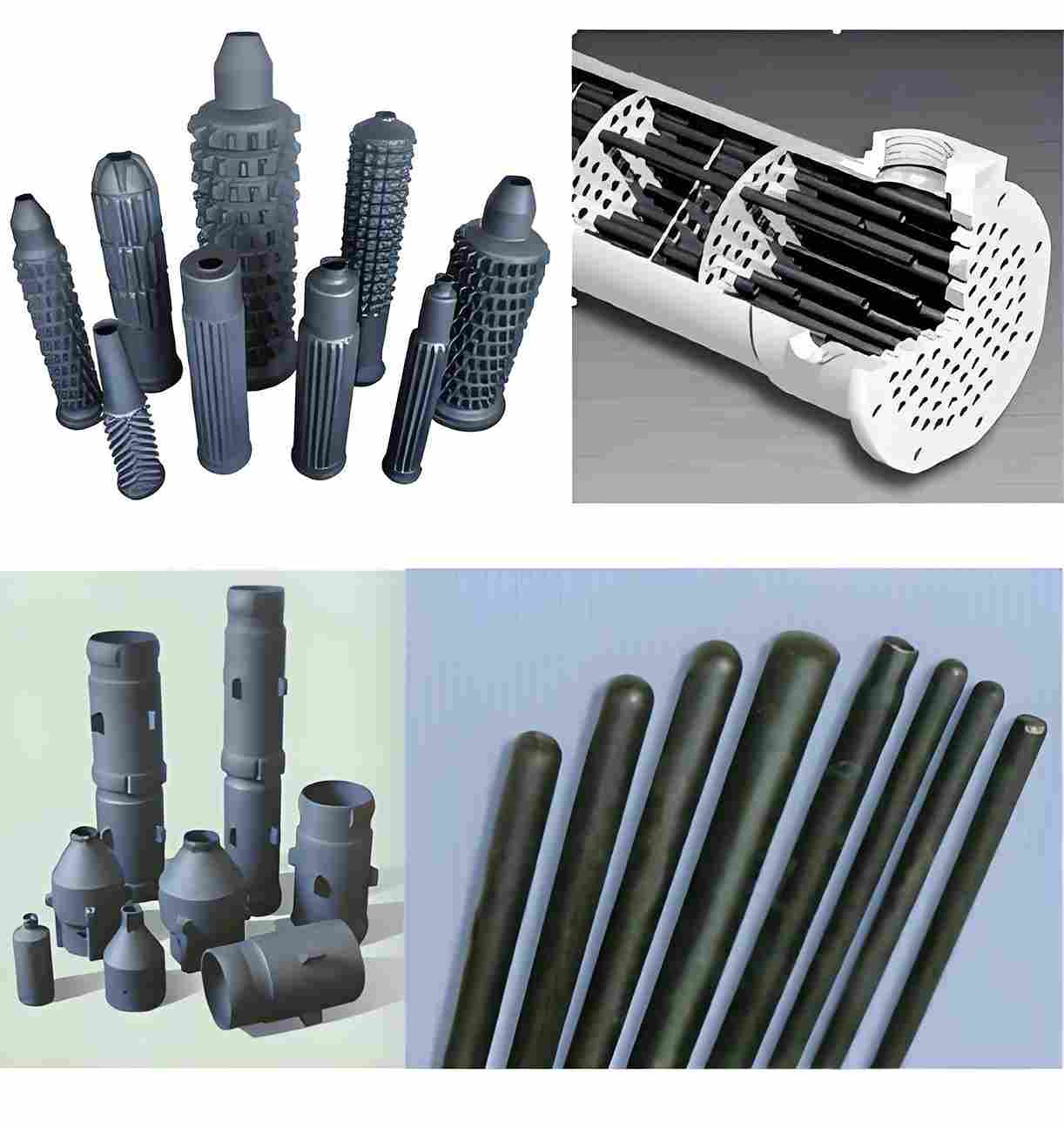
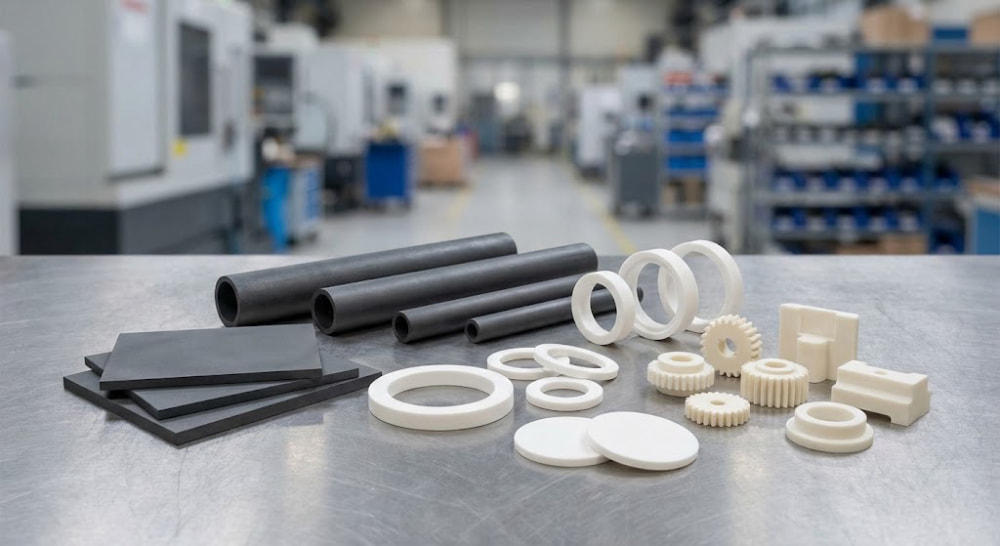
Common forms include pressureless sintered SiC (SSiC), reaction-bonded SiC (RBSiC / SiSiC), and recrystallized SiC (RSIC). Typical products: silicon carbide tubes, silicon carbide plates, crucibles, burner parts, rollers, and mechanical seal rings.
Alumina (Al₂O₃)
Alumina is the workhorse oxide ceramic.
- Good hardness and wear resistance
- Strong electrical insulation
- High maximum service temperature
- Typically lower cost than SiC on a per-part basis
Widely used for wear parts, insulators, and many general-purpose ceramic components.
Zirconia (ZrO₂)
Zirconia (often partially stabilized) is a toughened oxide ceramic.
- Very high fracture toughness for a ceramic
- Good wear resistance
- Lower thermal conductivity and higher thermal expansion than SiC
Often used where impact resistance and toughness are more important than extreme high-temperature strength.
Silicon nitride (Si₃N₄)
Silicon nitride is another strong non-oxide ceramic.
- High strength and fracture toughness
- Good thermal shock resistance
- Good wear and fatigue properties
Common in bearings and rotating components where dynamic loads and thermal cycling are severe.
3. Key comparison: silicon carbide vs other advanced ceramics
The table below summarizes how SiC typically compares with other advanced ceramics at a high level. Exact values depend on grade and supplier, but the trends are consistent.
| Property / Focus | Silicon Carbide (SiC) | Alumina | Zirconia | Silicon Nitride |
|---|---|---|---|---|
| Wear resistance | Excellent, especially in abrasive slurries | Good to very good | Very good | Very good |
| High-temperature strength | Excellent at elevated temperatures | Good, but strength drops at high end | Moderate at very high temperatures | Good at moderate to high temps |
| Thermal conductivity | High for a ceramic | Low | Very low | Moderate |
| Thermal shock resistance | Very good (with proper design) | Moderate | Poor to moderate | Very good |
| Chemical resistance | Excellent (grade-dependent) | Good, some chemical limits | Good, application-specific | Good, but sensitive to some chemistries |
| Fracture toughness | Moderate (ceramic brittle behaviour) | Lower than SiC | High (toughest of the group) | High for a ceramic |
| Typical cost level | Higher than alumina; similar or below many niche ceramics | Baseline (often lowest) | Higher | Higher |
4. Where silicon carbide usually wins
Silicon carbide tends to be the best fit when several difficult conditions are present at the same time.
Combined high temperature + wear + corrosion
If your component sits in a zone with all three, SiC is almost always on the shortlist:
- High-temperature furnace tubes exposed to gas flow and particle carryover
- Kiln furniture and plates under cyclic load and contamination
- Burner nozzles and tips seeing high-velocity, particulate-laden gases
In these cases, alumina and basic refractories often fail by erosion or thermal shock, while SiC maintains geometry and surface integrity much longer.
Severe abrasion in slurries and fluids
For sliding and erosive wear in pumps, valves, and nozzles, silicon carbide’s hardness and microstructure provide a clear advantage:
- Mechanical seal rings and seats in chemical and slurry pumps
- Abrasive spray and desulfurization systems using silicon carbide nozzles
- Wear plates and liners in chutes, cyclones, and transfer points
Alumina can also perform in wear duty, but SiC typically offers better combined wear + thermal shock + corrosion performance in harsh environments.
High-temperature structures requiring stiffness and stability
When components such as tubes, beams, and plates must carry load at high temperature without creeping or bowing, silicon carbide’s high-temperature strength and low thermal expansion are a major advantage. This is why products like SiC plates and beams are widely used in kilns and furnaces that cycle frequently.
5. Where other advanced ceramics can be the better choice
Despite SiC’s strengths, alumina, zirconia, and silicon nitride still have clear roles.
Alumina: good enough at lower risk, lower cost
Alumina remains attractive when:
- Wear is moderate, not extreme.
- Temperatures are high but not at the limit of alumina’s capability.
- Failure is inconvenient, but not extremely costly.
It is often the cost-effective choice for generic wear pads, insulating components, and less critical ceramic parts where the full performance of SiC is not needed.
Zirconia: toughness and impact resistance
Zirconia’s main advantage is toughness – it can handle impact and bending better than most ceramics. It is useful where:
- Components see mechanical shocks or dynamic loading.
- Fracture toughness is more important than maximum temperature or high thermal conductivity.
However, its low thermal conductivity and high thermal expansion make it less attractive for large, high-temperature structural parts where SiC excels.
Silicon nitride: rotating and fatigue-critical components
Silicon nitride is common in high-speed bearings and rotating components due to its:
- Good fatigue strength
- High fracture toughness for a ceramic
- Good thermal shock performance
For pump or compressor designs with very specific loading patterns, Si₃N₄ can be the right niche choice, even if SiC is superior in wear or corrosion elsewhere in the same system.
6. Making the choice: application-driven selection
A useful way to choose between silicon carbide and other advanced ceramics is to start from failure modes and cost of failure, not from catalog data alone.
Step 1 – Identify the dominant failure mode
- If components fail mostly from wear and abrasion → SiC or alumina, with SiC preferred under severe or combined conditions.
- If components fail from thermal shock or warping → SiC or silicon nitride, depending on load and geometry.
- If components fail from cracking due to impact → zirconia or silicon nitride may deserve a closer look.
Step 2 – Map operating conditions
- Normal and peak temperature
- Type of fluid or gas and its chemistry
- Presence and nature of solids (size, hardness, loading)
- Mechanical loads, rotation, and dynamic effects
Step 3 – Rank cost of failure
- If downtime is very expensive, and failure is hard to predict → skew towards SiC even if up-front cost is higher.
- If downtime is acceptable and parts are easy to replace → alumina or other ceramics may be sufficient.
Step 4 – Match material to part type
Typical patterns:
- Tubes, beams, kiln plates, burner parts: SiC is usually first choice; others are second line or for special constraints.
- Mechanical seal rings, sleeves, wear parts in liquids: SSiC as primary, with alumina as a cost-driven alternative for easier duties.
- Impact-exposed small parts: zirconia or silicon nitride where toughness dominates.
7. How internal and external stakeholders see the trade-offs
In practice, different roles look at this decision from different angles:
- Process engineers: care about uptime, temperature uniformity, and product quality.
- Maintenance teams: care about how often they have to change parts and how predictable failures are.
- Purchasing: looks at unit price, but increasingly at lifecycle cost when downtime is visible in the numbers.
Silicon carbide tends to become the consensus choice when all three groups see that fewer failures, fewer shutdowns, and better process stability offset the higher per-part cost compared with alumina or simple refractories.
8. Summary: when is silicon carbide the “best fit”?
Silicon carbide is not automatically better than every other advanced ceramic. It is the best fit when:
- You face combined wear, temperature, and corrosion that traditional ceramics cannot handle reliably.
- Component failure causes significant lost production, safety risk, or quality problems.
- You need long-term dimensional stability in tubes, plates, supports, or sealing interfaces.
Alumina remains a cost-effective general-purpose ceramic, zirconia and silicon nitride have important niche roles, and all four can coexist in one plant. The key is to assign silicon carbide to the most critical and punishing locations, where its performance advantages translate directly into lower lifecycle cost and higher reliability.