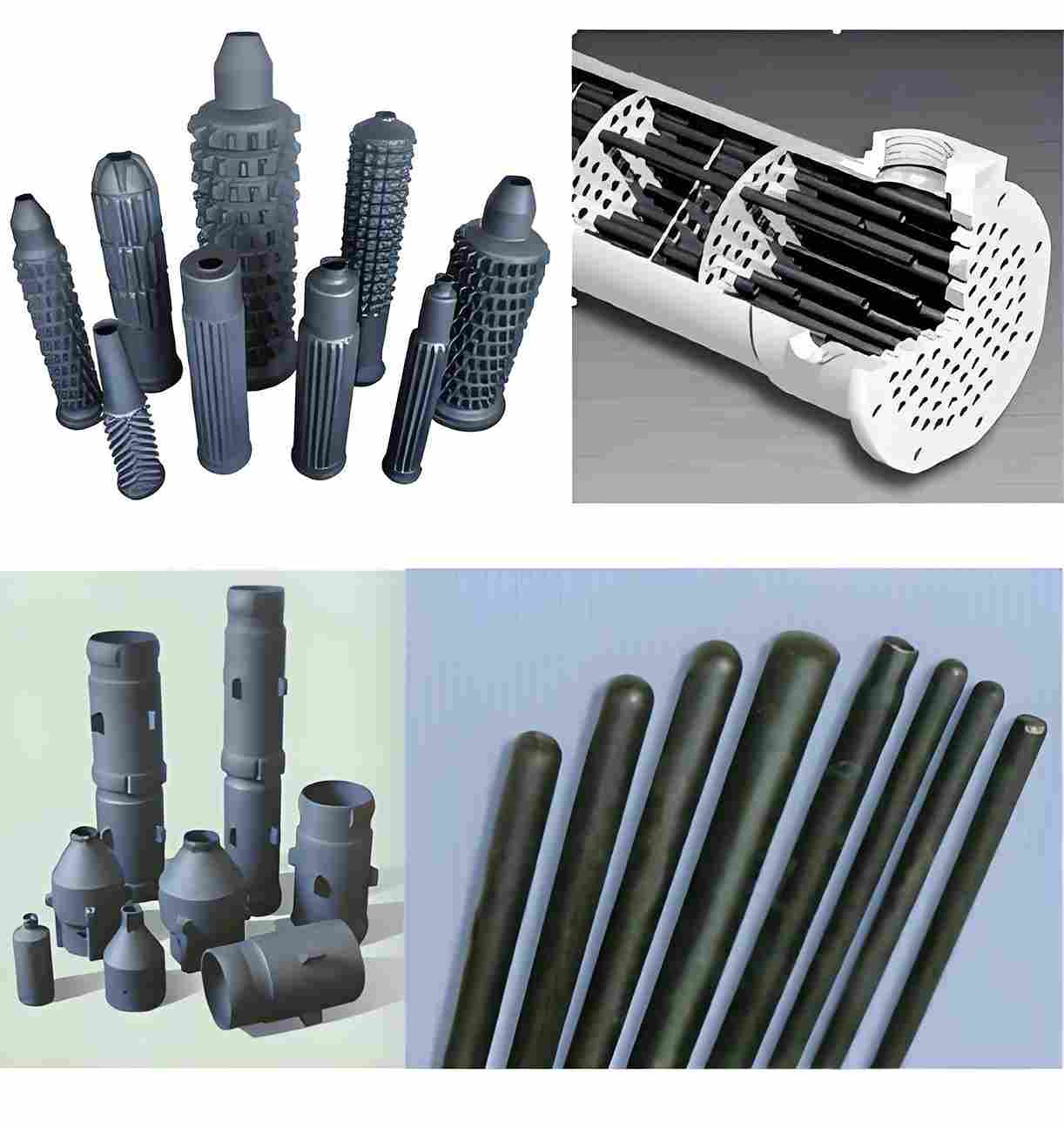
Two plants can buy “silicon carbide components” and get completely different results. In one, SiC parts run for years with minimal issues. In the other, tubes crack, seals leak, and plates warp long before the next shutdown. The difference is not just the drawing – it is quality and supplier capability.
This article explains how silicon carbide (SiC) quality affects performance in real equipment and how to choose a supplier you can trust for critical components.
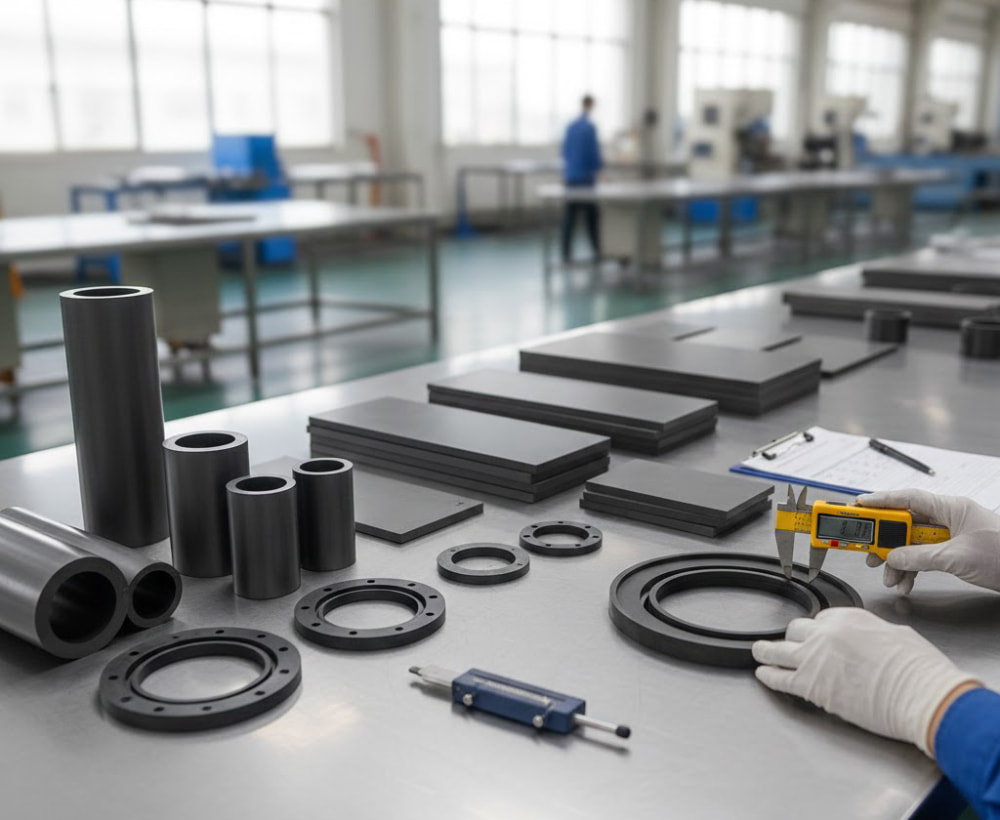
1. Why silicon carbide quality matters more than the datasheet
On paper, many silicon carbide materials look similar. Strength, hardness, and temperature limits often fall in the same range. In practice, small differences in quality can mean:
- Shorter lifetime under thermal cycling
- Unexpected cracking under moderate loads
- Leakage from micro-porosity or poor density
- Dimensional drift or poor sealing performance
For critical parts such as tubes, plates, crucibles, and seal rings, the real question is not “Is this SiC?” but “Is this SiC made, inspected, and documented well enough for my application?”
2. What “quality” really means for silicon carbide components
Quality in silicon carbide is more than visual appearance. It is a combination of:
- Consistent raw materials: controlled SiC powder, binders, and additives.
- Stable forming and sintering processes: repeatable density, shrinkage, and microstructure.
- Accurate machining and finishing: tight tolerances where needed, correct surface finishes on sealing and bearing areas.
- Robust inspection and documentation: dimension reports, material certificates, and traceability by batch.
Two components with the same drawing and nominal material can behave very differently if any of these elements are weak.
3. How poor SiC quality shows up in the field
Low or inconsistent quality usually reveals itself in predictable ways. Typical symptoms include:
- Early cracking and breakage: due to internal defects, high porosity, or poor grinding causing micro-cracks.
- Leakage in tubes and hollow parts: from insufficient density or uncontrolled open porosity.
- Seal failure: when flatness, parallelism, or surface finish are outside requirements for mechanical seals.
- Warping of plates and beams: caused by non-uniform sintering, uneven support, or internal stresses.
- Inconsistent wear behaviour: parts from the same nominal grade wearing at very different rates.
These problems usually cost far more than the price difference between a strong supplier and a weak one, especially when they cause unplanned shutdowns.
4. Key quality factors for common silicon carbide components
SiC tubes and protection tubes
For furnace, burner, and process tubes, such as silicon carbide tubes, pay attention to:
- Density and porosity: sufficient for gas-tightness and mechanical strength.
- Wall thickness and straightness: consistent over length to avoid hot spots and stress concentrations.
- End geometry: proper machining for safe sealing, flanges, or couplings.
- Pressure and leak testing: for tubes that carry process fluids or gases.
SiC plates, tiles, and kiln furniture
For plates and kiln furniture, such as silicon carbide plates, key factors are:
- Flatness and thickness consistency: critical for stable stacking and load distribution.
- Microstructure uniformity: affects thermal shock resistance and long-term strength.
- Edge quality: clean edges reduce crack initiation and handling damage.
Mechanical seal rings and precision parts
For mechanical seals and other precision components, quality depends heavily on:
- Exact diameters, run-out, and concentricity for rotating parts.
- Face flatness and surface finish for reliable sealing behaviour.
- High-purity, low-porosity SiC to handle aggressive fluids and minimize leakage paths.
5. What to look for when choosing a silicon carbide supplier
Choosing a supplier is not just about who says “yes” to your drawing. It is about whether they can repeat good results, batch after batch. When evaluating suppliers, look at the following areas.
Technical competence and grade selection
- Can they clearly explain the differences between sintered SiC (SSiC), reaction-bonded SiC (RBSiC/SiSiC), and recrystallized SiC?
- Do they recommend grades based on your temperature, chemistry, and load conditions rather than just offering “standard SiC”?
- Can they show real data for density, porosity, strength, and thermal properties for the proposed grade?
Process control and consistency
- Is there a defined process for forming, debinding, and sintering with documented parameters?
- Do they monitor density and shrinkage per batch, not just during development?
- Can they describe how they control tool wear, grinding conditions, and lapping on precision parts?
Inspection and test capabilities
- Do they perform 100% inspection of critical dimensions and visual quality?
- Do they have access to CMMs, profilometers, and pressure test rigs where relevant?
- Can they perform or coordinate thermal shock, corrosion, or pressure tests for qualification?
Documentation and traceability
- Can they supply inspection reports, material certificates, and batch IDs with each shipment?
- Is there a clear link between your part number and their internal production records?
- How do they handle non-conforming parts and corrective actions?
Engineering support and communication
- Will they review your drawings and suggest improvements for ceramics (fillets, thickness, support, etc.)?
- Can you speak with engineers familiar with ceramics, not only sales staff?
- Do they respond with clear, technical answers to application questions?
6. Practical steps to qualify an SiC supplier
Rather than making a decision solely from emails and quotations, follow a structured qualification process.
Step 1 – Share real operating conditions
Provide the supplier with:
- Temperature range and cycling profile
- Fluid or gas composition and presence of solids
- Mechanical loads, pressure, and flow conditions
- Known failure modes of current components
Suppliers that ask detailed questions and propose specific grades and design tweaks are generally more reliable than those who simply quote what you send.
Step 2 – Start with a pilot batch
Use an initial batch to evaluate:
- Dimensional accuracy and surface quality
- Consistency within the batch
- Clarity and completeness of inspection and material reports
Install parts in a monitored application and track performance over one maintenance cycle if possible.
Step 3 – Compare lifecycle cost, not just piece price
When comparing suppliers, do not stop at unit cost. Include:
- Expected service life based on material and design
- Risk of early failures and unplanned downtime
- Cost of logistics, communication, and problem resolution
A slightly higher piece price from a consistent supplier often delivers a lower total cost per operating hour.
7. Example scenario: two suppliers, two outcomes
Consider a plant replacing metallic tubes in a high-temperature furnace with silicon carbide tubes.
- Supplier A: offers low unit price, minimal documentation, and vague answers to technical questions. First batch shows variation in wall thickness and slight bowing; after a short period in service, several tubes crack during cycling.
- Supplier B: provides grade recommendations, density and strength data, and full inspection reports. Tubes are straight, with consistent wall thickness and leak tests completed. In service, they survive the full campaign with no unplanned failures.
On paper, both sell “SiC tubes.” In practice, Supplier B delivers real value in uptime and predictability, which matters far more than the quoted price per piece.
8. FAQ: evaluating silicon carbide quality and suppliers
Q1: How can I quickly screen whether an SiC supplier takes quality seriously?
A: Ask for a sample inspection report, density and porosity data for their SiC grades, and an example of how they handle non-conforming parts. Suppliers with real process control will have this information ready and specific.
Q2: Do I always need full mechanical property testing for each batch?
A: Not necessarily. For most applications, you can combine 100% dimensional and visual inspection with periodic mechanical testing on samples per batch or per defined interval. For very critical parts, more frequent property testing may be justified.
Q3: Is it safe to buy SiC parts purely based on catalog material grades?
A: Catalog grades give a starting point, but they do not guarantee performance. Always confirm that the supplier’s process, inspection, and documentation meet your specific requirements.
Q4: How important is surface finish for SiC components?
A: It depends on the function. For mechanical seals and bearing surfaces, surface finish is critical to leakage and wear behaviour. For plates and structural parts, a functional ground finish is usually sufficient, and over-specifying finish only adds cost.
Q5: Can a single SiC supplier cover all my applications?
A: Often yes, if they work with multiple SiC grades (SSiC, RBSiC, RSIC) and have both precision and structural capabilities. The key is whether they can support both small precision parts and large structural components with consistent quality.
Conclusion
The impact of silicon carbide quality on performance is direct and measurable: it shows up in lifetime, reliability, and total cost of ownership. Choosing the right supplier is less about finding the lowest price and more about finding a partner that:
- Understands your operating conditions
- Controls their processes and materials
- Provides transparent inspection and documentation
- Supports you with engineering input, not just quotations
When those pieces are in place, silicon carbide components – tubes, plates, seals, and custom parts – stop being a risk and become one of the most reliable elements in your industrial system.